
Table of Contents
- Why Choosing the Right Commercial Disinfectant Matters
- EPA-Registered Disinfectants for Offices: What to Look For
- Office Surface Disinfectant Contact Time: A Critical Factor
- Disinfectant Compatibility With Electronics and Office Furniture
- Office Cleaning and Disinfecting Checklist for High-Touch Surfaces
- Cost Efficiency and Coverage: Comparing Concentrate vs. Ready-to-Use Solutions
- Frequently Asked Questions
Last Updated: October 12, 2026
Why Choosing the Right Commercial Disinfectant Matters
Choosing the right disinfectant for your commercial office space protects employees, impresses clients, and supports productivity.
High-touch surfaces in shared workspaces, doorknobs, conference tables, elevator buttons, restroom fixtures, harbor pathogens that spread rapidly. A disinfectant that doesn’t kill the right pathogens, or requires contact times your crew can’t maintain, fails to protect anyone.
This guide covers the 5 best disinfectants for commercial office spaces, breaking down what makes each effective, how to apply them, and which scenarios each handles best, including EPA registration, active ingredients, contact times, and compatibility concerns most guides skip.
EPA-Registered Disinfectants for Offices: What to Look For
An EPA-registered disinfectant for commercial office use must meet strict efficacy standards against specific pathogens (the EPA). Registration means the product was tested to kill listed microorganisms under controlled conditions, but the label claims matter enormously.
Check the EPA registration number on the label to confirm efficacy testing, then read the pathogen list: does it cover the viruses and bacteria you’re concerned about?
Active Ingredients and Pathogen Coverage
The active ingredient determines what the disinfectant kills.
Hypochlorous acid is highly effective against viruses, bacteria, and spores, and breaks down quickly with minimal residue.
Chlorine-based disinfectants deliver fast, broad-spectrum kill but require careful handling, ventilation, and proper personal protective equipment (gloves, masks, eye protection).
For offices, choose a disinfectant that kills enveloped viruses (influenza, coronavirus), non-enveloped viruses (norovirus), and bacteria like Staphylococcus aureus and E. coli.
Contact Time and Application Method
Contact time, or dwell time, is how many minutes the disinfectant must remain wet to kill pathogens.
Most commercial disinfectants for offices require 1-10 minutes of contact time. Shorter times (1-3 minutes) suit high-traffic areas; longer times work for overnight deep cleaning when surfaces stay undisturbed.
Application method matters too. Spray-and-wipe suits small areas and quick turnarounds; ready-to-use solutions cost more per treated area; concentrates require dilution but offer better cost efficiency at scale.
Office Surface Disinfectant Contact Time: A Critical Factor
Contact time, also called dwell time or wet contact time, is how many minutes the surface must remain visibly wet to achieve the labeled kill claim. It’s the most common failure point in office disinfection, and the easiest to verify if you know where to look.
Where the real number lives
Contact time isn’t on the front of the bottle, it’s on the EPA-registered master label, and it can differ by pathogen. A product may claim 30 seconds against one organism and 10 minutes against another. When you see ‘kills in 30 seconds,’ check which organism that applies to; it’s often a single virus or bacterium, not the full list.
To verify a product’s claims:
- Locate the EPA registration number on the label (format: EPA Reg. No. XXXXX-XX).
- Look up the product in the EPA’s registered pesticide product database to confirm the registration is active and to see the full label.
- Read the microorganism list and match each organism to its specific contact time.
- Confirm the use sites on the label include the surfaces you intend to treat (hard, non-porous surfaces; some labels exclude food-contact surfaces or specific materials).
Photograph the label’s contact-time table and post it in your supply closet. Crews cannot comply with a number they cannot see.
Typical contact times by active ingredient
Exact figures vary by product and registration, but the ranges below reflect what most office-appropriate EPA-registered products carry on their labels:
| Active ingredient | Common contact time range | Notes for office use |
|---|---|---|
| Accelerated hydrogen peroxide | 1-5 minutes | Low residue, generally electronics-friendly; shorter times on some registrations |
| Quaternary ammonium (quat) | 1-10 minutes | Residual antimicrobial activity; can leave film on glass and some plastics |
| Hypochlorous acid | 1-5 minutes | Fast kill, minimal residue; shorter shelf life once diluted |
| Sodium hypochlorite (bleach) | 1-10 minutes | Fast and broad, but corrosive to many metals and damaging to fabrics |
| Citric acid / other acids | 5-10 minutes | Often used for food-contact and low-toxicity programs |
| Alcohol (60-80% ethanol or IPA) | 30 seconds-1 minute | Fast, evaporates clean; flammable and hard on some plastics with repeated use |
Why contact time fails in real offices
Three things break wet contact time in a working office:
- Evaporation. A thin mist on a warm conference table can dry in under a minute, if the label requires 5 minutes, you’ve dampened the surface, not disinfected it.
- Wiping too soon. Crews wipe for appearance, not kill; a dry-looking surface looks ‘done.’
- Traffic. Reception desks, elevator buttons, and break-room counters get touched before the dwell time elapses.
Practical fixes that actually work
- Match the product to the surface’s realistic dwell window. High-traffic touchpoints need a 1-3 minute claim; overnight deep cleaning can use a 5-10 minute product.
- Apply enough product to stay wet. Use a coarse spray or saturated wipe, not a fine aerosol.
- Use a dwell timer. A timer set to the label’s contact time removes guesswork and is the highest-impact training tool for compliance.
Do not assume a shorter contact time is ‘stronger.’ Contact time is a property of the specific formulation and the specific organism on the label. A 30-second claim against one virus does not mean the product kills everything in 30 seconds.
Documenting compliance
Build contact time into your written cleaning procedure: surface, product, dilution, contact time, and wipe or rinse step. Train to it and spot-check with a timer after any product change. A simple log, date, area, product, dwell time observed, gives a defensible record if a client or inspector asks how disinfection is verified.
Disinfectant Compatibility With Electronics and Office Furniture
This is where many office cleaning programs damage equipment: disinfectants that work on tile or laminate can corrode electronics, degrade leather, or stain fabric.
Electronics are everywhere in modern offices: monitors, keyboards, phones, touch screens, printers, security panels. Most disinfectants damage them if applied directly.
Avoid applying strong chlorine-based disinfectants or undiluted quats directly to electronics.
For office furniture, desks, chairs, conference tables, check the material first.
High-touch surfaces like armrests, phone handsets, and light switches drive most pathogen transmission, but they also take repeated chemical exposure.
Office Cleaning and Disinfecting Checklist for High-Touch Surfaces
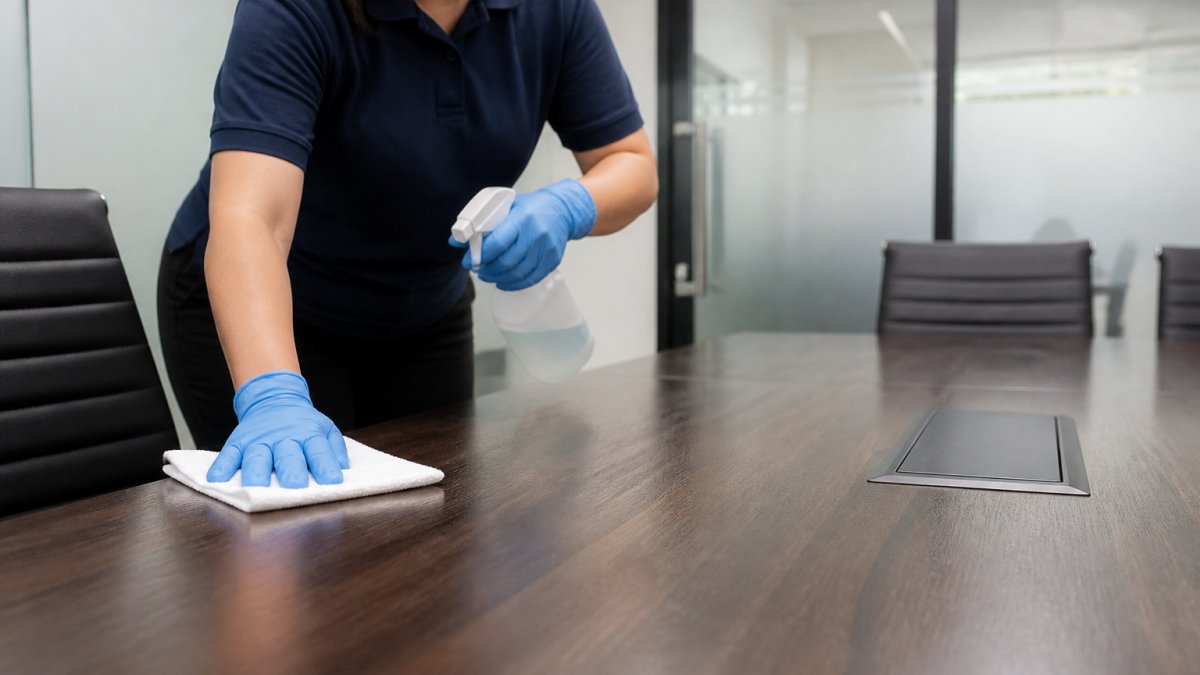
High-touch surfaces are the priority in infection control, surfaces multiple people touch throughout the day, transferring pathogens from hands to surface to the next person’s hands.
Start with this checklist and customize it for your specific office layout:
- Doorknobs and door handles (all doors including restroom, conference room, and entry doors)
- Light switches (every switch in common areas and offices)
- Elevator buttons (all floors, both up and down buttons)
- Stair railings (handrails on all stairwells)
Frequency matters. High-traffic areas need disinfection multiple times daily, morning, midday, and evening. Lower-traffic areas can be done once daily. Overnight deep cleaning should cover all surfaces, not just high-touch ones.
| Surface Type | Frequency | Recommended Contact Time | Best Disinfectant Type |
|---|---|---|---|
| Doorknobs, handles | 2-3 times daily | 1-3 minutes | Spray-and-wipe or ready-to-use |
| Light switches | 1-2 times daily | 1-3 minutes | Spray-and-wipe or ready-to-use |
| Conference tables | After each use | 3-5 minutes | Ready-to-use or diluted concentrate |
| Restroom fixtures | 3-4 times daily | 1-3 minutes | Spray-and-wipe or ready-to-use |
| Keyboards, phones | Daily or as-needed | 1-2 minutes | Alcohol-based or hydrogen peroxide |
| Elevator buttons | 2-3 times daily | 1-3 minutes | Spray-and-wipe or ready-to-use |
Cost Efficiency and Coverage: Comparing Concentrate vs. Ready-to-Use Solutions
Bottle price is the least useful number on a disinfectant label. What matters is cost per usable gallon and cost per 1,000 square feet treated, the figures that actually hit your facilities budget. Most office guides skip this math, which is why so many facilities overpay for convenience or under-dilute concentrate and waste product.
The two cost models, side by side
Ready-to-use (RTU) formulas arrive at label strength, no dilution, no measuring, no risk of a wrong ratio. The trade-off is that you’re paying to ship and store water.
Concentrates require dilution per the label. A typical quat or hydrogen peroxide concentrate dilutes anywhere from 1:64 to 1:256 depending on product and target pathogen. At 1:64, one gallon yields roughly 65 gallons of usable solution; at 1:256, roughly 257.
Normalize every product to cost per usable gallon before you compare. A $30 RTU quart and a $30 concentrate gallon are not the same purchase, one is ready to spray, the other may make 65 to 256 gallons of working solution.
How to run the math for your facility
- Find the label dilution ratio. It’s on the concentrate label and in the EPA registration documents. If different ratios apply to different pathogens, budget with the strongest (most dilute-resistant) ratio so you don’t under-buy.
- Calculate usable gallons. Divide concentrate volume by the dilution fraction: one gallon at 1:64 = 65 usable gallons; at 1:128 = 129; at 1:256 = 257.
- Divide cost by usable gallons. A $40 concentrate gallon at 1:128 is roughly $0.31 per usable gallon; a $6 RTU quart is roughly $24. The gap is real, but only if dilution is done correctly.
- Estimate coverage. A light trigger-spray covers a few hundred square feet per usable gallon on non-porous surfaces; a coarse spray or wipe-down of a large conference table uses more. Multiply square footage by application rate for gallons per cycle, then by cycles per month.
- Add hidden costs. Calibrated dispensing equipment, secondary labeled spray bottles, training time, and secure storage belong in the concentrate column. RTU avoids most of these but adds packaging waste and storage volume.
When each model wins
| Scenario | Better fit | Why |
|---|---|---|
| Small office, under ~5,000 sq ft, one or two cleaners | Ready-to-use | Dilution errors and dispensing equipment cost more than the product savings |
| Multi-floor office with a dedicated day porter | Hybrid | RTU for daytime touch-ups, concentrate for overnight |
| Facility with multiple buildings or a janitorial contract | Concentrate | Volume and recurring purchasing make the per-gallon savings compound |
| Sites with fragrance-sensitive staff or clients | RTU (fragrance-free) | Easier to control exactly what is applied |
Dilution discipline is the real cost driver
Over-diluted concentrate (too much water) fails to kill pathogens at the labeled contact time, you paid for a disinfectant and got a damp surface. Under-diluted (too strong) wastes product, leaves residue, and can damage finishes and electronics. Both errors erase the cost advantage.
Wall-mounted or bottle-fill proportioners typically pay for themselves within a few months in a mid-size facility by eliminating guesswork.
Never mix concentrates from different manufacturers, and never top off a diluted bottle with more concentrate ‘to be safe.’ Off-label mixing can create hazardous fumes and voids the EPA registration under which the product was approved.
A simple budgeting rule
For a single-location office under about 10,000 square feet with one cleaning shift, RTU is usually simpler and often cheaper once you count labor and error risk. Above that, or across multiple sites, concentrate almost always wins on cost per treated area, provided you invest in proportioning and training. Track actual usage for one quarter before switching; real consumption data beats any estimate.
Frequently Asked Questions
What disinfectants do commercial cleaners use in offices?
Commercial cleaners typically use EPA-registered disinfectants with proven efficacy against viruses and bacteria. These include quaternary ammonium compounds, hypochlorous acid, hydrogen peroxide, and chlorine-based solutions. The choice depends on surface type, contact time requirements, and the specific pathogens targeted. Professional cleaning services select products that balance efficacy with material compatibility and safety for shared workspaces.
How long should a commercial disinfectant stay wet on a surface?
Contact time varies by product and pathogen. Most EPA-registered office disinfectants require 30 seconds to 10 minutes of wet contact to kill targeted viruses and bacteria. Always check the product label for specific dwell time requirements for the pathogens you need to control. Shorter contact times are more practical for high-traffic office areas; longer times may be necessary for infection control in medical or high-risk environments.
Can you use the same disinfectant on desks, electronics, and floors?
Not all disinfectants are safe for all surfaces. Electronics and office furniture require disinfectants that won’t damage screens, keyboards, or upholstery. Many quaternary ammonium and hydrogen peroxide solutions work on multiple surfaces, but always verify compatibility on the product label. For electronics, consider alcohol-based or non-corrosive formulations. Floor disinfectants often differ from surface disinfectants and should not be used interchangeably.
How can an office verify that a disinfectant is effective against a specific pathogen?
Check the EPA registration number on the product label and review the label claims for specific pathogens (viruses, bacteria, fungi). The EPA registration confirms the product has been tested and approved for stated claims. Look for your target pathogen listed explicitly on the label. You can also verify EPA registration on the EPA website. Avoid products with vague claims; effective disinfectants list specific organisms and contact times required for efficacy.
Leave a Reply