
Table of Contents
- Immediate Workplace Hazards When Janitorial Staff Ignore Safety Protocols
- Cleaning Chemical Safety and Proper Handling
- Commercial Cleaning Safety Guidelines and Compliance Standards
- Financial and Operational Consequences of Noncompliance
- Janitorial Safety Training and Root-Cause Prevention
- Cleaning Safety Checklist and Task-Specific Scenarios
- Frequently Asked Questions
Last Updated: October 13, 2026
Immediate Workplace Hazards When Janitorial Staff Ignore Safety Protocols
Understanding what happens if janitorial staff ignore safety protocols reveals how they expose themselves and others to serious hazards.
Slip-and-Fall Injuries and Wet Floor Risks
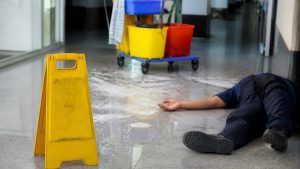
Slip-and-fall accidents are the most common janitorial injury: a worker mops without warning signs, and someone falls.
The injury is only the start of the chain reaction:
- Personal injury: Broken bones, head trauma, spinal damage
- Medical costs: Emergency room visits, ongoing treatment, rehabilitation
- Lost work time: The injured person misses shifts; the janitorial team loses capacity
Most slip-and-fall injuries are preventable with basic discipline: warning signs before cleaning, adequate drainage, non-slip footwear, and clear communication with occupants. When janitorial staff ignore these steps, a wet floor becomes a predictable injury waiting to happen.
Chemical Exposure and Contamination
Cleaning chemicals are effective because they’re potent, and dangerous when handled improperly.
Chemical exposure is acute (immediate) or chronic (over time). Ignoring safety protocols accelerates both.
Acute exposure occurs when a worker handles chemicals without proper personal protective equipment. Skin contact, inhalation, or splash injuries can cause:
- Chemical burns on skin or eyes
- Respiratory distress or lung damage
- Allergic reactions
Chronic exposure happens when workers repeatedly handle chemicals without protection.
When janitorial staff ignore safety protocols around chemical handling, the facility becomes a health hazard for its entire occupant population.
Cleaning Chemical Safety and Proper Handling
Cleaning chemical safety depends on knowing what you’re using, understanding the hazard, and following the procedure every time.
Many facilities fail at the first step: workers don’t read labels, don’t know what’s in the bottle, and mix incompatible chemicals because nobody explained why that’s dangerous.
Proper chemical handling requires:
- Reading the label: Every cleaning product has specific instructions. Workers must follow them.
- Understanding the hazard: Bleach + ammonia = toxic chlorine gas (the CDC). Acid + base = violent reaction. These aren’t theoretical, they kill people.
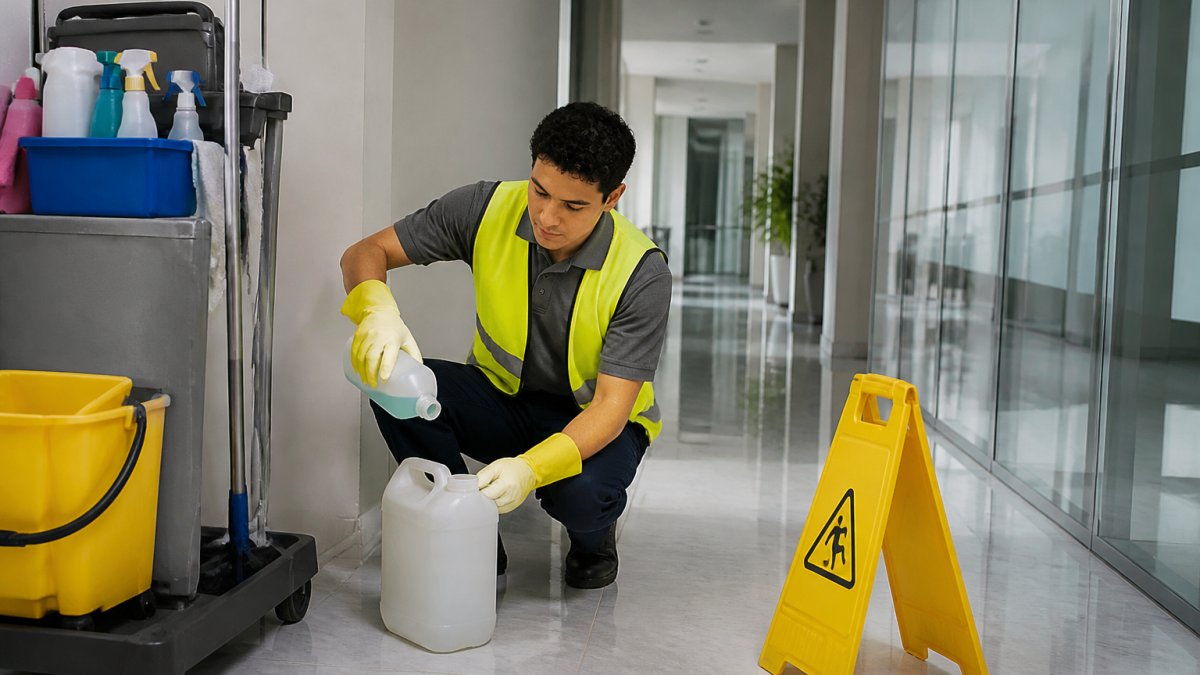
- Using correct PPE: Gloves, eye protection, respiratory protection (when needed). Not “sometimes.” Every time.
The consequences of what happens if janitorial staff ignore safety protocols around chemical handling include risking their own health and creating liability and hazards for everyone in the facility.
Commercial Cleaning Safety Guidelines and Compliance Standards
Safety guidelines reduce injuries, prevent contamination, and protect against liability. But “follow OSHA” is a slogan, not a guideline, compliance means knowing which standards apply, what triggers reporting, and what records to keep.
The Standards That Actually Apply to Janitorial Work
OSHA publishes no single “janitorial standard.” Cleaning falls under several general industry rules in 29 CFR Part 1910. The ones that come up most often:
- Hazard Communication (1910.1200): Employers must maintain safety data sheets (SDSs) for every hazardous chemical on site, label secondary containers, and train workers on the hazards before they handle a product. This is the standard most often cited after a chemical exposure.
- Personal Protective Equipment (1910.132-1910.138): Employers must assess the workplace for hazards, select appropriate PPE, and provide it at no cost to the worker. Eye, hand, and foot protection each have their own subpart.
- Bloodborne Pathogens (1910.1030): Applies whenever workers may be exposed to blood or other potentially infectious materials, which includes restroom cleaning, sharps pickup, and bodily-fluid cleanup. It requires an exposure control plan, training, and hepatitis B vaccination offered at no cost.
A common pattern: employers know chemical names but not the SDS requirement, and know “wear gloves” but not the written PPE hazard assessment, two gaps behind many citations in this industry.
Reporting Duties: When an Incident Becomes a Record
Not every cut finger triggers a federal report, but many do. Under OSHA recordkeeping rules (29 CFR 1904):
- Fatality: Must be reported to OSHA within 8 hours.
- In-patient hospitalization, amputation, or loss of an eye: Must be reported within 24 hours.
- Recordable injury or illness: Must be entered on the OSHA 300 Log if it results in death, days away from work, restricted work or job transfer, medical treatment beyond first aid, loss of consciousness, or a significant injury or illness diagnosed by a physician.
Many facilities skip this step, treating incidents as isolated events rather than data points, letting the same hazard repeat and exposing the employer to willful or repeat violation classifications.
Employer Responsibility Beyond Training
Employers must provide a safe environment, hazard training, PPE at no cost, incident documentation, and regular inspections. But responsibility doesn’t end with a signed training sheet:
- Enforcing safety procedures consistently across shifts and crews
- Investigating why workers skip procedures rather than only disciplining them
- Updating procedures when chemicals, equipment, or layouts change
OSHA penalties are adjusted annually for inflation. As of the most recent adjustment, serious and other-than-serious violations run into the low five figures per violation, willful and repeated violations run into the low six figures per violation, and failure-to-abate penalties accrue daily. Check the current OSHA penalty schedule before quoting a number to a client or crew.
Documentation That Holds Up
Every incident must be documented, including near-misses. Documentation provides legal protection, pattern identification, OSHA compliance, and trackable corrective action. A defensible record includes date, time, location, who was involved, what happened and why, injuries, immediate response, root cause, and corrective action.
OSHA recordkeeping and reporting requirements (29 CFR 1904)
OSHA Hazard Communication standard (29 CFR 1910.1200)
Financial and Operational Consequences of Noncompliance
The true cost of ignoring safety protocols extends far beyond the injury.
When a worker is injured, the facility loses:
- Productivity: The injured worker can’t work; other staff must cover their shifts.
- Operational continuity: A short-staffed janitorial team cleans poorly, affecting client perception and employee morale.
- Replacement cost: Finding and training a replacement takes time and money.
Hidden consequences include:
- Client impact: A dirty or unsafe facility drives clients away, and a reputation for poor safety spreads quickly.
- Employee morale: Workers in an unsafe environment become disengaged, and turnover increases.
- Regulatory fines: OSHA violations result in citations and penalties.
A single serious injury can cost tens of thousands of dollars; multiple incidents can bankrupt a business or trigger regulatory action that shuts it down.
Janitorial Safety Training and Root-Cause Prevention
Safety training is where prevention starts, but only if it’s specific, reinforced, and tied to accountability.
Identifying Why Employees Bypass Safety Procedures
Workers don’t ignore safety protocols randomly. They skip them for specific reasons:
- Time pressure: They’re rushing to finish and skip steps to go faster
- Discomfort: PPE feels uncomfortable, so they remove it
- Perceived low risk: They’ve done the task without incident before, so they think it’s safe
Understanding the reason is critical, you can’t fix a problem you don’t understand. If workers skip because they’re rushing, fix staffing or scheduling. If PPE is uncomfortable, provide better equipment. If they don’t understand why, communicate more clearly.
Corrective Action and Accountability
Corrective action means fixing the root cause, not just punishing the worker. When a violation is discovered, the response should include:
- Immediate intervention: Stop the unsafe behavior and correct it in the moment
- Investigation: Determine why the violation occurred
- Root-cause correction: Address the underlying reason, not just the symptom
- Retraining: Ensure the worker understands the correct procedure and why it matters
- Follow-up: Monitor to confirm the behavior has changed
- Documentation: Record the incident and corrective action for future reference
Accountability works only when it’s fair and consistent. If some workers face consequences and others don’t, compliance breaks down. If consequences are harsh but the underlying problem isn’t fixed, the violation repeats.
When janitorial staff ignore safety protocols repeatedly, it signals a deeper problem, training, resources, culture, or leadership. Fixing it requires addressing the root cause, not just the worker.
Cleaning Safety Checklist and Task-Specific Scenarios
A safety checklist converts abstract procedures into concrete steps and makes compliance measurable. But one covering only mopping and chemicals leaves the highest-consequence hazards uncovered, the scenarios below fill that gap.
Here’s what a basic janitorial safety checklist should cover:
| Task | Safety Requirement | Frequency |
|---|---|---|
| Chemical storage | Proper labeling and separation of incompatible chemicals | Daily |
| PPE inspection | Check gloves, eye protection, and respiratory equipment for damage | Before each use |
| Wet floor protection | Place warning signs before mopping; remove when dry | Every cleaning cycle |
| Spill response | Contain and clean spills immediately; document large spills | As needed |
| Equipment maintenance | Inspect mops, buckets, and cleaning tools for damage | Weekly |
| Ladder inspection | Check feet, rungs, and locking mechanisms before use | Before each use |
| Sharps and waste handling | Use tongs or a sharps container; never bare-hand | Every restroom and trash cycle |
| Equipment lockout | De-energize and tag before servicing scrubbers or vacuums | Before any repair |
| Incident reporting | Report all injuries and near-misses to supervisor | Immediately |
| Training updates | Attend refresher training on new procedures or hazards | Annually |
Scenario 1: Wet-Floor Signage That Actually Works
A sign placed after the floor is wet is placed too late. The correct sequence: place cones or signs at every approach before the mop touches the floor, mop in sections so occupants always have a dry path, and remove signage only after the surface is dry to the touch. In high-traffic lobbies, use two signs at each entry point and a physical barrier for large areas, a single sign in a wide corridor is not adequate protection.
Scenario 2: Chemical Dilution and Mixing
Most chemical injuries come from two mistakes: over-concentrating a product because “more is stronger,” and mixing bleach with an acid or ammonia cleaner. Bleach plus ammonia produces chloramine gas; bleach plus acid produces chlorine gas, both can cause immediate respiratory injury in a poorly ventilated restroom. The rule: use the label’s dilution ratio or the dispensing system, never mix two products in the same bottle, and never transfer a chemical into an unlabeled container.
Scenario 3: Sharps and Waste Handling
Restroom and trash duty is where needlesticks happen. Workers should never reach into a trash can, compress a bag with a hand or knee, or pick up an object they can’t identify. Use tongs or a dustpan, place sharps in a rigid, puncture-resistant container, and treat any needlestick as a bloodborne pathogens exposure: wash the site, report immediately, and seek medical evaluation.
Scenario 4: Ladder and Equipment Safety
Falls from ladders and step stools are a leading source of janitorial lost-time injuries. Before climbing, inspect the ladder for cracked rungs, missing feet, or a bent frame. Maintain three points of contact, never stand on the top cap, and never use a chair or bucket as a step. For powered equipment like floor scrubbers and wet vacuums, follow the manufacturer’s lockout/tagout procedure before clearing a jam or changing a pad, a scrubber that starts while a worker’s hand is under the deck is an amputation risk.
Scenario 5: Responding to a Chemical Spill
Stop work immediately and alert nearby workers and occupants. Contain the spill with absorbent material only if it’s safe and you know the product, then consult the SDS for cleanup and disposal. Report the incident to the supervisor and document what happened and how it was cleaned. If the spill is beyond a small incidental release, evacuate and call for trained responders rather than improvising.
Scenario 6: Handling a Slip-and-Fall Near the Work Area
Secure the area with warning signs. Assess the injured person’s condition and call for medical help if needed. Do not move them unless there is immediate danger. Document the incident with photos and witness statements, report to the supervisor and employer immediately, and determine whether the injury is OSHA-recordable.
Run these scenarios as live drills, not just reading assignments. Workers who have physically placed cones, donned PPE, and walked through a spill response retain the procedure far better than workers who only signed a training sheet.
When workers practice these scenarios, they develop muscle memory and respond correctly instead of improvising.
Frequently Asked Questions
What are the most common workplace injuries when janitorial staff ignore safety protocols?
The most frequent injuries include slip-and-fall accidents from unmarked wet floors, chemical burns or respiratory irritation from improper handling of cleaning products, and back injuries from unsafe lifting techniques. Wet floor hazards are particularly dangerous because they affect not only janitorial staff but also employees and visitors. Chemical exposure can occur when staff mix incompatible products, fail to wear personal protective equipment, or work in poorly ventilated areas. These injuries often result in workers’ compensation claims, lost productivity, and potential liability for the employer.
Are janitorial employees required to follow OSHA safety standards?
Yes. OSHA regulations apply to janitorial staff working in commercial facilities. Employers must ensure janitorial employees receive proper safety training, access to personal protective equipment, hazard communication about cleaning chemicals, and safe work procedures. The employer is legally responsible for maintaining a workplace free from recognized hazards. Failure to enforce safety compliance can result in OSHA citations, fines, and increased workers’ compensation insurance premiums.
What happens to an employer if janitorial staff cause an injury by ignoring safety protocols?
Employers face multiple consequences: workers’ compensation claims that raise insurance costs, OSHA investigations and potential fines ranging from thousands to tens of thousands of dollars, civil lawsuits from injured employees or third parties, reputational damage, and operational disruption. If an injury or near miss occurs, the employer must document the incident, investigate the root cause, and demonstrate corrective action. Repeated noncompliance or willful safety violations can result in criminal liability for company leadership.
How can supervisors prevent janitorial staff from ignoring safety procedures?
Establish clear, written cleaning safety protocols specific to your facility’s hazards. Provide mandatory janitorial safety training during onboarding and annually thereafter, covering chemical handling, wet floor procedures, and personal protective equipment use. Use a cleaning safety checklist at the start of each shift. Communicate the reasons behind safety rules, not just the rules themselves. Conduct regular safety audits and address violations consistently and fairly. Recognize and reward safe behavior. Make it easy for staff to report hazards or near misses without fear of retaliation.
Leave a Reply