
Last Updated: November 7, 2026
Quick Summary
A daily commercial floor maintenance checklist is a written set of floor-care tasks assigned to specific people, completed and signed off each day. It lists eight daily tasks in a fixed order: entryway and mat check, sweeping and dust mopping, vacuuming, damp mopping, spot cleaning, restroom floor care, floor inspection, and equipment cleaning.
- Dry soil removal always comes before any wet cleaning, every time.
- Damp mopping uses a barely wet mop, not a soaked one.
- Entryway care is the highest-value task because most tracked-in soil enters through one or two doors.
- Every checklist line needs a name, a time, and a sign-off.
- Post wet-floor signs during mopping and dry floors before reopening an area.
Table of Contents
- Why a Daily Floor Maintenance Checklist Protects Hard Floors
- The 8 Daily Tasks on a Commercial Floor Cleaning Checklist Template
- Building a Commercial Floor Cleaning Schedule by Frequency
- Floor Maintenance Schedule by Flooring Type
- Commercial Floor Cleaning Equipment Maintenance Checks
- Floor Inspection, Slip Hazards, and Measurable Safety Standards
- Task Ownership, Shift Handoff, and Kennesaw Service Planning
- Setting Up Your Daily Floor Care Program with Guso Janitorial Services
- Frequently Asked Questions
Why a Daily Floor Maintenance Checklist Protects Hard Floors
A daily commercial floor maintenance checklist is a written set of floor-care tasks assigned to specific people, completed and signed off each day, that keeps hard floors clean, safe, and intact. A floor that looks clean can still have grit you cannot see grinding away at its finish all day long.
That is the part most guides miss. A floor that looks clean at 9 a.m. can be accumulating abrasive soil at every entrance by noon. Sweeping and dust mopping remove that loose dirt before it acts like sandpaper under foot traffic. Skip a day, and you are not just losing shine. You are shortening the life of the flooring itself.
Below, we break down the eight daily tasks, the schedule behind them, and how to assign ownership so the checklist actually gets done. The ISSA cleaning industry standards provide a useful reference for how professional teams structure recurring floor care.
The 8 Daily Tasks on a Commercial Floor Cleaning Checklist Template
A commercial floor cleaning checklist template works best when it lists eight daily tasks in a fixed order, assigns each to a named person, and requires a signature at close of shift. Order matters: dry soil removal comes before any wet cleaning, every time.
Here is the daily sequence we use:
- Entryway and mat check, shake out, vacuum, or replace entrance mats first.
- Sweeping and dust mopping, clear loose dirt from open floor areas.
- Vacuuming, carpet edges, runners, and mat wells.
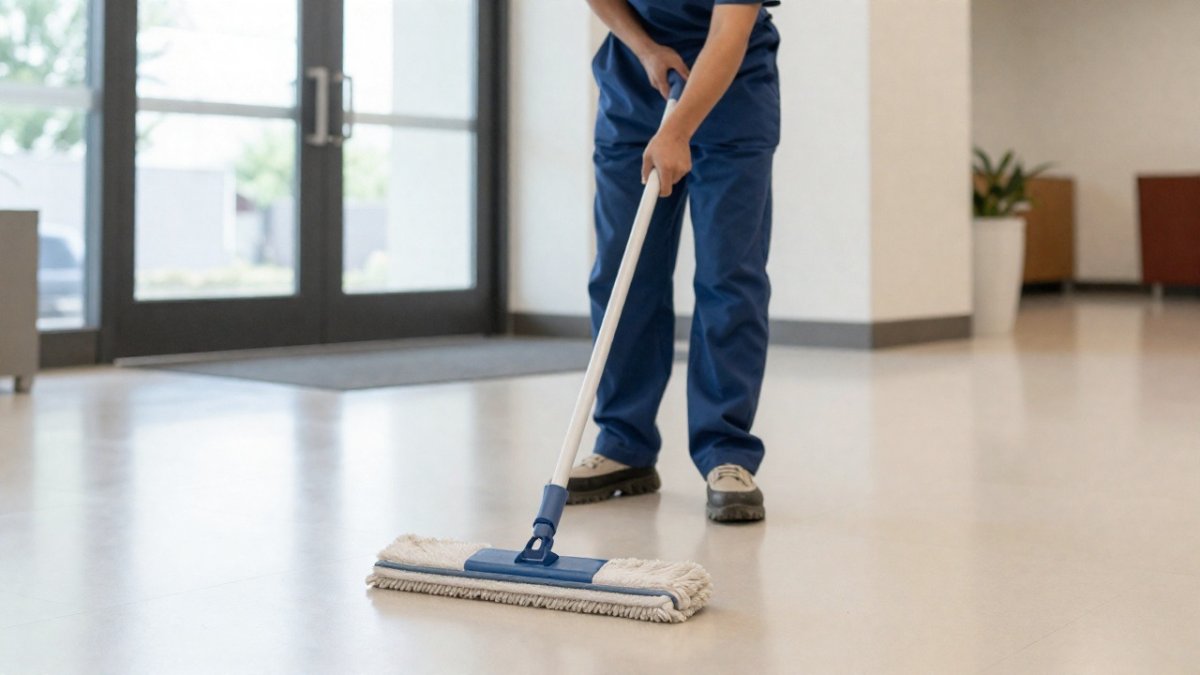
- Damp mopping, clean hard floors with a properly diluted solution.
- Spot cleaning, treat spills and stains as they are found.
- Restroom floor care, mop, disinfect, and dry.
- Floor inspection, walk the route and log hazards.
- Equipment cleaning, rinse mops, empty vacuums, wipe tools.
For a deeper walkthrough of degreasing and heavier tasks, see our guide to industrial floor maintenance and degreasing.
Sweeping, Dust Mopping, and Vacuuming Loose Dirt
Dry soil removal comes first because wet cleaning over loose grit just spreads mud. Sweep or dust mop open hard floors with overlapping passes, working from the walls toward the center. Vacuum mat wells and carpet edges, where tracked-in soil collects.
A common mistake is skipping the dust mop on days the floor “looks fine.” Fine grit is invisible. Remove it daily anyway.
Damp Mopping, Spot Cleaning, and Entryway Care
Damp mopping uses a barely wet mop, not a soaked one. Mix cleaning solution to the label’s dilution ratio, allow the stated dwell time, then pick up residue before it dries. Spot clean spills the moment you find them.
Entryway care is the highest-value task on the list. Most tracked-in soil enters through one or two doors. Clean mats daily and your whole floor stays cleaner.
Building a Commercial Floor Cleaning Schedule by Frequency
A commercial floor cleaning schedule splits tasks into daily, weekly, monthly, and seasonal bands so nothing gets skipped. Daily tasks handle soil removal and safety. Weekly and monthly tasks handle restoration.
| Frequency | Tasks | Why It Matters |
|---|---|---|
| Daily | Sweep, dust mop, damp mop, spot clean, inspect | Removes grit, prevents slip hazards |
| Weekly | Deep mop, edge cleaning, mat laundering | Resets high-traffic areas |
| Monthly | Scrub, buff, grout cleaning | Restores finish and appearance |
| Seasonal | Strip and recoat, deep extraction | Protects floor longevity |
Match frequency to traffic load. A retail entrance needs more daily attention than a back office corridor.
Floor Maintenance Schedule by Flooring Type
A floor maintenance schedule by flooring type changes the daily method, not the daily habit.
| Floor Type | Daily Method | Tool | Product Rule | Avoid |
|---|---|---|---|---|
| Vinyl and VCT | Dust mop, then damp mop with a barely wet mop | Microfiber flat mop, neutral cleaner | Neutral pH, mixed to label dilution | Over-wetting seams; high-alkaline strippers on a daily basis |
| Polished concrete | Dust mop; damp mop only where soil is visible | Dust mop, neutral cleaner | Neutral pH | Acidic cleaners, which etch the surface |
| Quarry tile and ceramic | Dust mop, then damp mop with a grout-safe solution | Grout brush for edges | Neutral or grout-safe cleaner | Soaking grout lines; acid on colored grout |
| Terrazzo | Dust mop, then damp mop with pH-neutral cleaner | Soft microfiber pad | pH-neutral only | Harsh acids and abrasive pads, which dull the polish |
| Sealed hardwood | Dry methods first; spot clean with a damp cloth | Soft dust mop, damp cloth | Manufacturer-approved wood cleaner | Standing water, steam mops, and oil-based soaps |
| Carpet and carpet tile | Vacuum high-traffic lanes and edges daily | Upright vacuum with a clean filter | No liquid applied daily | Over-wetting; skipping the vacuum on “clean” days |
Vinyl and VCT. Damp mop daily with a neutral cleaner mixed to the label ratio. Wring the mop until it is barely wet; standing water works into seams and lifts adhesive over time.
Polished concrete. Dust mop daily and damp mop only where soil is visible.
Quarry tile and ceramic. Dust mop, then damp mop with a grout-safe solution. Grout lines trap soil, so use a grout brush at edges and entrances rather than flooding the floor.
Terrazzo. Dust mop daily and damp mop with a pH-neutral cleaner. Terrazzo is polished stone; harsh acids and abrasive pads dull the polish and create a maintenance debt you cannot mop away.
Sealed hardwood. Dry methods first, minimal moisture, and immediate spill cleanup. A damp cloth for spots is fine; a wet mop is not.
Carpet and carpet tile. Vacuum high-traffic lanes, edges, and mat wells daily with a clean filter. Do not apply liquid daily; spot clean only.
If you are still choosing equipment, our guide on how to choose industrial floor cleaning equipment covers the selection side before you set up maintenance checks.
Commercial Floor Cleaning Equipment Maintenance Checks
Keeping cleaning equipment maintained daily matters because dirty tools spread soil instead of removing it.
If you are still choosing equipment, our guide on how to choose industrial floor cleaning equipment covers the selection side before you set up maintenance checks.
Floor Inspection, Slip Hazards, and Measurable Safety Standards
Floor inspection means walking the full route daily and logging specific, measurable conditions: wet spots, curled mats, cracked tiles, loose thresholds, and standing water. Record each finding with a location and a time. A logged hazard gets fixed; an unlogged one gets ignored.
Observable pass/fail criteria. Use these tests on every daily walk. If any line fails, log it, fix it if you can, and escalate if you cannot.
| Check | Pass | Fail |
|---|---|---|
| Visible soil | No visible grit, streaks, or smudges in the walked route | Visible grit, streaks, or smudges |
| Residue | Floor feels dry and non-tacky underfoot | Sticky or filmy feel; white haze after drying |
| Moisture | No standing water; damp areas signed and drying | Standing water or an unsigned wet area |
| Entry mats | Flat, dry, and seated in the mat well | Curled edge, saturated mat, or mat out of the well |
| Hazards | No cracked tiles, loose thresholds, or lifted edges | Any trip or slip hazard present |
| Accessible routes | Clear width maintained; no cords or buckets in the path | Blocked route or equipment left in the path |
Slip hazards. Slip hazards are the top floor-safety risk in any facility. Post wet-floor signs during mopping, dry floors before reopening an area, and repair damaged surfaces promptly.
Task ownership and shift handoff. Every line on the daily checklist needs a name, a time, and a sign-off. A printable format that works in most facilities has five columns: task, assigned role, completion time, initials, and escalation note.
Chemical dilution and floor-safety controls. Mix solutions to the label’s dilution ratio, allow the stated dwell time, and pick up residue before it dries. Post signage during wet work, wear the PPE the label requires, and store chemicals in labeled containers only.
For the broader context, see our guide to industrial cleaning safety standards, and use our OSHA compliance checklist for manufacturing floor safety to formalize your standards.
Task Ownership, Shift Handoff, and Kennesaw Service Planning
Task ownership is what separates a checklist that works from one that gets ignored. Every line needs a name, a time, and a sign-off. Shift handoff should include a quick walk of the floor and a note on any open hazards.
In Kennesaw, GA, seasonal pollen, summer thunderstorms, and red-clay soil tracked in from parking lots all raise the daily cleaning load. Facilities near busy retail corridors see heavier entrance soil and need more frequent mat care.
If you would rather hand off the work, our Kennesaw service details explain local coverage and planning. Many facility managers searching for commercial floor cleaning near me want a partner who shows up on schedule, every day.
Setting Up Your Daily Floor Care Program with Guso Janitorial Services
Running a daily floor care program takes discipline, and that is exactly where a reliable partner earns its place. Guso Janitorial Services provides tailored cleaning programs for specific business needs, available 24 hours a day, seven days a week.
We are fully licensed, bonded, and insured, and we use clean and green cleaning products that are part of our commitment to clean and green cleaning products. We have experience working with large and well-known brand names.
Get started with Guso Janitorial Services and put a checklist in place that protects your floors, your people, and your budget.
Your floors take a beating every single day, and a checklist that nobody owns will not protect them. Partner with a team that treats daily floor care as a commitment, not an afterthought. Guso Janitorial Services offers tailored programs, 24/7 availability, and clean and green products, all backed by a fully licensed, bonded, and insured operation. Call today to schedule your first walkthrough.
Frequently Asked Questions
What should be included in a daily commercial floor maintenance checklist?
A daily floor maintenance checklist should cover sweeping or dust mopping loose dirt, vacuuming carpeted zones, damp mopping hard floors, spot cleaning spills, and checking entryway mats. Add a floor inspection step for slip hazards, wet floor signage, and equipment condition. Record who completed each task and the time it was finished so a supervisor can verify the work at shift handoff.
How often should commercial floors be swept and mopped?
Sweep or dust mop high-traffic hard floors at least once a day, and more often in retail or manufacturing areas where grit builds up fast. Damp mop daily in entrances and break areas, and spot mop spills immediately. Floor-care resources recommend cleaning facility floors at least once a day, with wet mopping and spot cleaning as routine tasks rather than weekly extras.
How do you maintain different types of commercial flooring?
Use a floor maintenance schedule by flooring type. Vinyl composition tile and polished concrete need daily dust mopping and damp mopping with a neutral cleaner. Carpet needs daily vacuuming and immediate spot treatment. Sealed wood and luxury vinyl plank need low-moisture damp mopping to avoid water damage. Match the cleaning solution, dilution, and dwell time to the manufacturer’s guidance for each surface.
What floor-cleaning equipment should be checked daily?
Check dust mops and brooms for worn heads, inspect vacuum bags, belts, and filters, and confirm floor scrubber brushes and squeegees are clean and undamaged. Verify battery charge and terminal connections on sweepers, and empty recovery tanks after each use. A floor sweeper maintenance guide recommends inspecting dust filtration and vacuum motor airflow, with a 90-day interval for deeper component checks.
What safety steps should staff follow when cleaning commercial floors?
Place wet floor signs before mopping and remove them only after the surface is dry. Follow the cleaning product’s dilution ratio and dwell time so residue does not leave a slick film. Keep cords and equipment out of walkways, and inspect for standing water, torn mats, or uneven transitions. Report any slip hazard immediately and log the correction so the next shift knows the floor is safe.

Leave a Reply