
Table of Contents
- Why Office Hygiene Matters During Flu Season
- Office Cleaning Frequency During Flu Season
- Your Office Cleaning Checklist for Flu Season
- How to Disinfect an Office: Cleaning vs Disinfecting
- Cleaning Shared Office Equipment and High-Touch Surfaces
- Supporting Employee Health and Hand Hygiene
- Ventilation and Indoor Air Quality
- Conclusion
- Frequently Asked Questions
Last Updated: October 15, 2026
Why Office Hygiene Matters During Flu Season
Flu season puts every shared workspace under pressure. This guide from Guso Janitorial Services explains how to maintain office hygiene during flu season with a schedule your team can actually follow.
The core problem is simple. Most offices clean for appearance, not for infection prevention. Desks get wiped when they look dusty. Break rooms get attention when someone complains. That approach fails in winter, when respiratory viruses spread fastest.
How Germs Spread in Shared Workspaces
Germs move through offices in three main ways:
- Hands to surfaces. A cough or sneeze lands on a hand, then on a doorknob, keyboard or elevator button.
- Surfaces to hands. The next person touches that same spot, then rubs their eyes or eats lunch.
- Airborne droplets. Close conversation and meetings spread droplets directly between people.
The CDC guidance on how flu spreads notes that people can spread influenza before they feel sick. That is why routine cleaning matters more than reactionary cleaning.
The Cost of a Flu Outbreak on Your Team
One sick employee rarely stays one sick employee. Absences stack up, deadlines slip, and the people who stay healthy absorb the extra work.
The operational cost shows up in ways that are easy to track:
- Missed deadlines and delayed projects
- Overtime pay for covering shifts
- Lower morale as healthy staff pick up the slack
- Clients noticing slower response times
Prevention is cheaper than disruption. A steady routine beats scrambling after half the team calls out.
Office Cleaning Frequency During Flu Season
High-touch surfaces need daily attention during flu season, and shared equipment may need wiping more than once a day in busy offices. Frequency is the single biggest factor in whether a hygiene program works.
Think in tiers rather than one flat schedule:
- Daily: Doorknobs, light switches, keyboards, phones, break room counters, restroom fixtures
- Twice daily: Shared equipment in high-traffic areas, like conference room tables and coffee stations
- Weekly: Deep cleaning of carpets, upholstery and less-touched surfaces
- Monthly: Vent filters, storage areas and wall spots people rarely notice
Most offices miss the middle tier. Wiping shared equipment once in the morning and once after lunch cuts germ load far more than a single deep clean at night.
Your Office Cleaning Checklist for Flu Season
A checklist only works if every line has a name next to it. The most common failure in office hygiene programs is not laziness, it is ambiguity. When a task belongs to “everyone,” it belongs to no one.
Assign each task to a role, not a person, so the routine survives vacations and turnover. A typical split looks like this:
- Facilities or janitorial staff: restrooms, break room counters, floors, bins, supply restocking
- IT or office management: shared keyboards, printers, conference room remotes and AV equipment
- Individual employees: their own desk, keyboard, mouse, phone and headset
- Front desk or reception: lobby surfaces, door handles, visitor sign-in pens
Daily Tasks
- Wipe doorknobs, handles and light switches, facilities
- Clean keyboards, mice and shared phones, IT or office management
- Disinfect break room counters and tables, facilities
- Restock soap, paper towels and hand sanitizer, facilities
- Empty bins, especially in restrooms and kitchens, facilities
Weekly and Monthly Tasks
- Deep clean carpets and upholstered chairs, facilities, weekly
- Wipe down walls and switch plates, facilities, weekly
- Clean and check air vent filters, facilities, monthly
- Sanitize shared appliances like microwaves and fridges, facilities, weekly
- Review supply levels and reorder before running out, office management, weekly
- Audit checklist completion and note missed items, office management, weekly
Post the checklist where the work happens, inside the break room cabinet, next to the supply closet, not in a shared drive nobody opens. A printed sheet with initials and dates creates accountability that a digital file rarely does.
Skipping supply restocking is the most common failure point. If soap or paper towels run out midweek, handwashing drops and the whole routine falls apart. Track stockouts as a metric, not an afterthought, a restroom that ran out of soap on Tuesday tells you more about your program than any satisfaction survey.
How to Know the Checklist Is Working
A checklist that is never audited becomes decoration. Three simple indicators tell you whether the routine is holding:
- Supply stockouts: How many times did soap, sanitizer or paper towels run out this month? Zero is the target.
- Checklist completion rate: What percentage of daily and weekly tasks were initialed? Anything under 90% means the cadence is too heavy or the ownership is unclear.
- Employee participation: Are individual employees actually wiping their own desks? A quick spot check of keyboards and shared phones at end of day gives you a rough read.
None of these require software. A clipboard, a pen and five minutes a week will surface problems long before an outbreak does.
How to Disinfect an Office: Cleaning vs Disinfecting
Cleaning and disinfecting are not the same job. Cleaning removes dirt, dust and grime from a surface. Disinfecting kills the germs that remain. You need both, in that order.
If you disinfect a dirty surface, the product cannot do its job. Dirt shields germs from the disinfectant. So the rule is straightforward:
- Clean the surface with soap or a general cleaner.
- Let it dry.
- Apply an EPA-registered disinfectant.
- Let it sit for the full contact time.
- Wipe or let it air dry as the label directs.
Contact Time and Safe Product Use
Contact time is how long a disinfectant must stay wet on a surface to kill germs. Every product lists this on the label, and it varies widely.
Most people spray and wipe immediately. That wipes the product away before it finishes working. Read the label and wait.
A few safety basics:
- Wear gloves when handling concentrated products
- Never mix cleaners, especially anything with bleach
- Keep rooms ventilated while you clean
- Store products away from food and out of reach of children
The EPA list of registered disinfectants is the right place to check whether a product actually meets the standard for killing flu viruses.
Cleaning Shared Office Equipment and High-Touch Surfaces
Shared equipment carries the most risk because so many hands touch it. Keyboards, mice, phones, printers and conference room remotes all deserve daily attention.
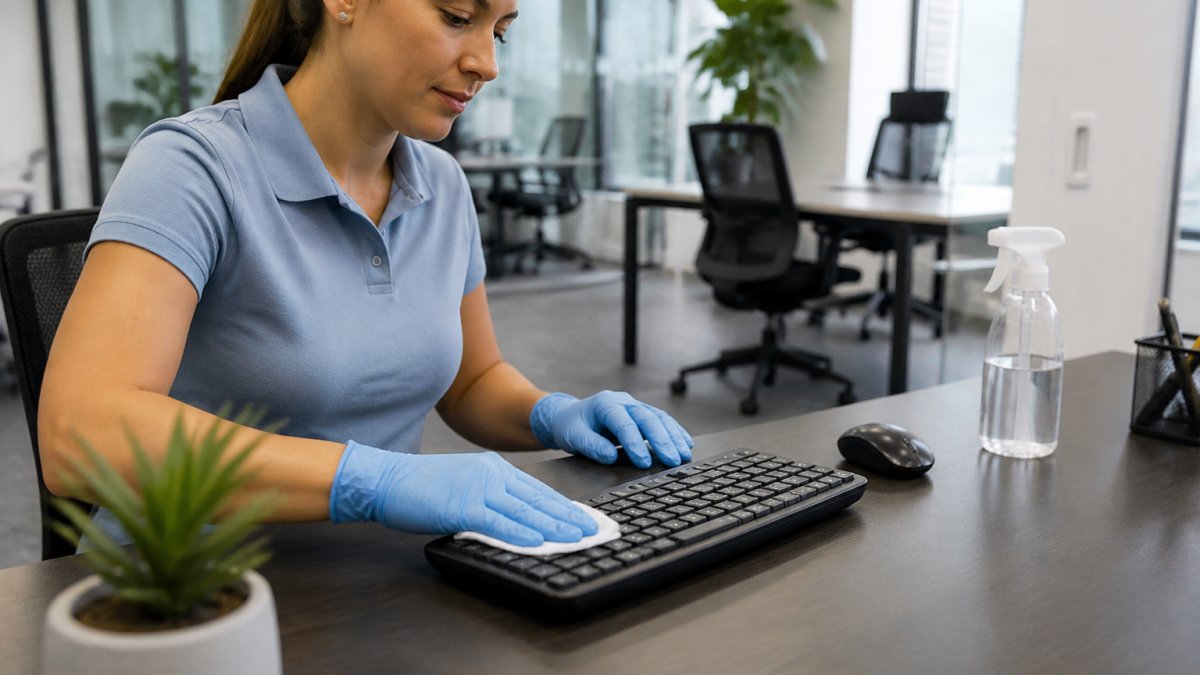
A few practical rules for equipment:
- Use a slightly damp wipe, never a soaking one, on electronics
- Unplug devices before cleaning where possible
- Keep a wipe station near shared printers and copiers
- Encourage each employee to wipe their own keyboard at day’s end
Shared equipment is where a routine either holds or breaks down. Make it easy for people to clean as they go.
Supporting Employee Health and Hand Hygiene
Hand hygiene is the cheapest and most effective tool you have. Handwashing with soap and water for at least 20 seconds removes most germs (the CDC). When soap and water are not available, an alcohol-based hand sanitizer with at least 60% alcohol is the next best option.
Make it easy:
- Put hand sanitizer stations at entrances and in break rooms
- Keep restrooms stocked with soap and paper towels
- Post reminders at sinks and shared equipment
- Encourage cough and sneeze etiquette: into an elbow or a tissue, never into hands
- Ask employees to avoid touching their eyes, nose and mouth
Hand hygiene works best when supplies are always within reach. Convenience drives compliance more than any reminder poster.
Ventilation and Indoor Air Quality
Surface cleaning handles the surfaces. Ventilation handles the air. During flu season, both matter, because influenza spreads through droplets and aerosols that can linger in a room after an infected person leaves.
The goal is simple to state and harder to execute: move more clean outdoor air through the space, filter what recirculates, and keep air moving so concentrations of airborne germs do not build up in one spot.
What Actually Improves Airflow
- Increase outdoor air intake. If your HVAC system has an economizer or adjustable outdoor-air damper, ask your building engineer to raise the outdoor-air percentage during work hours. This is the single highest-impact change and usually costs nothing but a phone call.
- Run HVAC fans longer. Standard schedules often shut fans down at 6 p.m. Running them two hours before and two hours after occupancy keeps air moving when people are actually present and clears the space afterward.
- Upgrade filtration where the system allows. MERV 13 filters capture a meaningful share of airborne particles, but not every HVAC system can handle the added resistance without reducing airflow. Check with your building engineer before swapping filters, a MERV 13 that chokes your system can make air quality worse, not better.
- Add portable air cleaners in small or crowded rooms. Look for units with a HEPA filter and a clean air delivery rate (CADR) sized to the room. A common rule of thumb is a CADR roughly equal to two-thirds of the room’s square footage for a typical office ceiling height.
- Keep vents and returns unobstructed. Furniture, storage boxes and even tall plants placed in front of return grilles cut airflow more than most people realize.
What to Skip
- Do not rely on open windows alone in winter. They help, but in cold climates people close them within an hour. Treat windows as a supplement, not a strategy.
- Do not block or cover vents to redirect air at a desk. It reduces total system airflow and creates dead zones elsewhere.
- Do not assume a new filter solves everything. Filtration is one layer. It does not replace cleaning, hand hygiene or staying home when sick.
How to Verify Ventilation Is Working
You do not need a lab to get a rough read on whether air is moving:
- Check filter change logs. If the last change date is more than three months old, filtration is likely degraded.
- Ask for a CO2 reading during a meeting. Elevated CO2 in a crowded conference room is a practical proxy for poor ventilation, if the room feels stuffy and CO2 is high, outdoor air intake is too low.
- Walk the space and feel for airflow at supply diffusers and return grilles. Weak or no airflow at a return is a red flag.
Ventilation is the layer most offices skip because it is invisible. But it is also the layer that keeps working after the cleaning crew leaves, which is exactly when a room full of people is most vulnerable.
Conclusion
Flu season will test your office no matter how prepared you are. The difference is whether you have a routine in place before people start calling out sick.
That is where Guso Janitorial Services helps. We offer 24/7 availability, tailored cleaning programs, and clean and green products, all backed by a fully licensed, bonded and insured team. We handle the cleaning so your staff can focus on their work.
Frequently Asked Questions
How often should an office be cleaned during flu season?
High-touch surfaces like doorknobs, light switches, and shared equipment should be cleaned and disinfected at least once daily, ideally twice for high-traffic areas. Routine cleaning of floors, break rooms, and restrooms should happen every day. During peak flu season, increase disinfection frequency for shared spaces and consider a professional cleaning service to maintain consistent office hygiene.
What is the difference between cleaning and disinfecting an office?
Cleaning removes dirt, grime, and some germs from surfaces using soap or detergent. Disinfecting kills germs on surfaces after cleaning, using EPA-registered disinfectants. You must clean a surface before disinfecting it, because dirt and oils can prevent disinfectants from working properly. Both steps are essential for effective office hygiene during flu season.
What supplies should an office keep on hand during flu season?
Stock soap, paper towels, tissues, disposable wipes, and EPA-registered disinfectants. Place alcohol-based hand sanitizer stations with at least 60% alcohol in common areas like break rooms, lobbies, and near restrooms. Keep a supply of gloves for cleaning staff and ensure handwashing stations are always fully stocked. Check supply levels weekly so you never run out during peak flu season.
Should employees stay home if they have flu symptoms?
Yes. Employees with flu symptoms should stay home to avoid spreading the virus to coworkers. The CDC recommends staying home for at least 24 hours after a fever is gone without fever-reducing medication. Encourage remote work options and flexible sick leave policies so employees do not feel pressured to come in while contagious. This protects your entire workforce and supports employee health.
Leave a Reply