
Last Updated: October 29, 2026
Quick Summary
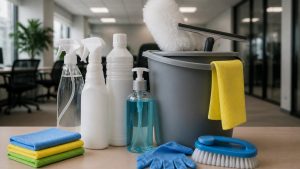
The best office cleaning supplies for a healthier workspace are EPA-registered disinfectants for high-touch surfaces, color-coded microfiber cloths, and a HEPA vacuum for carpets. Low-VOC products keep chemical residue and irritants low. Used consistently and with the right contact time, these supplies reduce germs and dust that employees touch and breathe.
- Choose disinfectants with an EPA registration number and follow the label’s contact time.
- Use color-coded microfiber cloths so restrooms, kitchens and general areas never share cloths.
- A HEPA-filter vacuum traps fine particles instead of returning them to the air.
- Low-VOC, fragrance-free cleaners reduce odor and airborne irritants in open-plan offices.
- Clean high-touch items such as keyboards, phones and door handles every day.
Table of Contents
- Why Office Cleaning Supplies Matter for Employee Health
- Essential Office Cleaning Supplies List for Daily Maintenance
- Best Disinfectant for Office Surfaces: EPA-Registered Options
- Eco-Friendly Office Cleaning Products That Still Disinfect
- Microfiber, Vacuums and Tools That Improve Indoor Air Quality
- Office Cleaning Checklist: How Often to Clean Each Area
- Scheduling Your Next Healthier Workspace Cleaning With Guso
- Frequently Asked Questions
Why Office Cleaning Supplies Matter for Employee Health
Clean offices are not just a matter of appearance. The office cleaning supplies you choose affect how many germs stay on desks, phones and door handles, and how much dust and chemical residue employees breathe during the workday. Guso Janitorial Services offers tailored commercial and office cleaning solutions and uses clean and green cleaning products.
Surfaces that get touched all day carry the most risk. Keyboards, copier buttons, elevator panels and break room fixtures pass germs from hand to hand. Cleaning them with the right supplies, used the right way, is one of the simplest ways to reduce illness-related absences. Many facility managers find that the products themselves matter less than whether the team uses them consistently.
Indoor air is the other half of the picture. Dust that settles on vents and carpet gets stirred up again with every footstep and every HVAC cycle. Cleaning tools that trap particles instead of spreading them help keep that dust out of the air people breathe. We come back to this later, but it is worth keeping in mind from the start.
Essential Office Cleaning Supplies List for Daily Maintenance
A workable daily kit is smaller than most people expect, but it has to cover four jobs at once: high-touch disinfection, floor and surface soil removal, waste handling, and hand hygiene. Start with the items that touch the most surfaces and the most people, then add specialty tools only when a specific problem calls for them. The list below is organized by job so a facility manager can build a kit that maps to a daily route rather than a shopping cart.
High-touch disinfection
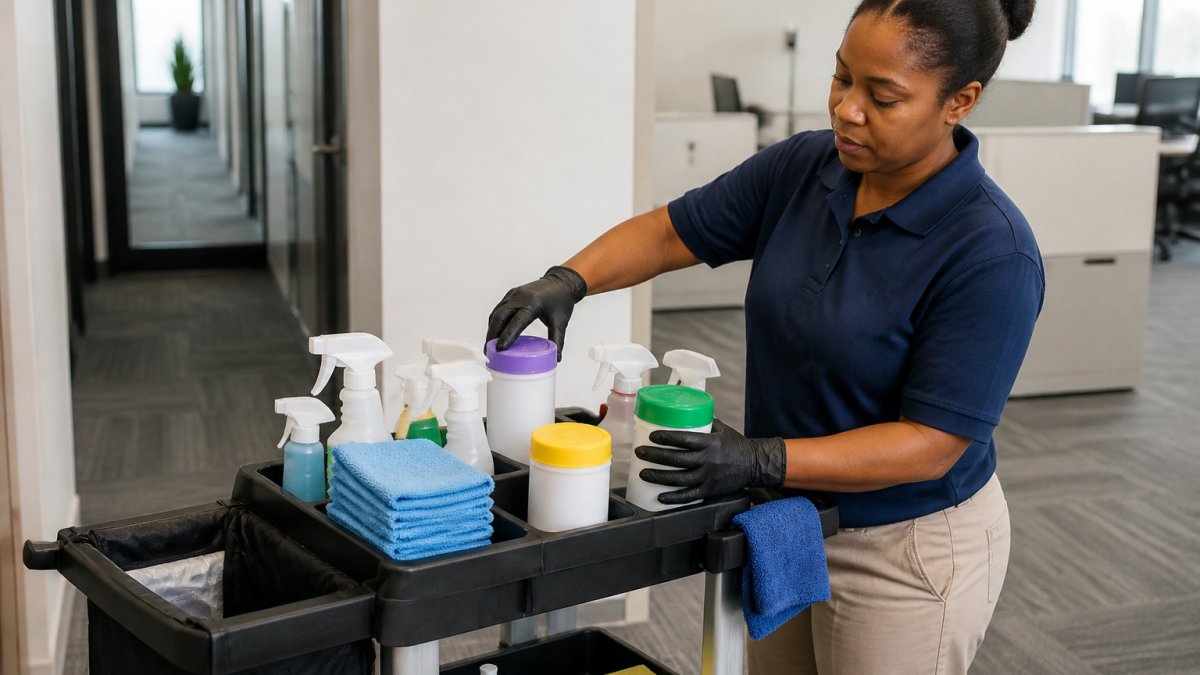
- Microfiber cloths in color-coded sets, so restrooms, kitchens and general office areas never share a cloth
- Disinfecting wipes for high-touch items such as phones, keyboards and door handles
- Spray bottles with clearly labeled, diluted cleaners for desks and counters
- Nitrile gloves for staff handling cleaning chemicals
Floors and surfaces
- A dust mop or flat mop with replaceable pads for hard floors
- A backpack or compact vacuum for quick pickup of crumbs and debris
- Glass cleaner for conference room walls and reception areas
- A commercial-grade upright vacuum with a HEPA filter for daily carpet runs in larger suites
Waste management
- Trash liners sized to each receptacle, a liner that is too large slips and spills, and one that is too small tears at the seam
- Separate liners for recycling and compost where the building has those streams, so custodial staff do not undo tenant sorting at the bin
- A sharps container where the building layout or tenant mix requires one, mounted at eye level in restrooms rather than left on the floor
Hand hygiene
- Soap dispensers that are sealed and refillable, because bulk pour-fill dispensers are a common contamination point
- Touch-free paper towel or hand dryer units in restrooms and break rooms
- Hand sanitizer stations at entrances, elevator lobbies and shared conference rooms
A common mistake is buying in bulk before deciding who will use what. Label every bottle and cloth color, store chemicals separately from food areas, and keep safety data sheets on hand for each product. Those sheets are required under OSHA’s Hazard Communication Standard, so they are not optional paperwork.
Build the kit around a daily route, not a product category. A cart that carries one color-coded cloth set, one labeled spray bottle, liners for the bins on that route, and a HEPA vacuum covers most offices without a second trip to the supply closet.
Never decant a disinfectant into an unlabeled bottle, and never store chemicals above food or paper supplies.
Best Disinfectant for Office Surfaces: EPA-Registered Options
For disinfection, look for products registered with the U.S. Environmental Protection Agency (the EPA). The EPA maintains a searchable list of disinfectants that have been reviewed for specific germs, and the registration number on the label tells you the product has been evaluated for that claim. For a closer look at non-toxic options for commercial workspaces, see non-toxic disinfectants for commercial workspaces. Reading the label, not the marketing, is the reliable way to check.
Pay attention to contact time. A disinfectant only works if the surface stays wet for the time printed on the label, which can range from under a minute to several minutes depending on the product. Wiping the surface dry too early means the product did not do its job, even if the bottle says it kills germs.
Match the disinfectant to the surface. Some products that work well on hard, nonporous surfaces can damage electronics, painted walls or certain finishes. Check the manufacturer’s compatibility notes before using a product on screens, laminate or wood.
Choosing Products for High-Touch Surfaces
High-touch surfaces need the most attention and the most careful product choice. Focus on these areas first:
- Keyboards and mice, which hold large numbers of germs and need a product safe for electronics
- Phones and tablets, cleaned with a wipe that will not leave residue on screens
- Door handles, light switches and elevator buttons
- Shared printers, copier panels and coffee machine handles
- Conference table surfaces and shared whiteboard markers
Use wipes or sprays on these surfaces, never soak them. Let the surface air dry for the full contact time. Staff should wash their hands after handling cleaning products, and cloths used on high-touch surfaces should be swapped out often rather than reused until they are dirty.
Eco-Friendly Office Cleaning Products That Still Disinfect
Green cleaning does not have to mean weaker cleaning. Many plant-based and low-VOC products still meet EPA disinfection standards when used as directed. The key is checking the label for a disinfection claim against a named germ, because a product can be eco-friendly and still be a general cleaner with no disinfecting power.
Look for these features when comparing options:
- An EPA registration number for any product claiming to disinfect
- Low or no volatile organic compounds (VOCs), which reduces odor and airborne irritants
- Concentrated formulas that reduce packaging and shipping waste
- Third-party eco-certifications, where the certifying body is clearly named
Some teams worry that switching to greener products means chemical smells will linger. In practice, low-VOC formulas usually leave less odor, not more. Test any new product on one restroom or break room before rolling it out across the whole facility, and note whether staff report irritation or headaches.
Watch out: a product that says “natural” or “green” on the front is not automatically safe for every surface. Read the full label, check the dilution ratio, and never mix cleaners, since combining products can release harmful fumes.
Microfiber, Vacuums and Tools That Improve Indoor Air Quality
Most cleaning-supply guides stop at surfaces. The tools you choose can affect what is floating in the air, not just what is sitting on a desk. Three levers matter: how dust is captured, how air is filtered, and what the products themselves off-gas.
Capture dust instead of lofting it. Microfiber cloths hold dust and bacteria in their fibers, while cotton rags tend to push particles around. Used dry on dusting tasks and damp for wiping, microfiber is one of the most effective and least expensive upgrades a facility can make. The mechanism is simple: split microfibers create a positive charge that attracts dust and a capillary action that traps it until the cloth is laundered.
Filter the air the vacuum pushes out. A standard vacuum filter catches large debris but returns fine particulate back into the room. A HEPA filter captures a much higher share of fine particles, which is why HEPA vacuums are the default recommendation for offices with allergy-sensitive staff or carpeted conference rooms.
Watch what the products add to the air. Low-VOC and fragrance-free cleaners reduce the odor and airborne irritants that trigger complaints in open-plan offices. The trade-off is real: some fragrance-free formulas have a shorter shelf life, and some low-VOC disinfectants need a longer contact time to hit the same claim. Check the label for both the disinfection claim and the VOC or fragrance statement rather than assuming green means low-irritant.
Monitor rather than assume. A growing number of facility teams pair cleaning supplies with simple indoor air quality monitoring, a CO2 sensor in a conference room, a particulate counter on a floor with heavy carpet traffic, or a building automation trend log for filter change intervals. You do not need a full IAQ program to act on the data.
Ergonomics is part of workplace health. Lightweight tools with adjustable handles reduce strain on the back and wrists during long shifts. A well-designed mop or vacuum that is easy to maneuver also tends to get used more consistently, which improves results.
The IAQ upgrade is rarely one product. It is a matched set: microfiber for capture, a HEPA vacuum for filtration, low-VOC chemistry for what the products add to the air, and a simple monitor to confirm the combination is working.
EPA indoor air quality and ventilation guidance
Office Cleaning Checklist: How Often to Clean Each Area
Cleaning frequency should follow how often an area is used. To find out whether desk disinfection is legally required, see whether OSHA requires daily desk disinfection. A reasonable starting schedule for most offices looks like this:
| Area | Daily | Weekly | Monthly |
|---|---|---|---|
| Desks and keyboards | Wipe high-touch items | Deep clean | Check under desks |
| Restrooms | Full sanitize | Scrub grout and fixtures | Restock supply audit |
| Break room and kitchen | Wipe counters and appliances | Clean inside microwave and fridge | Empty and sanitize cabinets |
| Floors | Vacuum or dust mop | Mop hard floors | Shampoo carpets |
| Vents and air returns | Visual check | Dust exposed surfaces | Schedule HVAC filter review |
Adjust the schedule for heavy-traffic offices and for areas with food, clients or manufacturing dust. A busy reception area may need extra wiping midday, while a quiet storage room can stay on a monthly cycle.
Scheduling Your Next Healthier Workspace Cleaning With Guso
Guso Janitorial Services provides janitorial service 24 hours a day, 7 days a week, with cleaning programs tailored to specific business needs. The company is fully licensed, bonded and insured, and uses clean and green products.
For current pricing, request a quote from Guso Janitorial Services. Call Today!
Frequently Asked Questions
What cleaning supplies does an office need?
A basic office kit includes disinfecting wipes or spray for high-touch surfaces, microfiber cloths in color-coded colors to limit cross-contamination, a HEPA-filter vacuum, a mop and bucket system, trash liners, hand soap and paper towels. Restrooms and kitchens also need separate cleaners for grease and limescale. Keep a supply inventory so staff never run out of disinfectant mid-week, and store chemicals away from food areas. Quantities depend on headcount, foot traffic and how often your space is serviced, so review your usage monthly.
How often should office surfaces be cleaned?
High-touch surfaces such as doorknobs, light switches, keyboards, phones and break room fixtures should be disinfected daily in most offices, and more often in high-traffic areas. Desks and conference tables are typically cleaned daily or several times a week. Floors are usually vacuumed or swept daily with deeper cleaning weekly or monthly. Follow the surface manufacturer’s guidance for electronics to avoid damage.
Which cleaning products are safe to use around employees?
Look for products with an EPA registration number when you need disinfection, and check the safety data sheet (SDS) for each product, which your vendor should provide. Choose low-VOC or fragrance-free formulas where possible to reduce irritation for employees with asthma or sensitivities. Always follow dwell times on the label, ensure good ventilation during use, and never mix chemicals. Train staff on the correct dilution and storage procedures.
What should be included in an office cleaning checklist?
A solid checklist covers daily tasks such as emptying trash, disinfecting high-touch surfaces, cleaning restrooms and restocking supplies, plus weekly tasks like dusting vents, cleaning glass and mopping hard floors. Monthly and quarterly items include carpet extraction, upholstery cleaning and HVAC filter checks. Assign each task a frequency and responsible person, and review the checklist regularly with your janitorial provider to keep it current.

Leave a Reply