
Last Updated: October 23, 2026
Quick Summary
The best non toxic disinfectants for commercial workspaces are EPA-registered products with low-exposure ingredients like hydrogen peroxide, citric acid, or hypochlorous acid, applied for the full label contact time. Always confirm the EPA registration number, approved surfaces, and first aid statements, since “non-toxic” has no legal definition for disinfectants.
- In the US, “non-toxic” has no legal definition for disinfectants, and Safer Choice certification is separate from EPA registration.
- Ammonia, bleach, and quats cause most odor, irritation, and equipment complaints; hydrogen peroxide and citric acid are common alternatives.
- A disinfectant only works at its labeled concentration, surface, and full contact time, so spray-and-wipe does not disinfect.
- Build contact time into the cleaning route by spraying a row of desks and wiping them on the return pass.
- Never mix bleach with ammonia or vinegar, because the reaction produces toxic gas.
Table of Contents
- What Makes a Disinfectant Truly Non-Toxic for Commercial Workspaces
- Top Non-Toxic Disinfectants for Commercial Spaces: Comparison Table
- EPA-Registered Disinfectants for Offices: Why Registration Matters
- Commercial Disinfectant Contact Time: The Step Most Teams Skip
- Office Disinfection Best Practices for High-Touch and Shared Surfaces
- Commercial Cleaning Product Safety: Protecting Workers and Occupants
- How to Choose the Right Non-Toxic Disinfectant for Your Workspace
- Frequently Asked Questions
What Makes a Disinfectant Truly Non-Toxic for Commercial Workspaces
Most “non-toxic” labels on a disinfectant bottle tell you almost nothing. A product can carry a green leaf, a plant-based claim, and a citrus scent while still requiring gloves, ventilation, and a dwell time nobody follows.
A non-toxic disinfectant is a cleaning product formulated to reduce pathogen exposure while limiting harm to the people who apply it and the occupants who share the space. The word describes a spectrum, not a certification.
Here is the part most buying guides skip: in the United States, “non-toxic” has no legal definition for disinfectants. The EPA’s Safer Choice program certifies ingredient safety for cleaning products, but that certification is separate from the EPA registration a disinfectant needs to make kill claims.
The Difference Between ‘Non-Toxic’ and ‘Green’ Claims
Green cleaning and non toxic disinfectants overlap but answer different questions. Green refers to environmental footprint; non-toxic refers to human exposure risk during normal use.
A green-certified product can still irritate skin or trigger asthma in a poorly ventilated copy room, and a non-toxic product can come in unrecyclable plastic. Neither label guarantees both.
For a facility manager, the practical test is simple: read the label’s first aid and precautionary statements.
LEED green cleaning requirements also treat cleaning products as one part of a broader program, covering entryway systems, equipment, and staffing. Certification language alone will not tell you whether a disinfectant is safe for daily use around employees.
Ingredients to Avoid: Ammonia, Bleach, and Quats
Three ingredient families cause most of the complaints we hear from office managers: chemical smell, eye irritation, and damage to equipment.
- Ammonia gives strong odor and can irritate airways in enclosed spaces.
- Bleach (sodium hypochlorite) is effective but corrosive to some metals and hard on skin with repeated use.
- Quaternary ammonium compounds (quats) are common in disinfectants and linked to skin and respiratory irritation in sensitive people.
Hydrogen peroxide, citric acid, and plant-based surfactants are the usual alternatives, not automatically safer, but generally lower exposure risk when used as directed. White vinegar and essential oils are popular in DIY recipes, yet neither is a registered disinfectant.
Never mix bleach with ammonia or vinegar. The reaction produces toxic gas, and this mistake still happens in offices where staff improvise cleaning routines.
Top Non-Toxic Disinfectants for Commercial Spaces: Comparison Table
Four products come up repeatedly when offices look for lower-exposure disinfectants. The table adds fields most buying guides omit: EPA registration status, label contact time, surface compatibility, and cost per use. Verify every number against the current label and Safety Data Sheet before purchase.
| Product | Type | EPA Registered | Label Contact Time | Best For | Watch Out For |
|---|---|---|---|---|---|
| Force of Nature | Electrolyzed water (hypochlorous acid) disinfectant | Yes | Typically 1-5 minutes depending on the specific label and pathogen | Teams avoiding bleach, quats, ammonia, fragrance, and dyes | Commercial dilution and dwell-time directions are not always published in retail listings; confirm the registration number and label directions with the supplier |
| REScue One-Step Ready-to-Use | Ready-to-use disinfectant cleaner | Yes (confirm on label) | Check label; ready-to-use products often carry a 1-10 minute dwell depending on the organism | Fast wipe-downs without dilution errors | “Non-toxic” framing comes from retail copy, not a formal certification; verify the EPA registration number and approved surfaces |
| Biokleen Spray & Wipe | All-purpose cleaner | No (cleaner, not a disinfectant) | Not applicable, no kill claims | Routine grime removal; EPA Safer Choice certified | Does not disinfect; do not count it toward a disinfection log |
| Guso Janitorial Services | Managed janitorial program | Uses registered products selected per site | Program-dependent | Facilities that want the work handled with documented contact times | Service area and scope depend on your site |
How to read the table. EPA registration divides products reviewed to support kill claims from those that are not.
Cost per ready-to-use gallon. Concentrates usually cost less per diluted gallon but add dilution errors, storage, and training burden; ready-to-use products cost more per bottle but remove mixing mistakes.
Surface compatibility. Non-porous surfaces such as glass, laminate, and stainless steel tolerate most registered disinfectants.
For readers comparing a wider set of options, our roundup of the 5 best disinfectants for commercial office spaces covers additional products and how they stack up.
EPA-Registered Disinfectants for Offices: Why Registration Matters
Registration divides products that claim to kill germs from those reviewed to do so. The EPA registers disinfectants only after the manufacturer submits efficacy data against specific pathogens, plus label directions for use.
A registered disinfectant’s kill claim is tied to a specific concentration, surface, and contact time. Use it differently and the claim no longer applies to what you did.
Three things to check on any label:
- EPA registration number printed on the container.
- The pathogen list the product is registered against, not a generic “kills 99.9%” badge.
- Approved surfaces, since some products are not cleared for porous materials or electronics.
Healthcare-grade standards are stricter than office standards, and most offices do not need them. What offices do need is a product registered for the organisms they actually worry about, applied exactly as directed.
Commercial Disinfectant Contact Time: The Step Most Teams Skip
Contact time, or dwell time, is the period a surface must stay visibly wet for the disinfectant to work as tested, the single most ignored instruction in office cleaning.
A crew that sprays and immediately wipes has cleaned the surface, not disinfected it. For a one-minute product, that minute has to pass before the cloth comes out.
This creates an operational problem: high-traffic surfaces get wiped constantly, and staff rarely stand and watch a desk stay wet. Two fixes work in practice:
- Choose products with shorter contact times for high-touch items.
- Train staff to work in zones, applying disinfectant ahead of themselves so dwell time elapses while they clean the previous area.
Build contact time into the route, not the clock. If your team sprays a row of desks and then returns to wipe them, the dwell time happens on its own without anyone standing idle.
Office Disinfection Best Practices for High-Touch and Shared Surfaces
High-touch surfaces deserve the most attention because they carry the most hand traffic: door handles, shared keyboards, conference tables, break room counters, elevator buttons, and printer panels.
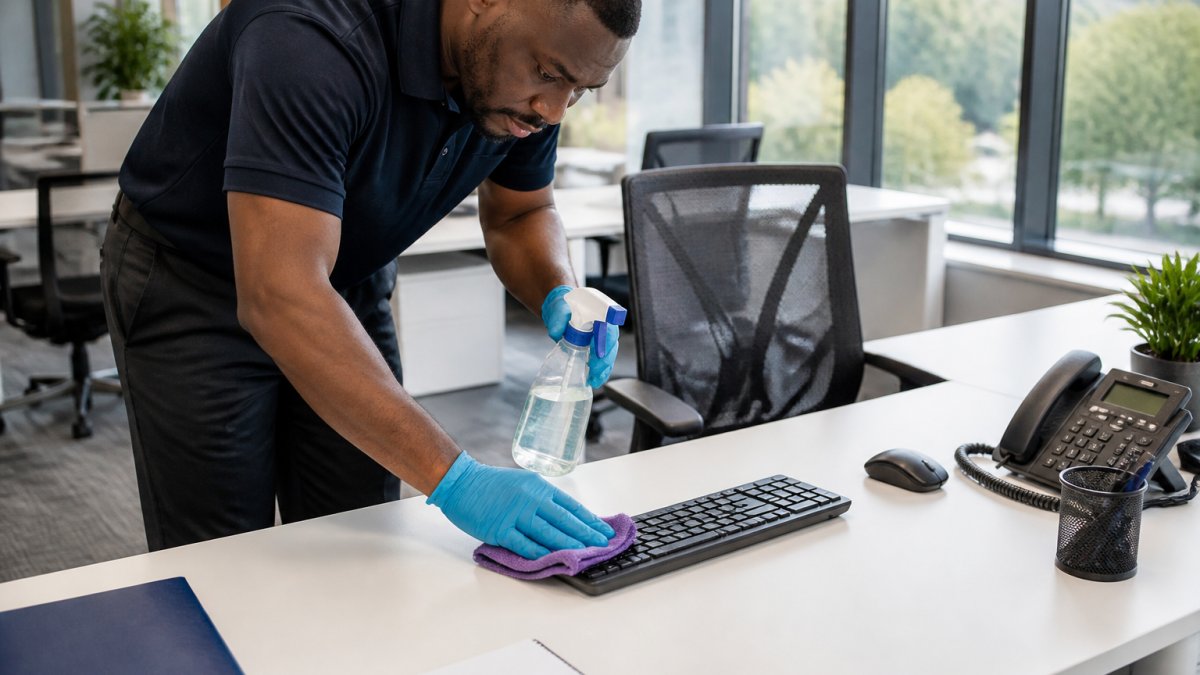
Effective practice follows a repeatable order:
- Clean visible soil first with a multi-surface cleaner.
- Apply the disinfectant to the whole surface, not just the center.
- Let it stay wet for the full contact time.
- Use separate cloths for separate zones to avoid moving germs around.
Non-porous surfaces like glass, laminate, and stainless steel hold up best to regular disinfection. Porous materials such as fabric chairs need products labeled for them. For a deeper walkthrough, see our guide on how to sanitize high-touch surfaces in shared spaces.
Commercial Cleaning Product Safety: Protecting Workers and Occupants
Worker and occupant safety pull in the same direction but are managed differently. Staff face concentrated exposure during application; occupants face residual exposure through odor, off-gassing, and wet surfaces.
The practical controls are straightforward:
- Ventilation during and after application, especially in small rooms.
- Dilution accuracy, since over-concentrating a product increases exposure and can leave residue.
- Storage in labeled containers, never in unmarked spray bottles.
- Training on first aid and spill response, not just application.
One question we get often: does OSHA require daily disinfection of desks? Our breakdown of whether OSHA requires daily disinfection of desks explains what the standard actually covers.
Indoor air quality is the other half of occupant safety. Chemical odors linger in closed offices, and staff notice. Our seven-step guide to improving office indoor air quality covers ventilation, filtration, and product selection together.
How to Choose the Right Non-Toxic Disinfectant for Your Workspace
Selection comes down to matching the product to the surface, pathogen risk, occupancy pattern, and labor you can sustain.
| Workplace condition | What to prioritize | What to avoid | Operational trade-off |
|---|---|---|---|
| High-touch, high-traffic surfaces (door handles, elevator buttons, shared keyboards) | Registered product with a short label contact time and low odor | Long-dwell products that staff wipe early | Short dwell times may cost more per ready-to-use gallon |
| Break rooms and food-contact areas | Product labeled for food-contact surfaces | General-purpose disinfectants not cleared for food contact | Food-contact labels may require a potable-water rinse |
| Glass and multi-surface | Separate streak-free glass cleaner plus a registered disinfectant | Overusing disinfectant as a glass cleaner | Two products mean two training routines |
| Occupied spaces with sensitive occupants | Fragrance-free formulas with verifiable certifications | Strong fragrances and unverified “non-toxic” front-label claims | Fragrance-free products may have narrower retail availability |
| Poorly ventilated rooms (copy rooms, storage closets) | Low-odor products and application during unoccupied hours | Products whose label requires ventilation the room cannot provide | Scheduling application around occupancy adds labor |
| Porous materials (fabric chairs, cubicle panels) | Products labeled for porous surfaces | Disinfectants cleared only for hard, non-porous surfaces | Porous-surface products may have longer dwell times |
| High-turnover cleaning staff | Ready-to-use products with clear pictograms | Concentrates that require accurate dilution | Ready-to-use costs more per bottle but reduces mixing errors |
| Stable, trained in-house team | Concentrates with dispensers and documented dilution | Unlabeled spray bottles and hand-mixed ratios | Concentrates save per gallon but add storage and training burden |
Total cost and operational fit. Compare cost per ready-to-use gallon, then add labor for mixing, dwell time, and dispenser maintenance.
Worker safety and implementation. Staff face concentrated exposure during application, so controls matter as much as the product.
If your facility spans manufacturing floors, retail space, and offices, product selection is only half the job.
For readers weighing formal green standards, our overview of LEED cleaning requirements in 2026 shows how product choice fits into a broader certification picture.
Frequently Asked Questions
Are non-toxic disinfectants effective against germs?
Yes, but effectiveness depends on EPA registration and correct use. Many non-toxic disinfectants are EPA-registered and kill 99.9% of bacteria and viruses when used as directed. The key is checking the label for specific pathogen claims and following the listed contact time. Products without EPA registration may clean but cannot legally claim to disinfect. For commercial workspaces, always verify the product’s EPA registration number and ensure staff allow the surface to remain wet for the full contact time.
How long should a disinfectant remain wet on a surface?
Contact time varies by product, typically ranging from 30 seconds to 10 minutes. The label states the required wet time for each pathogen. For example, a product may need 1 minute for influenza but 5 minutes for norovirus. In commercial settings, train staff to read the label and use a timer if needed. Rushing this step is the most common reason disinfection fails. Choose products with shorter contact times for high-turnover areas like break rooms and restrooms.
What should businesses look for when choosing an office disinfectant?
Look for an EPA registration number, a clear list of pathogens it kills, and the contact time. Check for certifications like EPA Safer Choice for reduced hazard. Avoid fragrances and harsh chemicals if occupants have sensitivities. Consider the format: ready-to-use is easier for staff, while concentrates cost less per use but require dilution. Also review surface compatibility to prevent damage. Finally, factor in total cost including training and PPE, not just the purchase price.
Can eco-friendly cleaning products disinfect commercial spaces?
Some can, but not all eco-friendly products are disinfectants. Many green cleaners are for general cleaning and do not carry EPA disinfectant claims. To disinfect, the product must be EPA-registered. Look for eco-friendly disinfectants that meet EPA Safer Choice or have low-hazard ingredients while still providing pathogen kill claims. Always verify the label for both green certification and disinfectant registration. Using a separate cleaner and disinfectant is often necessary for proper results.

Leave a Reply