

Table of Contents
- What LEED Cleaning Requirements Actually Apply in 2026
- LEED Green Cleaning Requirements: What Changed from v4 to v5
- Your LEED Cleaning Checklist by Building Type and Pathway
- Building a LEED Cleaning Policy Template That Passes Review
- Green Cleaning Documentation for LEED: Records That Hold Up in an Audit
- Product Selection and Verification: What Reviewers Look For
- Conclusion: Getting Your Cleaning Program Audit-Ready
- Frequently Asked Questions
Last Updated: October 5, 2026
What LEED Cleaning Requirements Actually Apply in 2026
LEED cleaning requirements in 2026 are not a single checklist. At Guso Janitorial Services, we build cleaning programs for facilities pursuing or maintaining certification.
A prerequisite is mandatory. Miss it and the project cannot certify, regardless of how many points you earn elsewhere. A credit is optional and worth points toward your target certification level.
That distinction drives everything. A green cleaning policy is typically a prerequisite, not a bonus. Documentation proving you followed it is what reviewers actually check.
Prerequisites vs. Credits vs. Pilot Credits
The green cleaning prerequisite requires a written policy covering product selection, procedures, and staff training. It applies to the building’s ongoing operations, not just the construction phase.
Credits go further. They reward purchasing verification, custodial effectiveness assessment, and occupant feedback mechanisms. Pilot credits often test newer approaches, such as advanced IAQ monitoring or reoccupancy protocols after disruptions.
Here is how the three tiers compare in practice:
| Tier | Mandatory? | Worth Points? | Typical Content |
|---|---|---|---|
| Prerequisite | Yes | No | Green cleaning policy, product criteria, staff training |
| Credit | No | Yes | Purchasing verification, custodial assessment, occupant surveys |
| Pilot credit | No | Yes | IAQ monitoring, reoccupancy, resilience measures |
If your policy exists only as a PDF nobody follows, you have met the paperwork requirement and none of the intent. Reviewers increasingly ask for evidence of implementation, not just adoption.
LEED Green Cleaning Requirements: What Changed from v4 to v5
The version your project registered under determines which cleaning requirements apply. The three versions in play in 2026, v4, v4.1, and v5, share a common spine (a green cleaning policy, product criteria, custodial training, and some form of performance verification) but differ in how prescriptive they are and how much they ask you to prove.
| Element | LEED v4 | LEED v4.1 | LEED v5 |
|---|---|---|---|
| Green cleaning policy | Prerequisite (written policy required) | Prerequisite, with clearer scope and responsible-party language | Prerequisite, folded into broader operations and maintenance requirements |
| Product criteria | Credit-driven; recognized third-party certifications expected | Credit-driven; certification language clarified | Credit-driven; emphasis on verified performance and transparency documentation |
| Custodial training | Required as part of the policy | Required, with more explicit content expectations | Required, with expectation of documented competency |
| Performance verification | Optional credit (custodial effectiveness assessment) | Optional credit, similar structure | Stronger expectation of measurable outcomes tied to occupant health |
| Purchasing documentation | Credit-level requirement | Credit-level requirement | Credit-level requirement, with tighter traceability |
| Occupant feedback | Optional credit | Optional credit | More integrated into occupant health and well-being credits |
Two things to read from that table. First, the green cleaning policy is a prerequisite in all three versions, it is not optional and it is not a point opportunity. Second, almost everything else (product verification, custodial assessment, occupant surveys, purchasing documentation) is a credit.
What Actually Changed, Version to Version
v4 to v4.1. The shift was mostly about clarity, not new obligations. v4.1 tightened the language around which product certifications count and what custodial training must cover. If your v4 policy was already specific about accepted certifications and training content, the v4.1 translation is largely a documentation refresh.
v4.1 to v5. This is the bigger jump. v5 folds cleaning into a broader building-performance and occupant-health narrative, which means reviewers are more likely to ask how your cleaning program contributes to measurable outcomes, indoor air quality readings, occupant satisfaction data, or documented performance trends, rather than accepting a policy and a stack of invoices.
The 2026 Transition Dates You Need to Know
Registration and certification timelines determine which version governs your project. Because the certifying body sets and occasionally shifts these dates, confirm your specific project’s applicable version directly with U.S. Green Building Council LEED resources rather than relying on secondhand summaries.
If you are unsure which version applies, the fastest way to find out is to check your project’s registration record. The version is locked at registration, and it does not change because a newer version is released mid-project.
Registering under one version and documenting against another is the fastest way to fail review. Lock your version at registration and build your entire documentation trail around it. If your team is unsure which version applies, resolve that question before you write a single policy section.
For 2026 planning, the practical answer to “what are the LEED cleaning requirements” is: a mandatory green cleaning policy under whichever version you registered, plus a menu of optional credits. Treat the prerequisite as non-negotiable and the credits as a deliberate choice tied to your target certification level.
Your LEED Cleaning Checklist by Building Type and Pathway
Cleaning requirements scale with building type and certification pathway. A multi-tenant office tower, an industrial manufacturing facility, and a high-traffic retail space each carry different operational realities, even under the same prerequisite.
A LEED cleaning checklist for a corporate office typically covers:
- Written green cleaning policy signed by building management
- Product selection criteria aligned with recognized certifications
- Custodial staff training records
- Cleaning procedures documented by space type
- Purchase records for approved products
- Occupant feedback or assessment mechanism
An industrial facility adds degreasing and floor maintenance documentation. A retail environment adds high-traffic disinfection and sanitization protocols. Post-construction cleanup follows its own sequence before a reoccupancy or IAQ assessment.
| Building Type | Added Cleaning Focus | Documentation Priority |
|---|---|---|
| Corporate office | Standard green cleaning, IAQ | Policy, training records, purchase logs |
| Industrial | Degreasing, floor maintenance | Procedure logs, product SDS sheets |
| Retail | High-traffic disinfection | Frequency records, product verification |
| Post-construction | Debris removal, reoccupancy | Sequence records, IAQ clearance |
Building a LEED Cleaning Policy Template That Passes Review
A LEED cleaning policy template needs six sections to survive review: scope, product criteria, procedures, training, verification, and review cadence. Skip any one and reviewers will ask for it.
Scope defines which spaces the policy covers and who is responsible. Product criteria names the certifications you accept and the categories they apply to. Procedures describe how each space type gets cleaned, including frequency. Training documents how custodial personnel learn the policy. Verification explains how you confirm the policy is followed. Review cadence sets how often the policy is updated.
Most failed policies are strong on scope and weak on verification. That is where the documentation section below becomes critical.
Write your verification section first, then build the rest of the policy around what you can actually prove. Policies written forward from intent tend to describe practices nobody can document.
Green Cleaning Documentation for LEED: Records That Hold Up in an Audit
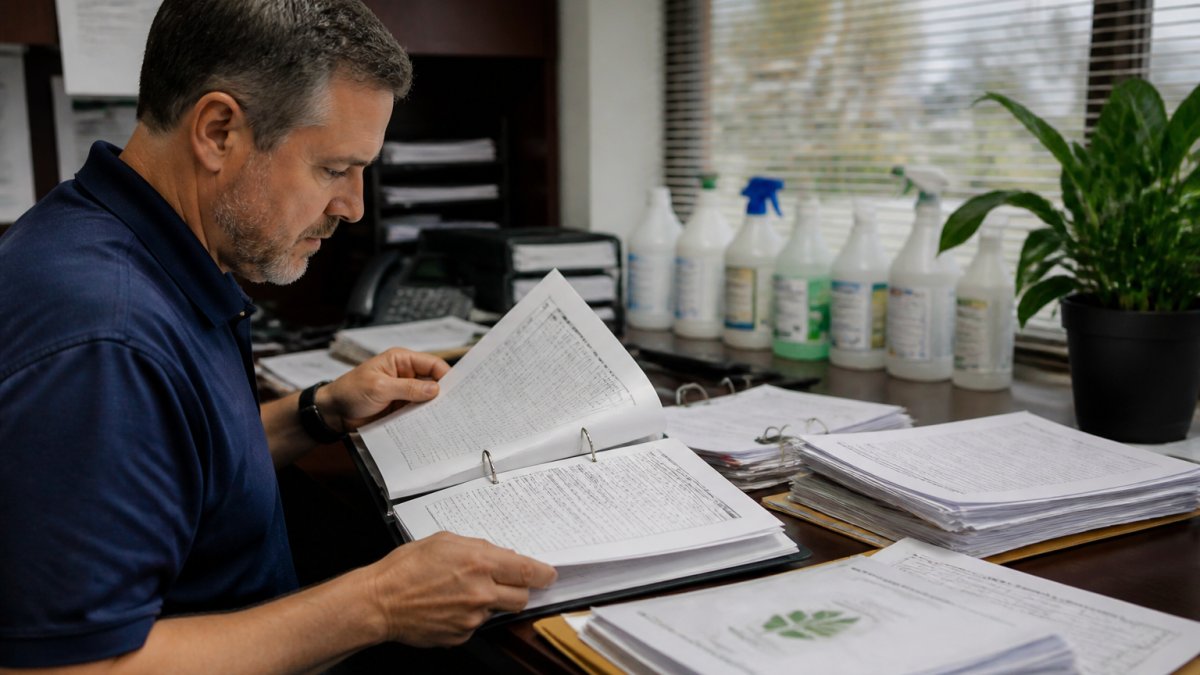
Green cleaning documentation for LEED is where most programs succeed or fail. Reviewers want a paper trail that connects policy to purchase to practice, and they want it to be current, traceable, and produced on request, not assembled after the fact.
The Four Record Types Reviewers Expect
1. Purchase records. Invoices, purchase orders, or vendor reports showing that the products you bought match the criteria in your policy.
2. Training logs. Dated records showing who was trained, on what content, and by whom.
3. Procedure records. Completed checklists or work orders showing that cleaning tasks were performed according to the procedures in your policy.
4. Assessment results. Periodic evaluations of cleaning effectiveness, whether through a custodial effectiveness assessment, occupant feedback, or an internal audit.
How Long to Keep Records
A common pattern is to retain records for the length of the certification cycle plus one year, so that any record a reviewer might request is still available. Because retention expectations can vary by rating system version and project type, confirm the specific requirement for your project against the current USGBC documentation guidance rather than assuming a fixed number.
The Three Failure Patterns That Sink Documentation
Retroactive assembly. Records created after the fact, backdated logs, reconstructed training sheets, are the single most common reason documentation fails review.
Broken chains. A purchase record that does not connect to a procedure log, or a policy section with no corresponding evidence, leaves a gap a reviewer will flag.
Expired certifications. Product certifications have expiration dates. An expired certificate on file is a documented failure, even if the product was compliant when purchased. Track expiration dates and refresh them before they lapse.
Digital vs. Paper Records
Digital logs beat paper binders for three reasons: they are searchable, they are timestamped automatically, and they are harder to lose. A shared spreadsheet or a facility management platform both work. Whichever format you use, the records must be audit-ready at any point in the certification cycle, not assembled retroactively when a reviewer asks.
For guidance on safe product handling and worker protections that support these records, reference OSHA hazard communication standards and EPA Safer Choice program criteria.
Build your documentation system backward from the review. Ask what a reviewer would need to see to confirm each policy claim, then create the record that proves it. Programs designed this way pass review with far less last-minute scrambling.
Product Selection and Verification: What Reviewers Look For
Product selection criteria must be written down, applied consistently, and verifiable.
Recognized third-party certifications carry the most weight. Products certified under recognized environmental and health standards are easier to verify than products with self-declared claims. Keep certificates on file for every approved product, and note expiration dates.
The verification step is where teams cut corners. A purchase order alone does not prove the product was used. Pair purchase records with procedure logs so the chain from shelf to surface is complete.
Facilities pursuing their first certification, where a clean, simple documentation trail beats an elaborate system nobody maintains.
Conclusion: Getting Your Cleaning Program Audit-Ready
Guso Janitorial Services builds cleaning programs for facilities that need to demonstrate exactly that. We offer 24/7 availability, tailored programs matched to your building type, and clean and green products that align with the product criteria reviewers check. We are fully licensed, bonded, and insured, and we have experience serving well-known brands across Metro Atlanta.
Get started with Guso Janitorial Services and turn your cleaning documentation into an asset instead of a scramble.
Frequently Asked Questions
What are the LEED cleaning requirements for 2026?
LEED cleaning requirements in 2026 depend on which rating system version your project registers under. LEED v4 and v4.1 projects must meet the prerequisite for a green cleaning policy covering products, procedures, and staff training. LEED v5, which launched in 2025, tightens these requirements and adds emphasis on indoor air quality and occupant health. Always verify the specific requirements for your registered version on the USGBC website.
Does LEED require green cleaning products?
Yes. LEED green cleaning requirements mandate that cleaning products meet recognized environmental standards. For LEED v4 and v4.1, this means products certified under programs like Green Seal, UL ECOLOGO, or EPA Safer Choice. The prerequisite requires that cleaning products by cost meet these criteria. Disinfectants are generally exempt when required for public health, but you must document why they were used.
What cleaning practices can help earn LEED points?
Beyond the mandatory prerequisite, several LEED credits reward advanced cleaning practices. These include using entryway matting systems to reduce contaminants, implementing a green cleaning policy with measurable goals, conducting occupant satisfaction surveys, and adopting custodial training programs. Pilot credits may also be available for innovative approaches. Check the USGBC credit library for your specific rating system version.
How should a facility document its LEED cleaning program?
Green cleaning documentation for LEED should include: a written cleaning policy signed by leadership, product inventory with certifications and safety data sheets, staff training records with dates and topics covered, daily and periodic cleaning logs, and equipment maintenance records. Digital systems with timestamps and photo verification are easier to manage than paper logs.
What is the LEED 40-60 rule?
The LEED 40-60 rule refers to a common threshold in some LEED credits where a certain percentage of a category must meet specific criteria. For cleaning-related credits, this often means that 40-60% of products or practices must meet sustainability benchmarks to earn points. The exact percentage varies by credit and rating system version. Always confirm the current threshold in the USGBC credit library for your project’s registered version.
Is LEED certification still relevant in 2026?
Yes. LEED remains the most widely used green building rating system in the United States. As of 2026, LEED v5 places greater emphasis on decarbonization, resilience, and occupant health, which aligns with corporate ESG goals and tenant expectations. Many commercial leases and government projects still require or prefer LEED certification. For facility managers, maintaining LEED compliance supports both building value and workplace health.