
Table of Contents
- Janitorial vs Commercial Cleaning: Core Differences
- Routine Maintenance vs Deep Cleaning: Scope and Frequency
- Commercial Cleaning Checklist and Task Breakdown
- Commercial Cleaning Frequency: Scheduling for Your Facility
- How to Choose a Commercial Cleaning Company
- Janitorial and Commercial Cleaning Service Comparison
- Frequently Asked Questions
Last Updated: October 14, 2026
Janitorial vs Commercial Cleaning: Core Differences
Understanding the distinction in janitorial vs commercial cleaning is essential for facility managers and business owners. At Guso Janitorial Services, we work with businesses across Metro Atlanta to clarify what each service type covers, because choosing the wrong approach can leave gaps in your facility’s cleanliness and hygiene.
Janitorial services focus on routine, day-to-day maintenance that keeps your space presentable and functional. Commercial cleaning is a broader category that includes both routine tasks and specialized, deeper work performed on a scheduled basis.
What Janitorial Services Cover
Janitorial work is the backbone of facility maintenance: small, repetitive tasks performed daily or nightly.
The focus is consistency and frequency. Janitorial staff work on a predictable schedule, often after hours or early morning, so the facility looks clean when employees or customers arrive.
What janitorial services typically do NOT include: deep carpet cleaning, floor stripping and waxing, pressure washing, exterior window washing, or specialized industrial degreasing.
What Commercial Cleaning Includes
Commercial cleaning is an umbrella term covering a wider range of services.
A manufacturing facility might need janitorial maintenance plus regular degreasing of equipment and floors. A medical office requires heightened sanitation protocols. A multi-tenant building might contract routine daily maintenance plus quarterly deep cleaning of common areas.
The scope is customizable: commercial cleaning contracts are tailored to facility type, industry requirements, and client needs. That flexibility distinguishes commercial cleaning from basic janitorial work.
Routine Maintenance vs Deep Cleaning: Scope and Frequency
The real operational difference between janitorial and commercial cleaning comes down to frequency and depth.
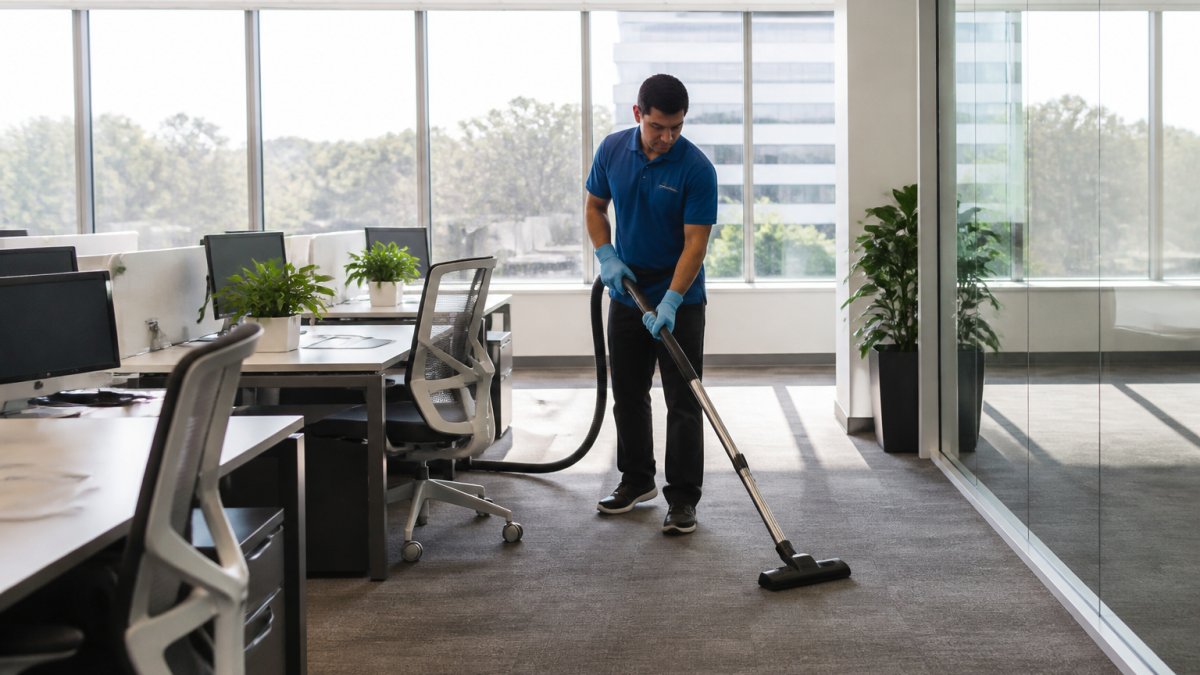
Routine maintenance includes vacuuming high-traffic areas, dusting surfaces, mopping restroom floors, wiping door handles and light switches, and emptying trash.
Deep cleaning tackles jobs that accumulate over time: shampooing carpets, stripping and waxing hard floors, cleaning inside cabinets and drawers, scrubbing grout lines, cleaning HVAC vents, and detailed sanitation of restrooms and kitchens.
Many businesses combine both: daily or weekly janitorial maintenance keeps the space hygienic, while periodic commercial deep cleaning addresses wear, buildup, and specialized needs.
Commercial Cleaning Checklist and Task Breakdown
When you contract commercial cleaning services, the scope of work should be clearly defined. Here’s how tasks typically break down between commercial cleaning and routine janitorial work:
| Task Category | Janitorial (Routine) | Commercial (Can Include) |
|---|---|---|
| Vacuuming carpets | Daily/weekly | Daily + periodic deep shampooing |
| Mopping floors | Daily/weekly | Daily + stripping, waxing, refinishing |
| Dusting surfaces | Daily/weekly | Daily + detailed furniture cleaning |
| Restroom sanitation | Daily/weekly | Daily + grout cleaning, tile scrubbing |
| Trash removal | Daily | Daily + recycling management |
| Window cleaning | Interior only | Interior + exterior surfaces |
| Equipment degreasing | Not included | Yes (industrial facilities) |
| Carpet shampooing | Not included | Yes (quarterly or as-needed) |
| Floor stripping/waxing | Not included | Yes (semi-annual or annual) |
| Post-construction cleanup | Not included | Yes (specialized debris removal) |
A commercial cleaning checklist is essential for any facility manager defining a contract. It should specify which tasks happen daily, weekly, and on a longer schedule.
Commercial Cleaning Frequency: Scheduling for Your Facility
Frequency is where the janitorial-versus-commercial distinction starts driving your budget. The right schedule is not a single number but a set of intervals, one per task, matched to how fast each surface degrades. Two buildings of identical square footage can justify different schedules because traffic, occupant density, operating hours, and industry rules differ.
The Variables That Actually Move the Schedule
Most providers build a frequency recommendation from four inputs:
- Occupant density and traffic volume. A lobby seeing 2,000 people a day soils differently than one seeing 200. High-traffic entries, elevators, and restrooms usually need daily or multiple-daily attention regardless of building size.
- Operating hours and access windows. A 24/7 facility forces cleaning into occupied hours or split shifts, changing both cost and what can be done (wet-mopping a busy corridor mid-day is impractical).
- Surface type and finish. Carpet hides soil but traps it; hard floors show it immediately. High-gloss floors need burnishing more often than matte ones.
A Task-and-Frequency Matrix You Can Adapt
The table below maps common tasks to typical intervals. Treat it as a starting template; your provider should adjust each row after a walkthrough.
| Task | Typical Interval | Primary Driver |
|---|---|---|
| Trash and recycling removal | Daily (or per shift) | Occupancy, odor, pest risk |
| Restroom cleaning and disinfection | Daily; high-traffic restrooms 2x daily | Traffic, health expectations |
| Restroom supply restocking | Daily, sometimes mid-day | Consumption rate |
| Vacuuming high-traffic carpet | Daily to 3x weekly | Foot traffic, visible soil |
| Vacuuming low-traffic carpet | Weekly | Accumulation rate |
| Damp-mopping hard floors | Daily to 3x weekly | Spills, traffic, weather |
| Dusting horizontal surfaces | Weekly | Dust load, HVAC filtration |
| High dusting (vents, ledges, light fixtures) | Monthly to quarterly | Height, buildup |
| Carpet deep extraction (shampooing) | Quarterly to annually | Traffic, stains, appearance standard |
| Hard-floor stripping and waxing | Semi-annually to annually | Finish wear, traffic |
| Interior glass and partitions | Weekly to monthly | Fingerprints, visibility |
| Exterior window cleaning | Quarterly to semi-annually | Weather, curb appeal |
| Equipment degreasing (industrial) | Weekly to monthly | Production volume, grease load |
How Facility Type Shifts the Intervals
- High-traffic retail. Daily end-of-day janitorial work plus weekly deep cleaning of floors and restrooms. Entrances and restrooms often need mid-day attention on weekends.
- Office buildings. Nightly janitorial maintenance (vacuuming, restroom cleaning, surface wiping) plus monthly or quarterly deep cleaning of carpets and hard floors. Quarterly interior glass and semi-annual high dusting are typical add-ons.
- Manufacturing and industrial. Daily janitorial maintenance, with degreasing and equipment cleaning weekly or bi-weekly depending on production volume and grease or dust load.
Ask your provider to quote each task line separately rather than one bundled monthly figure. Itemized quotes make it easy to see what a frequency change actually costs and to trim the lowest-value line instead of cutting the whole service.
The practical takeaway: match each task’s interval to its actual soil rate, not a generic package. Over-cleaning low-traffic areas wastes budget; under-cleaning high-traffic areas accelerates wear and undermines the appearance you are paying to protect.
How to Choose a Commercial Cleaning Company
Choosing a provider is a procurement decision, not just a service decision. The strongest differentiator between similar bids is rarely price; it is how clearly each provider defines scope, transfers risk, and proves performance. The framework below covers the contract mechanics and quality metrics most comparison articles skip.
Step 1: Define Scope Before You Solicit Bids
Write your scope of work first, then ask providers to price against it. A useful scope document specifies:
- Task list by area. Restrooms, lobbies, offices, break rooms, production floors, and exterior entries each get their own list.
- Frequency per task. Daily, weekly, monthly, quarterly, and annual tasks listed separately (see the frequency matrix above).
- Supplies and equipment responsibility. State whether the provider supplies consumables (paper towels, soap, liners) or you do; this line item can swing a bid meaningfully.
- Access and security requirements. Badge access, alarm codes, key control, and off-limits areas.
Step 2: Verify Insurance, Licensing, and Staff Screening
Ask for certificates, not assurances, and confirm they are current:
- General liability insurance. Protects against property damage and third-party injury claims from the work.
- Workers’ compensation insurance. Covers employee injuries on your property. Without it, an injured worker may look to you for coverage, a risk most facility managers should not accept.
- Bonding. A fidelity or janitorial bond protects you against theft by the provider’s staff.
- Business licensing. Requirements vary by state and locality; confirm the provider holds all licenses required for your jurisdiction.
If a provider cannot produce a current certificate of insurance or resists naming you as an additional insured where appropriate, treat that as a disqualifying signal rather than a paperwork delay.
Step 3: Read the Contract Terms That Drive Disputes
Most service disputes trace back to a handful of contract clauses. Confirm each is addressed in writing:
- Term and termination. Initial term length, renewal terms, and cancellation notice period. Long auto-renewals with short cancellation windows are a common friction point.
- Price adjustment mechanism. How and how often rates can change, and what triggers an increase (such as a documented scope or square-footage change).
- Scope-change process. How additional tasks or frequency changes are requested, priced, and approved.
- Service-level agreement (SLA). Complaint response times, re-cleaning obligations, and remedies if standards are missed.
Step 4: Measure Quality With Concrete Metrics
Vague satisfaction language is hard to enforce. Build measurable criteria into the SLA:
- Inspection scores. A periodic walkthrough using a scored checklist (for example, a 100-point inspection across restrooms, floors, surfaces, and trash) gives both sides an objective number.
- Task completion rate. The percentage of scheduled tasks confirmed complete over a period.
- Complaint response time. The maximum time allowed to acknowledge and resolve a reported issue.
- Re-clean rate. How often work must be redone, a leading indicator of training or staffing problems.
The provider that wins on price alone often loses on scope clarity and quality measurement. A slightly higher bid with an itemized scope, current insurance certificates, a defined SLA, and a scored inspection process usually costs less over the contract term than a cheap bid you have to manage and re-bid.
Step 5: Run a Structured Pilot
Before committing to a full term, run a defined pilot period (often 30 to 90 days) using the same inspection criteria you will use long term. Use it to confirm crew consistency, response times, and whether the scope document matches reality. Document issues in writing; how a provider responds to documented problems predicts the working relationship better than how they perform when everything is going well.
Janitorial and Commercial Cleaning Service Comparison
The difference between janitorial and commercial cleaning services becomes clearest side by side. Here’s how they compare:
| Dimension | Janitorial Services | Commercial Cleaning Services |
|---|---|---|
| Primary Focus | Daily/routine upkeep | Routine + specialized/deep work |
| Typical Frequency | Daily or several times per week | Daily routine + periodic deep cleaning |
| Common Tasks | Vacuuming, dusting, mopping, trash removal | All janitorial tasks + shampooing, stripping, waxing, degreasing |
| Scope Flexibility | Limited; standard package | Highly customizable to facility needs |
| Cost Structure | Lower cost; predictable monthly fee | Variable; depends on scope and frequency |
| Best For | Offices, retail, general facilities | Manufacturing, healthcare, specialized facilities |
| Scheduling | Consistent schedule (usually after-hours) | Flexible; can include 24/7 availability |
| Specialization | General cleaning skills | May include specialized certifications |
For most businesses, the answer isn’t “janitorial OR commercial cleaning”, it’s both. Daily janitorial maintenance keeps your space functional and presentable. Periodic commercial deep cleaning addresses accumulated wear and specialized needs.
At Guso Janitorial Services, we work with businesses across Metro Atlanta to design cleaning programs that combine both approaches.
Choosing between janitorial and commercial cleaning doesn’t have to be complicated.
Frequently Asked Questions
What is the difference between janitorial services and commercial cleaning?
Janitorial services focus on routine, daily or nightly upkeep, vacuuming, dusting, restroom sanitation, and trash removal. Commercial cleaning is a broader category that includes janitorial work plus specialized, less frequent tasks like deep carpet cleaning, floor waxing, window washing, and degreasing. Janitorial maintains day-to-day cleanliness; commercial cleaning addresses longer-term facility maintenance and hygiene.
How often should a business schedule commercial cleaning?
Frequency depends on facility type, foot traffic, and industry. High-traffic retail spaces may need daily commercial cleaning alongside janitorial services. Manufacturing facilities often require weekly or monthly specialized degreasing and floor maintenance. Office buildings typically schedule deep commercial cleaning quarterly or semi-annually, while daily janitorial work handles routine upkeep. Your facility’s specific needs and equipment determine the right commercial cleaning frequency schedule.
Can a cleaning company provide both janitorial and commercial cleaning services?
Yes, many professional cleaning providers offer both services. A comprehensive approach combines daily janitorial maintenance with scheduled commercial cleaning tasks. This integrated strategy ensures consistent routine upkeep while addressing specialized cleaning needs on a planned schedule. When choosing a commercial cleaning company, verify they can customize a plan that covers both your daily maintenance and deeper cleaning requirements for your specific facility type.
What tasks are included in a commercial cleaning checklist?
A commercial cleaning checklist typically includes carpet and hard-floor cleaning, window and glass washing, wall and surface sanitization, restroom deep cleaning and disinfection, kitchen or break room cleaning, upholstery cleaning, and specialized work like degreasing or post-construction debris removal. The exact commercial cleaning checklist varies by facility type, manufacturing facilities require equipment degreasing, retail spaces need high-traffic area treatment, and office buildings may need conference room deep cleaning and carpet shampooing.
What should I look for when choosing a commercial cleaning company?
Verify licensing, bonding, and insurance coverage. Ask how they customize cleaning plans for mixed-use facilities (office, retail, manufacturing). Request references from similar businesses and confirm their availability for your schedule. Discuss pricing models and whether they use eco-friendly products. Confirm their reliability, ask about backup crews for no-show situations and how they handle service disruptions. Ensure they understand your specific facility maintenance needs and can provide both routine janitorial and specialized commercial cleaning services.
Leave a Reply