
Last Updated: November 6, 2026
Quick Summary
Deep cleaning retail entrance mats means removing embedded soil, oils, and stains from below the mat surface, not just vacuuming the top layer of dust. Vacuum both sides first, spot treat stains, then wash with a pH-neutral shampoo, rinse until the water runs clear, and dry the mat flat with a fan before returning it to the door.
- Vacuum both sides of the mat with slow, overlapping passes before any water touches it.
- Test every cleaner on a hidden corner and wait 10 minutes before committing.
- Wash mats monthly, spot clean weekly, and vacuum the entry mat daily.
- Never mix bleach with ammonia-based or acid-based cleaners; it releases toxic gas.
- Replace mats that stay damp over a day or have been washed roughly 40 to 50 times.
Table of Contents
- Why Retail Entrance Mats Need Deep Cleaning
- What You’ll Need Before You Start
- How to Clean Commercial Floor Mats Step by Step
- Commercial Mat Stain Removal for Common Storefront Messes
- Building an Entrance Mat Cleaning Schedule
- Commercial Floor Mat Replacement Signs to Watch For
- Common Mistakes That Shorten Mat Life
- Set Up a Mat Cleaning Program with Guso Janitorial Services
- Frequently Asked Questions
Why Retail Entrance Mats Need Deep Cleaning
Retail entrance mats take more abuse than any other surface in your store.
Grit works like sandpaper underfoot.
Mats that look fine from standing height often fail the touch test once grit has worked into the pile.
Skip it and you’ll notice the signs fast. Fibers flatten. Edges curl.
Below, we’ll walk through the full cleaning method, a stain playbook, and a schedule that keeps mats working year-round.
What You’ll Need Before You Start
Gather your supplies first so you’re not hunting mid-job. The right kit makes the work faster and safer.
Here’s a practical starter list:
- Wet/dry vacuum or a strong shop vac with a floor attachment
- pH-neutral mat shampoo or a mild dish soap
- A soft-bristle deck brush and a stiff nylon brush
- Clean microfiber cloths and a spray bottle
Check the mat’s backing before you begin. Rubber-backed mats tolerate water well. Some adhesive-backed or specialty mats need spot cleaning only.
Watch out: soaking a mat with a damaged backing lets water sit inside the layers, and that trapped moisture causes mildew and a smell customers notice at the door.
Set up in a well-ventilated area, or plan the wash for after hours.
How to Clean Commercial Floor Mats Step by Step
This is the core method. Follow the three steps in order and your mats will last noticeably longer.
Step 1: Vacuum and Remove Loose Debris
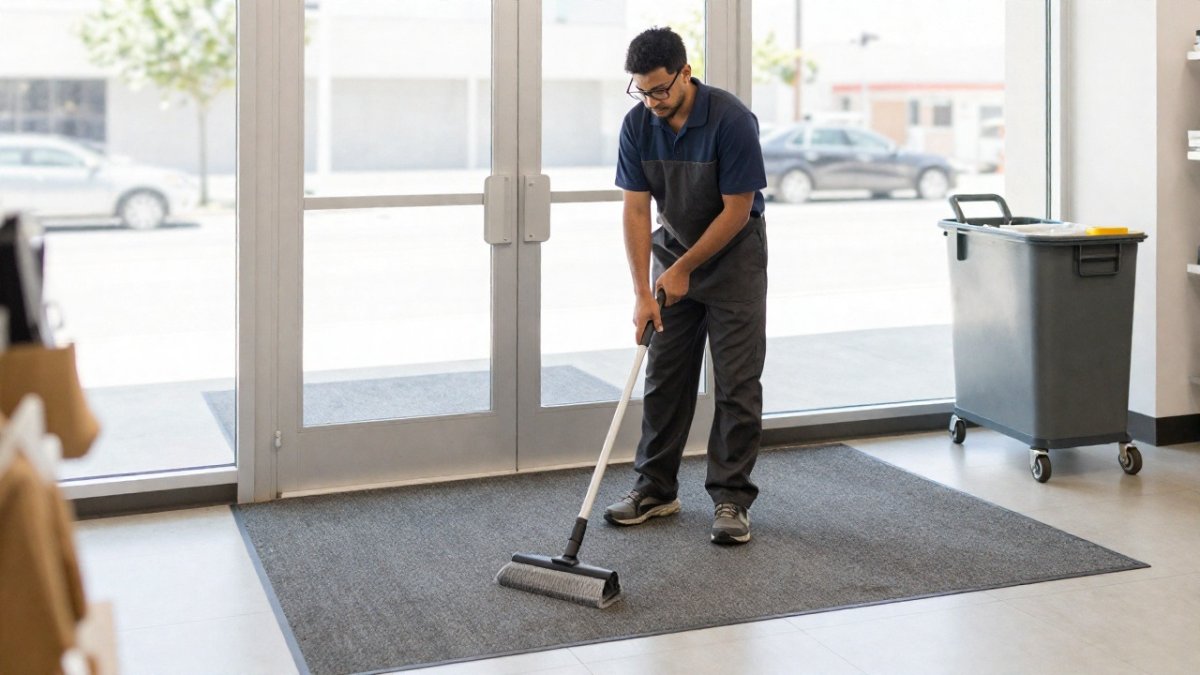
Start dry. Vacuum both sides of the mat with slow, overlapping passes.
A common mistake is rushing this step. Loose grit that stays in the pile turns into mud the moment water hits it.
Lift the mat and vacuum the floor underneath too. Sand collects there and works back up into the fibers.
Step 2: Treat Stains and Spot Clean
Treat spots before the full wash. Test any cleaner on a hidden corner first.
Apply your cleaner, let it sit a few minutes, then blot with a clean cloth. Work from the outside of the stain toward the center so it doesn’t spread.
Step 3: Wash, Rinse, and Dry
Wash with a brush and your soap solution, working in sections. Rinse thoroughly with clean water.
Rinse water should run clear when you’re done. Soap left in the fibers attracts new dirt quickly.
Dry the mat flat, raised slightly off the floor, with a fan moving air across it. Never put a damp mat back at the door.
Commercial Mat Stain Removal for Common Storefront Messes
Different messes need different treatments. Using the wrong product can set a stain permanently, and a set stain becomes a permanent complaint at the door.
| Stain Type | First Treatment | Why It Works | Avoid |
|---|---|---|---|
| Chewing gum | Freeze with an ice cube in a plastic bag for 3-5 minutes, then lift with a putty knife | Cold makes the gum brittle so it releases from the fiber instead of smearing | Hot water or a heat gun, which melts gum into the pile |
| Coffee or soda | Blot with cool water and a drop of mild dish soap, working from the outside in | Cool water keeps the sugar and tannins from setting; blotting lifts rather than drives | Rubbing, which spreads the stain and abrades the face yarn |
| Grease or oil | Apply a citrus or solvent degreaser, let dwell 5 minutes, agitate with a stiff nylon brush, then rinse | Degreasers break the bond between oil and fiber; agitation lifts it into the rinse | Water alone, which floats oil around the mat |
| Salt and slush | Rinse with warm water, extract with a wet/dry vacuum, then dry flat with air moving across it | Warm water dissolves the salt crystals; extraction pulls the brine out of the backing | Leaving it damp, which pushes salt into the backing and speeds corrosion |
| Ink | Dab rubbing alcohol onto a clean white cloth, then blot the stain | Alcohol dissolves the ink carrier so it transfers to the cloth | Pouring alcohol directly on the mat, which spreads the ink |
| Blood | Use cold water and an enzyme cleaner, blot only | Cold keeps the protein from coagulating; enzymes digest it | Hot water, which sets the protein into the fiber |
| Wax or candle drips | Harden with ice, chip off the bulk, then place a paper towel over the residue and press with a warm (not hot) iron | The paper wicks the softened wax out of the pile | Scraping with a sharp blade, which cuts face yarn |
Two rules apply to every row. First, test any product on a hidden corner of the mat and wait 10 minutes before you commit. Second, blot liquids, don’t scrub them, scrubbing pushes the stain deeper into the pile and fuzzes the face yarn, and a fuzzed mat traps less grit going forward.
Watch out: mixing bleach with an ammonia-based cleaner, or with any acid-based descaler, releases a toxic gas. Never combine cleaning chemicals in the same bucket, and rinse and dump between products.
For scuff marks that end up on the hard floor around the mat, a targeted method matters. Our guide on how to remove scuff marks from commercial vinyl flooring covers the right approach for hard surfaces.
Log Every Stain So It Becomes a Preventive Record
A simple mat-condition record can help you log each stain: date, location, stain type, product used, dwell time, and result. After 30 to 60 days, the log shows you which entrance is generating the most stains, which product actually worked, and whether the same tenant or delivery route is the source. That record is also the evidence you need when a mat fails early and you want the vendor or the manufacturer to stand behind it.
Building an Entrance Mat Cleaning Schedule
A written entrance mat cleaning schedule beats cleaning by memory every time. It keeps the work consistent no matter who’s on shift.
Here’s a rhythm that works for most high-traffic stores:
- Daily: Vacuum the entry mat and shake out loose debris.
- Weekly: Spot clean stains and check for curled edges.
- Monthly: Full wash, rinse, and dry.
- Seasonally: Deep clean and inspect backing for wear.
Adjust for weather. Rainy and snowy weeks mean more frequent vacuuming and faster replacement of soaked mats.
If you want to build a plan around your store’s specific traffic and layout, our guide on customized cleaning plans for retail spaces walks through how to set one up.
Commercial Floor Mat Replacement Signs to Watch For
Some mats can’t be saved. Knowing when to replace one saves you money on cleaning products that won’t fix the problem, and it prevents the slip claim that a failed mat invites.
- Backing that’s cracked, brittle, or peeling. A cracked rubber backing no longer grips the floor, so the mat slides underfoot and stops sealing out water.
- Fibers that stay flat after a full wash and dry. Once the pile is matted, the mat has lost the loft that traps grit; cleaning won’t restore it.
- Edges that curl and won’t lie flat. A curled edge is a trip hazard, and it also channels dirt under the mat instead of onto it.
- A mat that stays damp for more than a day after cleaning. That points to a saturated backing or a failed drainage layer, and damp backing grows mildew that customers smell at the door.
A mat with a failing backing no longer traps dirt. It becomes a trip hazard and a tracking problem at once, and both show up as complaints and, in the worst case, as a slip-and-fall claim.
Put Replacement on an Inspection Cadence, Not a Gut Feeling
The gap most competitors miss is that replacement decisions should be scheduled, not reactive.
Watch out: replacing a mat without fixing the reason it failed wastes the new mat. If the backing cracked because the mat was rolled up damp, or the pile matted because the mat was over-wet during cleaning, the replacement will fail the same way.
Replace worn mats before they cost you a slip claim or a scuffed floor.
Common Mistakes That Shorten Mat Life
Most mat damage comes from a handful of avoidable habits. Fix these and your mats will last through more cleaning cycles.
The biggest one is over-wetting. More water does not mean cleaner. It means longer drying times and mildew risk.
Other frequent errors:
- Using bleach or harsh chemicals that break down rubber backing
- Skipping the rinse and leaving soap residue behind
- Drying in direct sun, which fades and stiffens fibers
- Rolling up a damp mat and storing it
- Beating a mat against a wall instead of vacuuming it
Damaging cleaning practices aren’t limited to mats. Our industrial floor maintenance and degreasing guide covers how to avoid the same mistakes on the floors around them.
Set Up a Mat Cleaning Program with Guso Janitorial Services
Consistent mat care is hard to keep up when your team is busy running the store. That’s where a scheduled program pays off.
Guso Janitorial Services builds tailored cleaning programs for businesses across Metro Atlanta.
Our teams are available 24 hours a day, seven days a week. We’re fully licensed, bonded, and insured, and we use clean and green products.
If you’re handing off deep cleaning, it helps to know what to expect. Our guide on how to prepare your office for professional deep cleaning covers the prep steps.
For deeper mat and carpet care between visits, our commercial carpet cleaning maintenance tips are worth a read.
Frequently Asked Questions
How often should retail entrance mats be deep cleaned?
High-traffic storefronts should deep clean entrance mats every two to four weeks, with daily vacuuming in between. Stores near parking lots, construction, or in wet seasons may need weekly deep cleans. Rotate mats so wear is even, and inspect them each week for embedded grit. A written entrance mat cleaning schedule keeps the job from slipping when staff get busy, and it makes vendor accountability easier.
Can you pressure wash commercial entrance mats?
Pressure washing works for rubber-backed mats and some outdoor grades, but it can damage adhesive, backing, and printed logos if the pressure is too high. Keep the nozzle at a wide angle, use low to moderate pressure, and dry the mat completely before placing it back. For interior retail mats, vacuuming plus spot treatment is safer. Check the manufacturer’s care label before pressure washing any mat.
When should a retail entrance mat be replaced instead of cleaned?
Replace a mat when the backing is cracked, edges are curled, fibers are matted flat, or stains return within days of cleaning. These commercial floor mat replacement signs mean the mat can no longer trap dirt effectively. A worn mat lets grit reach your floors, which raises floor care costs. Most high-traffic retail mats last one to three years depending on traffic and cleaning frequency.
How do you dry entrance mats quickly and safely?
Lift the mat and stand it on edge or hang it in a ventilated area. Use fans or a wet-dry vacuum to pull out moisture, and avoid direct high heat that can warp rubber backing. Never place a damp mat back on the floor, since trapped moisture causes mold and slips. In humid weather, allow at least several hours of air drying before the store opens.
Your entrance mat is the first thing customers touch and the last thing most teams think about. A simple schedule, the right products, and a crew that shows up on time keep it working. Guso Janitorial Services offers tailored retail cleaning programs, 24/7 availability, and clean and green products that protect both your mats and your floors. Call today to set up a program that keeps your entrance clean and your customers safe.

Leave a Reply