
Table of Contents
- Why Professional Construction Cleaners Matter After Renovation
- Time Savings and Project Deadline Management
- Cost-Effectiveness and Budget Control
- Health, Safety, and Indoor Air Quality
- Rough Cleaning vs. Final Cleaning: Understanding the Phases
- How to Remove Drywall Dust After Renovation
- Construction Cleanup Checklist for Quality Assurance
- Protecting Your Property and Assets During Cleanup
- Frequently Asked Questions
Last Updated: October 9, 2026
Why Professional Construction Cleaners Matter After Renovation
When a construction project wraps up, your space isn’t ready for occupancy. The benefits of hiring professional construction cleaners go far beyond aesthetics.
This is where professional construction cleaners make the difference. At Guso Janitorial Services, we understand that post-construction cleanup isn’t just another cleaning job, it’s a critical phase that determines whether your facility is truly ready for employees, customers, or tenants.
The gap between “looks clean” and “actually clean” is enormous after construction. Professional construction cleaners have the equipment, training, and expertise to catch what standard cleaning crews miss entirely.
Time Savings and Project Deadline Management
Professional construction cleaners compress what might take weeks into days.
A typical post-construction cleanup involves multiple phases: rough cleaning to remove bulk debris, intermediate cleaning as trades finish their work, and final cleaning before occupancy. Each phase has specific requirements.
Without professional help, you’re asking your facilities team or general staff to handle work they’re not trained for, using equipment they don’t own, on a timeline that conflicts with everything else they’re doing.
Professional construction cleaners also work outside standard business hours. Early morning or evening crews mean your project timeline stays on track without disrupting ongoing operations or other trades still on site.
Cost-Effectiveness and Budget Control
The real cost of DIY or in-house post-construction cleanup isn’t just labor, it’s opportunity cost, equipment rental, waste disposal, and the risk of damage that creates expensive repairs.
Your facilities staff can’t be trained overnight on construction cleanup hazards. Equipment like HEPA-filter vacuums, pressure washers rated for fine dust, and industrial dumpsters require investment and knowledge.
Professional construction cleaners bring their own equipment and handle waste disposal correctly. You pay for the service, not for equipment you’ll rarely use again.
Additionally, professional cleaners work faster because they specialize in this work. Speed means your space is ready sooner, which means you can start generating revenue sooner. For commercial properties, that difference translates directly to dollars.
Health, Safety, and Indoor Air Quality
Construction generates fine dust and airborne particles that settle into HVAC systems, on surfaces, and in the air your occupants breathe.
Professional construction cleaners use HEPA-filter equipment designed to capture fine dust without recirculating it. They also know how to clean HVAC systems and ductwork safely, which is critical for indoor air quality after construction.
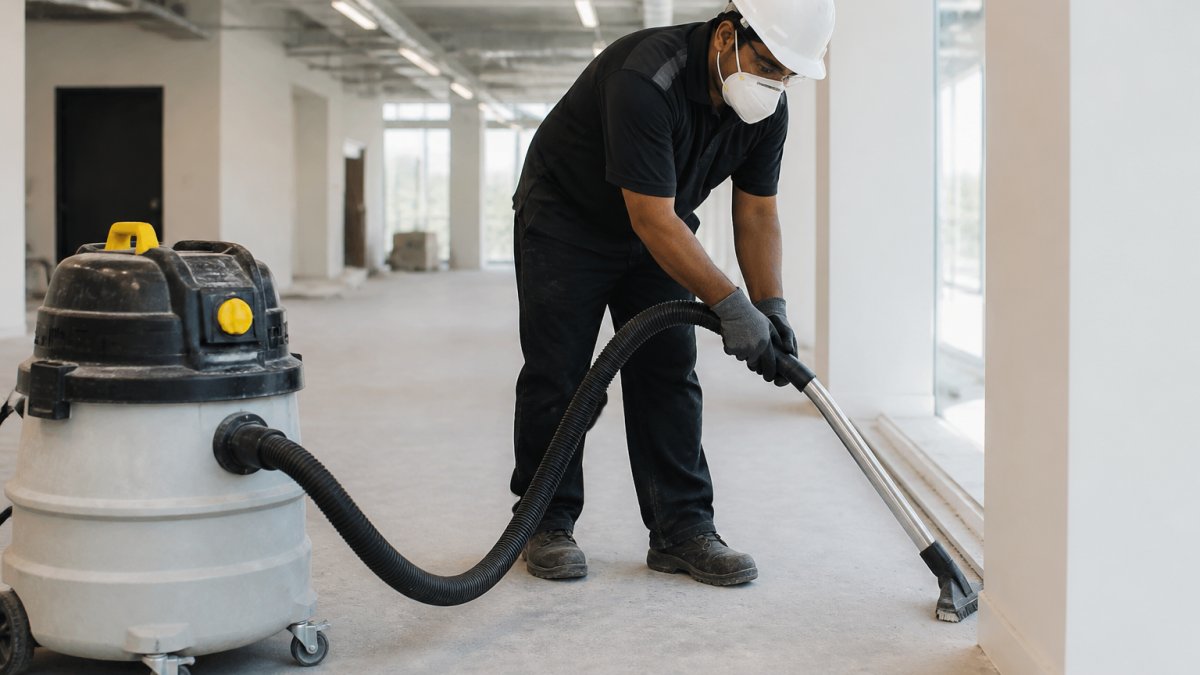
Untrained crews often use standard vacuums that actually spread fine dust through the air, making the problem worse. Professional teams follow protocols that protect occupant health from day one.
Rough Cleaning vs. Final Cleaning: Understanding the Phases
Post-construction cleanup isn’t one job, it’s multiple phases, each with different goals and requirements.
Rough cleaning happens as construction winds down. Crews remove bulk debris, sweep large areas, and clean up obvious mess.
Final cleaning is the detailed phase. Every surface is cleaned, windows are polished, floors are treated, and the space is inspected for completeness.
Professional construction cleaners manage both phases strategically. They schedule rough cleaning to avoid interfering with ongoing trades, then perform final cleaning only when all construction is complete.
Many property owners underestimate the time final cleaning requires. A typical commercial space might need 40-80 hours of final cleaning depending on square footage and construction scope.
How to Remove Drywall Dust After Renovation
Drywall dust is the most stubborn challenge after renovation. Knowing how to remove drywall dust after renovation properly prevents it from becoming a persistent air quality problem.
Standard vacuuming spreads drywall dust rather than capturing it. The solution requires HEPA-filter vacuums that trap particles instead of recirculating them.
Drywall dust also requires wet-cleaning methods. Damp cloths and mops capture dust without creating airborne particles. Dry dusting alone leaves residue. Professional teams use both methods, HEPA vacuuming followed by damp-wiping, to ensure complete removal.
HVAC systems need special attention because drywall dust clogs filters and circulates through ductwork. Professional cleaners replace HVAC filters and sometimes clean ducts directly to restore air quality.
Construction Cleanup Checklist for Quality Assurance
A construction cleanup checklist is only useful if it does two things: it organizes work by room and surface, and it defines what “done” looks like so a contractor, owner, or property manager can sign off without argument. Most generic lists stop at “dust everything”, which is exactly why punch-list disputes happen at handover.
A working checklist has three layers: scope (what gets cleaned), acceptance criteria (how clean is clean), and verification (who confirms it and how). Build all three before the first crew arrives.
Room-by-room scope and acceptance criteria
Use a matrix like the one below. Acceptance criteria should be observable, not subjective, “no visible dust on a white-glove wipe” beats “clean.”
| Area | Scope | Acceptance criteria |
|---|---|---|
| Entry / lobby | Floors, glass, door frames, hardware, light fixtures, ceiling vents | No film on glass; no dust on frames or hardware; vents free of visible debris |
| Open office | Floors, baseboards, cubicle surfaces, chair rails, outlets, switch plates | White-glove wipe on baseboards and outlets shows no residue; no dust rings under furniture |
| Restrooms | Fixtures, grout, mirrors, partitions, exhaust grilles, floors | No grout haze; no water spots on fixtures; grilles free of drywall dust |
| Breakroom / kitchen | Counters, cabinet exteriors, appliance exteriors, sink, floor | No adhesive residue; no construction dust inside cabinet doors; sink drains clear |
| Corridors / stairs | Floors, handrails, wall scuffs, corner guards, exit signage | No scuff transfer on handrails; no dust in stair nosings |
| Mechanical / electrical rooms | Floors, panels exteriors, equipment exteriors, filters | Panels wiped, not sprayed; filters replaced; no debris within 3 ft of equipment |
| Exterior entries / loading | Concrete, thresholds, glass, signage | No mortar or grout residue; no tracked dust inside threshold |
Verification and sign-off
A checklist without a verification step is just a to-do list. The standard pattern is a two-pass walkthrough:
- Crew self-check, the lead cleaner walks the space with the checklist and flags anything that fails acceptance criteria before the client sees it.
- Client or GC walkthrough, the general contractor, owner’s rep, or facility manager walks the same list, marks pass/fail per line, and either signs off or issues a punch list.
Document each pass with dated photos of the same angles (before, after, and any punch items). This protects both sides: the cleaner can prove scope was met, and the owner has a record if a defect appears later.
Define acceptance criteria in the contract, not at the walkthrough. If “clean” is ambiguous, the punch list becomes a negotiation instead of a checklist.
Common punch-list items to pre-empt
Most failed walkthroughs come back to the same handful of items. Pre-clean these before the client sees them:
- Drywall dust inside electrical outlets and switch plates (power off, then wipe or vacuum)
- Adhesive residue on glass from protective film
- Grout haze on tile that only shows under raking light
- Dust on top of door frames, above cabinets, and on ceiling fan blades
- Paint overspray on hardware, hinges, and floor edges
- Sticker residue on fixtures and appliances
- Debris inside HVAC return grilles and floor registers
A written checklist also protects you commercially. It defines what “clean” means for the specific project, reduces misunderstandings, and provides documentation that the work was completed as agreed, which matters if a dispute arises weeks after handover.
Protecting Your Property and Assets During Cleanup
Construction cleanup can damage finished surfaces if done carelessly, and it can also injure the people doing the work. The two risks are linked: the same fine dust, chemical residue, and sharp debris that threaten your building also threaten the crew. Professional construction cleaners manage both at once, using material-specific methods and trade-specific safety practices that untrained crews rarely know.
Material-specific cleaning methods
Not every surface tolerates the same approach. A few common pairings:
- Hardwood and engineered wood, damp-mop with a pH-neutral cleaner; never soak, never use abrasive pads. Excess water warps seams and lifts finish.
- Natural stone (marble, travertine, limestone), avoid acidic cleaners, which etch the surface. Use stone-safe neutral cleaners and dry microfiber.
- Grout and tile, grout haze removal requires a mild acid or specialty haze remover, but it must be tested in an inconspicuous area first and never left to dwell on adjacent stone or metal.
- Glass and mirrors, remove protective film adhesive with a plastic scraper and a solvent approved for the coating; razor blades scratch low-E and tinted glass.
- Painted walls and trim, dry dust first, then damp-wipe with a mild detergent. Abrasive pads burnish the sheen and leave visible patches.
- Stainless steel and brushed metal, wipe with the grain; abrasive pads leave permanent scratch patterns.
- Electronics, panels, and fixtures, wipe exteriors only; never spray directly into panels, outlets, or equipment enclosures.
Trade-specific hazards crews must plan around
Post-construction sites carry hazards that a standard janitorial crew isn’t trained to handle. A professional crew plans for them before the first pass:
- Silica and fine dust, concrete, drywall, and masonry cutting generate respirable crystalline silica. Crews use HEPA-filtered vacuums, NIOSH-approved respirators when dust is heavy, and wet methods to suppress airborne particles. Standard shop vacuums recirculate the dust they pick up.
- Sharp debris, screws, staples, cut metal, broken tile, and glass shards hide under paper and drywall scraps. Cut-resistant gloves and a debris-first pass before any wiping prevent hand injuries.
- Chemical residues, adhesives, sealants, paint thinners, and curing compounds can burn skin, irritate airways, or stain surfaces. Crews check safety data sheets, ventilate the space, and use the right gloves for the chemical, not just any glove.
- Electrical and live systems, outlets, panels, and fixtures may be energized during cleanup. Crews keep liquids away from energized equipment and coordinate lockout/tagout with the GC when panels must be opened.
- Working around active trades, cleaners and finishing trades often share a site. Crews sequence their work around painting, flooring, and punch-list trades to avoid rework and to keep from disturbing wet finishes.
- Fall and trip hazards, extension cords, hoses, and uneven subfloors are common. Crews keep walk paths clear and use ladders per manufacturer limits.
Never assume a site is safe because construction “looks finished.” Confirm with the GC which systems are live, which areas are clear, and which trades are still working before crews enter.
Protecting the asset and the crew at the same time
Professional crews use drop cloths, corner guards, and protective coverings on finished floors and fixtures before cleaning begins, not after damage appears. They mask or remove hardware that could be scratched, and they work top-down so dust doesn’t resettle on already-cleaned surfaces.
They also carry liability insurance and workers’ compensation coverage. If damage occurs despite careful work, insurance covers repairs; if a crew member is injured, the owner isn’t exposed to a workers’ comp claim. That combination, material-specific methods, trade-specific safety, and proper coverage, is what separates a professional construction cleaning scope from a standard janitorial contract.
Frequently Asked Questions
What does post-construction cleaning include?
Post-construction cleaning covers rough cleaning (removing large debris, dust, and construction waste) and final cleaning (detailed surface work, window washing, fixture polishing). Professional construction cleaners remove drywall dust, sawdust, concrete particles, and other fine debris from floors, walls, ceilings, and hard-to-reach areas. They also clean windows, sanitize surfaces, and dispose of waste properly. The scope depends on your project phase and specific needs.
Why should you hire professional construction cleaners instead of doing it yourself?
Professional construction cleaners have specialized equipment, trained staff, and expertise to remove fine dust and construction debris safely and thoroughly. DIY cleanup exposes you to health hazards, takes significantly longer, and often misses allergens and particles that affect indoor air quality. Professionals follow safety protocols, protect your fixtures and floors, and complete the job faster, allowing you to occupy or sell your space sooner without risking occupant health or property damage.
How long does professional post-construction cleaning take?
Timeline depends on project size, scope, and cleanup phase. Rough cleaning typically takes one to three days for standard renovations. Final cleaning may take an additional one to two days. A professional cleaning company can assess your square footage and construction debris volume to provide an accurate schedule. Hiring professionals ensures the work is completed on time, meeting your project deadlines without delays.
Is professional post-construction cleaning worth the cost?
Yes. Professional construction cleanup saves money by reducing labor costs, preventing property damage that could cost thousands to repair, and minimizing health risks that lead to lost productivity. The cost-effectiveness comes from speed (faster move-in or sale), thoroughness (avoiding costly rework), and safety (reducing liability). When you factor in time savings, specialized equipment, and the value of a properly cleaned space, professional services deliver significant return on investment.