

Table of Contents
- What Does Bonded and Insured Mean?
- Why You Need to Verify a Bonded Cleaning Company
- Step 1: Request a Certificate of Insurance
- Step 2: Check the State License Database
- Step 3: Review Background Checks and Professional References
- Janitorial Services Vetting Checklist
- Red Flags to Watch During Verification
- Frequently Asked Questions
Last Updated: September 25, 2026
What Does Bonded and Insured Mean?
To verify bonded cleaning, understand that bonded means a cleaning company has purchased a surety bond. This is a three-way contract between the company, a bonding agency, and you. If the company damages your property or steals from you, the bond covers the cost. Insured means the company carries liability coverage. This protects you if an employee gets injured on your property or causes damage during work.
Ask your vendor for their bonding amount before hiring.
A bonded and insured cleaning company signals legitimacy. It shows they’ve passed a background check to get bonded and they’re willing to back their work with real financial protection. This is worth verifying before you sign a contract.
Why You Need to Verify a Bonded Cleaning Company
Hiring a bonded cleaning company protects your business since employees will have access to offices, equipment, and sensitive areas. Verification gives you peace of mind.
Don’t take a company’s word for bonding, verify bonded cleaning credentials directly. Verification takes 15 minutes and can save you thousands.
Without verification, if an employee steals equipment, the company may disappear or deny responsibility, leaving you unprotected. Proper verification ensures you know who to contact and what’s covered.
Verification reveals red flags: invalid licenses, failed background checks, or inactive insurance. These checks separate professional providers from unreliable operations.
Step 1: Request a Certificate of Insurance
Start by asking for proof directly. Email the cleaning company and request their certificate of insurance. Most professional companies have this ready to send in minutes.
Use a Verification Email Template
Don’t wing it. Use this template to ensure you ask for the right information:
Subject: Certificate of Insurance and Bonding Verification Request
Dear [Company Name],
Before we proceed with your cleaning services, I need to verify your insurance and bonding credentials. Please provide the following within 2 business days:
-
A current Certificate of Liability Insurance (COI) showing:
- Your company name and address
- Policy effective and expiration dates
- Insurance carrier name and policy number
- Coverage limits for general liability
- Coverage limits for property damage
- Coverage limits for bodily injury
- Your name listed as the certificate holder
-
Proof of bonding, including:
- Bonding company name and contact information
- Bond amount and type (e.g., performance bond, fidelity bond)
- Bond expiration date
- Your company name as the principal
-
Confirmation that all employees have passed background checks before assignment to my facility.
Please send these documents as PDF attachments. If you have any questions, let me know.
Thank you,
[Your Name]
What a Legitimate Certificate of Liability Insurance Looks Like
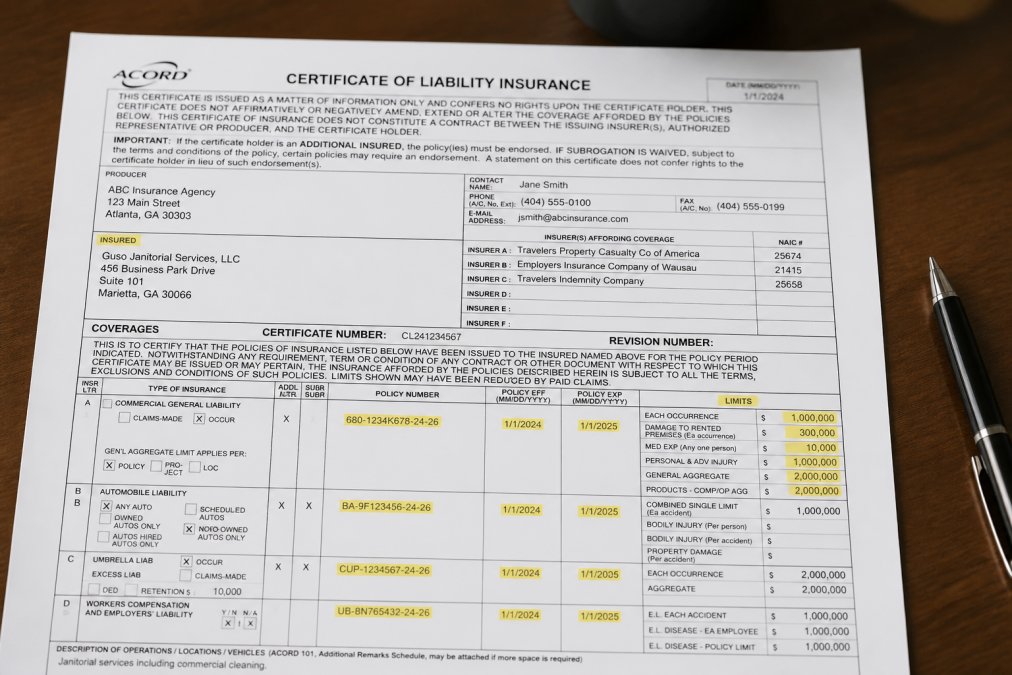
When you receive the certificate, you’re looking at a standardized ACORD form (ACORD 25-S or similar). Here’s what to verify:
Header section: The certificate should state “Certificate of Liability Insurance” at the top with the insurance broker’s name in the upper left, not the cleaning company’s letterhead.
Insured section: The cleaning company’s legal business name, address, and phone number must match exactly what they provided. If names differ, ask for clarification.
Insurance carrier information: Verify the insurance company name is real and licensed by checking the National Association of Insurance Commissioners (NAIC) website.
Policy numbers and dates: Each coverage line should have a unique policy number with a current or future expiration date. Expired policies mean no active coverage.
Coverage limits: If limits are unusually low, ask why.
Certificate holder: This should list your company name or “Additional Insured.” If blank or listing only the cleaning company, the certificate may not protect you.
Signature and date: The certificate should be signed by an authorized representative of the insurance agency and dated recently (within the last 30 days is typical).
Red Flags in Insurance Documents
Fraud and misrepresentation happen. Watch for these warning signs:
Blurry or low-resolution images: Pixelated PDFs or phone photos suggest alteration or forgery. Legitimate certificates are crisp and professional.
Handwritten information: Handwritten policy numbers, dates, or names suggest post-issuance modification.
Mismatched company names: This is a major red flag suggesting fraudulent use of another company’s insurance.
Missing or blank fields: All required fields should be filled. Blank spaces are suspicious.
Unusual formatting or fonts: Non-standard layouts or inconsistent fonts suggest the form isn’t authentic.
No insurance carrier contact information: If the carrier name is vague or unlisted, that’s a problem.
Expiration date in the past: An expired policy means zero coverage.
Verify the Certificate Directly
Call the insurance company to verify the policy is active, coverage limits match the certificate, your company is listed as additional insured, and there are no lapses. This 10-minute step eliminates the possibility of a forged certificate.
Never hire a cleaning company without a current, verified certificate of insurance. The risk of property damage, theft, or injury claims is too high. If a company can’t or won’t provide this proof, move to another vendor immediately.
Step 2: Check the State License Database
Cleaning company regulation varies by state. Some require licenses and bonding; others have minimal oversight. Understanding your state’s requirements is critical.
How State Regulation Works
States regulate cleaning companies through different agencies and with different standards:
Strict regulation states (California, Florida, Texas) require registration and often mandate bonding and background checks. Moderate regulation states require business registration and bonding for certain cleaning types. Minimal regulation states have no specific licensing requirement for cleaning companies.
Finding Your State’s Regulatory Agency
The correct agency varies by state. Here’s how to locate it:
Start with the Secretary of State website. Search for the company name and verify it’s registered and active, check the legal structure, registered agent, and filing date.
Check your state’s Department of Labor or Occupational Licensing board for a searchable database of licensed cleaning companies.
Look for state-specific bonding requirements by searching your state’s labor board website for “cleaning company bonding” or “janitorial service bond.”
Contact your state’s Attorney General’s Consumer Protection Division if unsure which agency regulates cleaning companies.
State-by-State Verification Nuances
California: Register with Secretary of State; cities may require bonding. Florida: Register with Department of State; $10,000 bond required for biohazard cleanup. Texas: Register with Secretary of State; check municipal requirements. New York: Register with Division of Corporations; bonding recommended. Illinois: Register with Secretary of State; check city requirements. Pennsylvania: Register with Department of State; bonding recommended. Ohio: Register with Secretary of State; bonding may be required for schools/government. Massachusetts: Register with Secretary of Commonwealth; bonding often required by clients.
What to Look for in the Database
Once you’ve found the correct database, search for the cleaning company by name.
Active status: The business should be “Active” or “In Good Standing.” “Inactive,” “Suspended,” or “Dissolved” means the company is not legally operating.
What to Do If Your State Has No Licensing Requirement
If your state doesn’t regulate cleaning companies: (1) Verify business registration through the Secretary of State, (2) Ask for their EIN or Federal Tax ID, (3) Confirm they have a physical address (not just a P.O. box), (4) Rely more heavily on insurance verification, background checks, and references.
State regulation of cleaning companies is inconsistent. Don’t assume your state requires licensing or bonding. Research your specific state’s requirements, then verify the company meets those standards. This step prevents you from hiring an unlicensed or non-compliant vendor.
Step 3: Review Background Checks and Professional References
Ask if all employees pass background checks before working, how often checks are updated, and what their hiring process is. They don’t need to share individual details, but should confirm checks were done.
Background checks and references show whether a cleaning company actually delivers on its promises. A company confident in its staff will happily provide both.
Janitorial Services Vetting Checklist
Use this checklist when evaluating any cleaning company. Print it or save it as a reference.
- Request and review current certificate of insurance
- Verify insurance expiration date is current
- Confirm coverage limits are adequate
- Check state license database for active license
- Confirm license is not expired or suspended
- Ask about background check process for employees
- Request professional references from existing clients
- Call at least three references and ask about reliability
- Ask about their bonding agency and bond amount
- Request proof of bonding from the bonding agency
- Review any complaints or violations on file
- Confirm service agreement includes liability and damage terms
- Ask about their process for handling damage claims
- Verify the company is registered as a business entity
- Check online reviews on independent platforms
Red Flags to Watch During Verification
Certain signs suggest a cleaning company isn’t trustworthy. Stop the hiring process if you see these warnings.
Frequently Asked Questions
What is the difference between bonded and insured cleaning services?
Bonding and insurance serve different purposes. A surety bond protects your business from employee theft or damage caused by negligence, with claims paid by the bonding agency if the cleaning company fails to cover it. Insurance covers liability for property damage or injuries that occur during service. A reputable cleaning company should carry both to provide complete customer protection and demonstrate business legitimacy.
How can I verify a cleaning company’s bond status?
Request a certificate of insurance directly from the cleaning company, which should list their bonding agency and bond amount. Contact the bonding agency to confirm the bond is active and current. You can also check your state’s regulatory board or contractor license database for verification. Ask for the policy expiration date and confirm it covers the scope of work you need performed.
What should I ask for when requesting a certificate of insurance from a janitorial service?
Request a certificate of insurance that lists your business as an additional insured party. The certificate should show general liability coverage and bonding details. Ask for the policy limits, coverage types, and expiration dates. Request that they provide updated certificates before policies expire to ensure continuous coverage during your service agreement.
What red flags suggest a cleaning company is not properly bonded or insured?
Watch for companies that refuse to provide documentation, offer vague answers about their credentials, or claim bonding is unnecessary. Be cautious if they cannot verify their surety bond through a bonding agency or if their license lookup shows no active contractor license. Companies unwilling to list you as additional insured or hesitant about background checks may lack due diligence standards that protect your business.