
Table of Contents
- Daily vs Weekly Office Cleaning Schedule: A Side-by-Side Comparison
- What Belongs on an Office Cleaning Checklist for Small Business
- The Benefits of Daily Office Cleaning for Productivity and Health
- How to Implement ISSA Standards in Small Offices
- How to Adjust Your Office Cleaning Schedule for Hybrid Work
- DIY vs Outsourced Cleaning: Calculating the Real ROI
- Green Cleaning Standards and Your Office Cleaning Schedule
- Conclusion
- Frequently Asked Questions
Last Updated: September 27, 2026
Daily vs Weekly Office Cleaning Schedule: A Side-by-Side Comparison
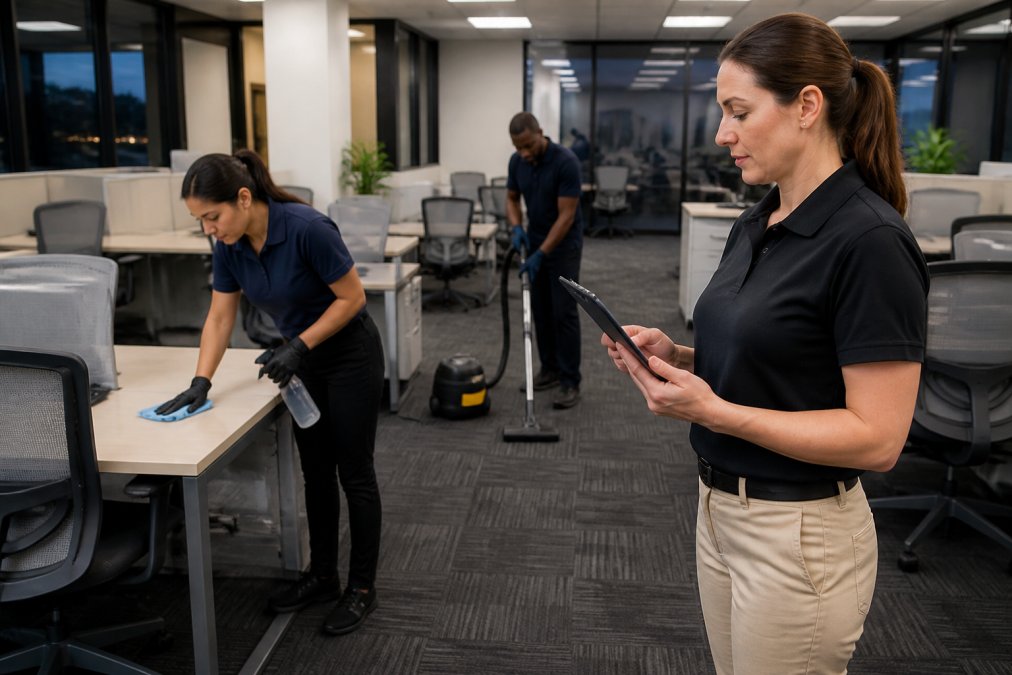
An office cleaning schedule is the written plan that assigns specific cleaning tasks to daily, weekly, and monthly timeframes based on how often each area gets used. Daily cleaning protects the surfaces everyone touches, while weekly cleaning handles the spaces that accumulate grime slowly. Choosing between a daily vs weekly office cleaning schedule for small businesses is not an either-or decision.
Here is how the two schedules divide the work:
| Task | Daily | Weekly | Why It Matters |
|---|---|---|---|
| Surface wiping (desks, counters) | Yes | Spot-check | High-touch surfaces collect germs fast |
| Vacuuming (traffic lanes) | Yes | Deep pass | Daily keeps dust and debris down |
| Restroom detailing | Yes | Full sanitization | Restrooms drive client perception |
| Trash removal | Yes | Bin washing | Prevents odors and pests |
| Dusting (shelves, vents) | No | Yes | Dust builds slowly, not hourly |
| Floor care (buffing, waxing) | No | Scheduled | Protects long-term floor maintenance |
A daily schedule without a weekly layer leaves dust, vents, and floor finish neglected. A weekly schedule without daily coverage lets high-touch surfaces and restrooms slip within days.
What Belongs on an Office Cleaning Checklist for Small Business
The core of any office cleaning checklist for small business is a clear split between daily, weekly, and monthly tasks so nothing gets skipped and nothing gets overdone. A checklist also gives you a way to hold a crew accountable, whether that crew is in-house or outsourced.
A working checklist for a small office typically covers:
- Daily: surface wiping, high-touch surfaces (door handles, light switches, shared keyboards), trash removal, restroom wipe-down, spot vacuuming
- Weekly: full vacuuming, dusting, restroom detailing, floor care touch-ups, waste management review
- Monthly: deep cleaning of vents and baseboards, carpet extraction, window washing, preventative maintenance checks
Build your checklist around high-touch surfaces first, not around rooms. A small office with four restrooms and one break room has a different risk profile than one with a single restroom, and the checklist should reflect that.
The Benefits of Daily Office Cleaning for Productivity and Health
Daily cleaning does more for a small office than most owners expect. The benefits of daily office cleaning show up in two places: fewer sick days and a workspace that signals competence to every client who walks in.
Skipping restroom detailing even one day is the single fastest way to lose the impression you are trying to build. It is the first thing clients and staff judge, and it is hard to recover from.
How to Implement ISSA Standards in Small Offices
- Map your spaces by traffic level. High-traffic areas (lobbies, shared restrooms, break rooms, main corridors) versus low-traffic areas (storage rooms, individual offices, conference rooms used once a week). This mapping drives everything else.
- Assign daily tasks to high-touch surfaces and restrooms. Door handles, light switches, shared keyboards, faucets, and dispenser levers are the surfaces that move germs between people. These get daily attention regardless of office size.
- Assign weekly tasks to dusting, floor care, and deep cleaning. Dust and floor finish accumulate on a slower clock than germs, so weekly is usually sufficient in a small office.
- Write a measurable standard for each task. “Clean” is not a standard. “Free of visible soil, no streaks, no standing moisture” is. For disinfection, the standard includes the product’s required dwell time, the surface has to stay wet for the labeled contact time, which is often several minutes, not a quick wipe-and-go (the EPA).
- Review the plan quarterly against actual occupancy. Hybrid schedules and seasonal headcount swings change which areas are high-traffic. A plan that was right in January may be wrong by April.
Ask any prospective cleaning vendor to show you how they document task standards and how they verify them. A crew that can describe its inspection process is usually a crew that follows it.
One more point on scope: ISSA-style standards cover both cleaning (removing soil) and disinfection (killing pathogens on a pre-cleaned surface). These are different tasks with different products and different dwell times. A schedule that treats them as the same step will under-perform on both, and a small office with a single restroom and a shared break room is exactly where that gap shows up fastest.
How to Adjust Your Office Cleaning Schedule for Hybrid Work
Hybrid work changed the math on office cleaning frequency. Fewer people in the building on any given day does not mean less cleaning. It means the cleaning has to follow the people.
For hybrid offices, we recommend:
- Base daily coverage on peak occupancy days, not average headcount
- Move weekly deep cleaning to the quietest day so it does not disrupt work
- Increase restroom and break room attention on high-occupancy days
- Keep a lighter daily pass on low-occupancy days for trash and high-touch surfaces
DIY vs Outsourced Cleaning: Calculating the Real ROI
Deciding between DIY and outsourced cleaning comes down to the true cost of each, not the hourly rate. DIY looks cheaper until you count labor, supplies, equipment, and the management time it eats. This section gives you a framework for actually calculating them.
Step 1: Calculate your true DIY labor cost
Start with the loaded hourly cost of the person doing the cleaning, not just their wage, but payroll taxes, benefits, and any overhead you carry. Then multiply by the hours per week spent cleaning. A common pattern in small offices is that cleaning gets absorbed into an existing role (office manager, admin, or a rotating staff duty), which means the hours are real but invisible on any budget line.
Step 2: Add supplies, equipment, and storage
Supplies and equipment are easy to underestimate because they are bought in small increments. Track them for one month and annualize. Include:
- Consumables (paper products, liners, chemicals, microfiber)
- Equipment replacement and repair (vacuums, mops, buckets, carts)
- Storage space for supplies and equipment, which in a small office is often a closet that could be used for something else
Step 3: Price the management time
This is the category most owners miss. Someone has to schedule the cleaning, train the person doing it, check the quality, and handle the day the cleaner calls out sick. Add those hours to the loaded labor cost from Step 1. In a small business, that someone is usually the owner or a senior manager, which makes the hourly cost higher than the cleaning labor itself.
Step 4: Price the turnover risk
When the person doing the cleaning leaves, the task does not disappear, it lands on someone else until a replacement is found and trained. Turnover cost includes recruiting time, training time, and the quality dip in between. A professional cleaning contract removes this risk entirely because the vendor absorbs turnover.
Step 5: Compare the totals
Add Steps 1 through 4 to get your true annual DIY cost. Then compare it to a professional cleaning contract quote. For many small businesses, the DIY number is higher than expected once management time and turnover risk are included. Outsourcing also removes the reliability risk: a professional crew shows up on schedule, and a licensed, bonded, and insured provider covers damage and no-shows.
Track how many hours per week your team actually spends on cleaning for one month. Most small offices underestimate this by a wide margin, and the real number usually settles the DIY vs outsourced question on its own.
The hybrid-work wrinkle
If your office operates on a hybrid schedule, the DIY calculation gets harder because the cleaning load swings with occupancy. A staff member who cleans on Tuesday and Thursday may not be in the office on the days the mess actually accumulates. A professional service can flex its schedule to your occupancy pattern, which is difficult to replicate with in-house staff whose primary job is something else.
Green Cleaning Standards and Your Office Cleaning Schedule
Green cleaning is not a separate schedule. It is a set of product and process choices layered onto the schedule you already have. The EPA Safer Choice program for cleaning products identifies products that meet the agency’s safety and environmental criteria, which gives buyers a verifiable standard instead of a marketing claim.
Two things matter when you go green:
- Product choice: look for third-party certification rather than a label that says “eco-friendly”
- Process: green products still need correct dwell time on surfaces to work, so the schedule must allow for it
Conclusion
The real challenge with a daily vs weekly office cleaning schedule for small businesses is not picking one, it is building a plan that matches your traffic, your hybrid patterns, and your budget without gaps. Most small offices need daily coverage on high-touch surfaces and restrooms, plus a weekly layer for dusting, floor care, and deep cleaning.
Frequently Asked Questions
What are the essential daily cleaning tasks for a small office?
Daily tasks include trash removal, surface wiping of desks and common areas, vacuuming high-traffic paths, restroom detailing, and disinfecting high-touch surfaces like door handles, light switches, and shared keyboards. These tasks prevent cross-contamination and keep the workplace presentable for clients. A written office cleaning checklist for small business helps staff or janitorial services stay consistent and accountable.
How does cleaning frequency impact employee productivity and health?
More frequent cleaning reduces airborne dust, allergens, and surface germs that contribute to illness and absenteeism. The benefits of daily office cleaning include fewer sick days, higher morale, and a workspace that impresses visiting clients. Weekly-only schedules can leave high-traffic areas visibly soiled between visits, which affects both employee comfort and professional appearance.
How do I determine if my office needs daily or weekly professional cleaning?
Count your occupancy, square footage, and daily foot traffic. Offices with more than 20 employees, customer-facing spaces, or shared kitchens typically need daily service. Smaller teams with hybrid schedules may manage with weekly deep cleaning plus employee-led daily tidying. A professional walkthrough can give you a data-driven recommendation based on your actual usage patterns.
What are the OSHA requirements for office sanitation?
OSHA requires employers to maintain a clean and sanitary workplace under the General Duty Clause. While no specific cleaning frequency is mandated, restrooms, drinking water areas, and food preparation surfaces must be kept sanitary. Following ISSA standards for commercial cleaning helps small offices meet these expectations and document their cleaning protocols for compliance.
Can a small business customize a cleaning schedule for mixed-use facilities?
Yes. Facilities that combine office space, retail areas, and light manufacturing can use zone-based scheduling. High-traffic retail zones get daily attention, office areas receive daily or alternate-day service, and industrial sections follow a specialized degreasing and floor care plan. A tailored program from a commercial cleaning provider can handle all zones under one contract.