
Table of Contents
- Coverall vs ServiceMaster: A Side-by-Side Comparison
- How the Franchise Models Work
- Coverall: Strengths and Weaknesses
- ServiceMaster: Strengths and Weaknesses
- The Commercial Cleaning Contract Checklist: What to Verify Before You Sign
- Benefits of Local vs Franchise Cleaning for Your Facility
- Office Cleaning Service Cost: What Drives the Price
- Conclusion
- Frequently Asked Questions
Last Updated: September 23, 2026
Coverall vs ServiceMaster: A Side-by-Side Comparison
Choosing between Coverall and ServiceMaster means choosing between two very different commercial cleaning models. Coverall is a franchise network built for local owner-operators. ServiceMaster is a national brand with a corporate structure and a broad service menu. Both handle office and facility cleaning, but the way they price, staff, and manage accounts differs in ways that affect your budget and your day-to-day experience.
This guide breaks down how each model works, where each one is strong, and what to verify before you sign a commercial cleaning contract.
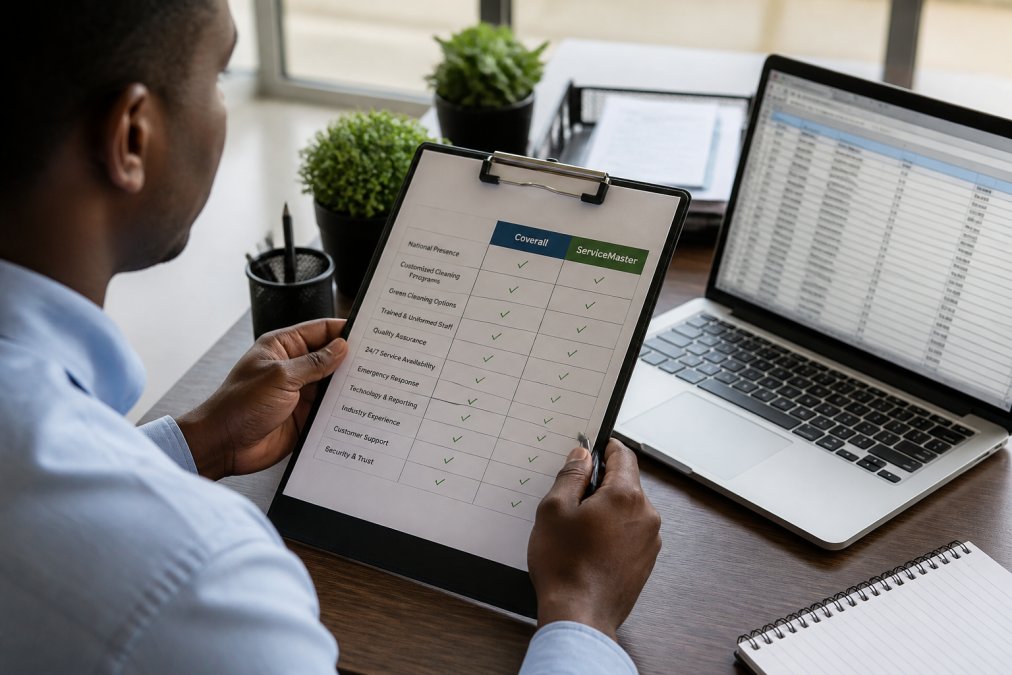
Comparison Matrix: Key Differences at a Glance
| Factor | Coverall | ServiceMaster |
|---|---|---|
| Ownership model | Franchise, local owner-operators | National brand, corporate and franchise mix |
| Service scope | Janitorial and commercial cleaning focus | Broader facility services |
| Pricing approach | Quote-based, varies by franchisee | Quote-based, varies by location |
| Contract terms | Often month-to-month or short-term | Typically longer agreements |
| Best for | Businesses wanting a local owner on site | Businesses wanting a national account |
How the Franchise Models Work
The core difference between these two companies comes down to who actually cleans your building, and how that entity is paid.
Coverall operates as a franchise system. Each location is owned and run by an independent operator who buys into the brand. That means you are hiring a local small-business owner, not a corporate crew. The franchisee typically pays the franchisor an initial franchise fee plus ongoing royalties calculated as a percentage of revenue, and often contributes to a national advertising fund.
Why the Structure Changes Your Contract
The ownership model shows up in three places that matter at signing:
- Who signs the agreement. With a franchise, your contract is usually with the local franchisee, a separate legal entity from the brand. If that operator sells, your account may be assigned to the buyer unless your contract restricts assignment.
- Who sets the price. Corporate branches price from a national rate card with local adjustments. Franchisees price independently, so the same scope can land at very different numbers.
- Who resolves a dispute. Corporate accounts escalate through a regional manager. Franchise disputes may route through the franchisor’s support team, which can mediate but is not your contracting party.
Ask whether your location will be serviced by a corporate-owned branch or a franchisee, and get the answer in writing. The two carry different escalation paths, different pricing authority, and different assignment risk if the account changes hands.
Coverall: Strengths and Weaknesses
Coverall’s biggest selling point is the local owner-operator structure. When the franchisee lives in your market, they tend to respond faster to problems and know the area.
What Coverall Does Well
- Local accountability. A franchise owner who depends on your account is motivated to keep it.
- Focus on janitorial work. Commercial cleaning is the core service, not a side offering.
- Flexible scheduling. Many franchisees work around your operating hours.
Where Coverall Falls Short
- Inconsistent quality across locations. Because each franchise is independently run, service varies from one operator to the next.
- Limited specialized capability. Industrial degreasing, floor stripping and waxing, and post-construction cleanup may not be available in every market.
- Turnover risk. If a franchisee sells or exits, your account can change hands with little notice.
Never sign a commercial cleaning contract based on the brand name alone. Ask to meet the actual crew or operator who will service your building. If the company cannot name that person before you sign, you have no way to judge quality until it is too late.
ServiceMaster: Strengths and Weaknesses
ServiceMaster brings scale and a recognizable name. For multi-site operations, that can simplify procurement.
What ServiceMaster Does Well
- National reach. One contract can cover multiple locations in different markets.
- Broad service menu. Beyond janitorial work, the brand offers restoration and specialty services.
- Established processes. Decades of operation mean documented procedures and training.
Where ServiceMaster Falls Short
- Less local control. Corporate processes can feel rigid when your facility has unusual needs.
- Longer contracts. Agreements often run longer than a small business may want to commit to.
- Pricing opacity. Costs are quoted per location, which makes comparison difficult.
The Commercial Cleaning Contract Checklist: What to Verify Before You Sign
A commercial cleaning contract checklist is the single best tool for avoiding a bad vendor relationship. Most disputes trace back to terms that were never written down.
- Scope of work, room by room, including high-touch surfaces and restrooms
- Cleaning frequency and exact service days
- Who supplies consumables like paper towels and soap
- Insurance and bonding certificates, with policy numbers
- Service level agreement with measurable quality standards
- Notice period and termination terms
- Procedure for missed visits or no-shows
- Disinfection protocols and product list
Ask for the certificate of insurance directly from the insurer, not a photocopy from the vendor. Anyone can print a logo on a PDF. A call to the insurance agent takes five minutes and confirms the policy is active.
Benefits of Local vs Franchise Cleaning for Your Facility
The benefits of local vs franchise cleaning come down to responsiveness and control. A local provider can adjust schedules, handle on-demand requests, and send the same crew each visit. A franchise or national brand offers scale and standardized processes but often less flexibility.
Office Cleaning Service Cost: What Drives the Price
Office cleaning service cost depends on square footage, cleaning frequency, and the type of space. A medical office with strict disinfection protocols costs more per square foot than a standard open-plan office. But the more useful question is how vendors build the number, because that is what lets you compare quotes apples to apples.
The Two Pricing Models You Will See
Commercial cleaning is quoted one of two ways, and mixing them up is the most common source of quote confusion:
- Per square foot, per visit. The vendor multiplies your cleanable square footage by a rate, then multiplies by visits per month. This model rewards larger, open floor plans and is easier to audit.
- Hourly, with an estimated labor budget. The vendor estimates hours per visit based on production rates (how many square feet a cleaner can cover per hour for a given task), then bills those hours at a loaded rate that includes labor, payroll taxes, insurance, supplies, supervision, and margin.
What Actually Moves the Number
- Square footage and layout. More rooms, corridors, and tight spaces take longer to clean than open floor plates of the same size.
- Frequency. Daily service costs more than three visits per week, but the per-visit rate often drops as frequency rises because travel and setup are amortized.
- Restroom count and fixture density. Restrooms are the most labor-intensive area per square foot and are frequently undercounted in bids.
- Specialty work. Floor stripping and waxing, carpet extraction, and industrial degreasing add labor, equipment, and drying time.
- Consumables. Paper towels, tissue, soap, and liners can be bundled into the contract or billed separately, a difference that can swing the effective rate materially.
- Access and hours. After-hours, weekend, and badge-restricted work may carry a premium.
- Disinfection protocols. Healthcare, childcare, and food-service facilities often require EPA-registered products and documented dwell times, which add labor minutes per touchpoint.
How to Compare Quotes Without Getting Burned
Because pricing is quoted per facility, the only reliable way to compare is to request written quotes with identical scope. Send every vendor the same square footage, the same task list, the same frequency, and the same consumable assumptions. Then normalize the numbers:
- Convert each quote to a cost per square foot per month so the units match.
- Separate base service from periodic work (floor care, carpet cleaning) and price the periodic work on an annualized basis.
- List what is excluded, many bids quietly omit restroom consumables, window cleaning, or floor care.
- Compare total annual cost, not the monthly rate.
The lowest quote is rarely the cheapest option. A bid that excludes floor care, consumables, or weekend coverage will cost more once those items are added back. Compare total annual cost, not monthly rate.
Conclusion
Comparing cleaning vendors is harder than it should be, because most quotes hide the details that matter. Whether you lean toward a franchise network or a local provider, the deciding factors are the same: who shows up, what they actually do, and what happens when something goes wrong.
Frequently Asked Questions
How do national cleaning franchises compare to local janitorial services?
National franchises like Coverall and ServiceMaster offer standardized processes and brand recognition, but local providers often deliver more flexibility and direct accountability. Local companies can customize cleaning plans for your specific facility, respond faster to issues, and typically provide consistent crews. Franchises may rely on franchisees with varying quality levels. For businesses needing tailored programs, local providers often prove more reliable and cost-effective.
What should you look for in a commercial cleaning contract?
A strong contract should specify the scope of work, cleaning frequency, service level agreement (SLA), insurance and bonding details, termination clauses, and pricing structure. Look for clarity on how disputes are resolved and what happens if a crew misses a scheduled visit.
Are national cleaning brands better than local providers?
Not necessarily. National brands provide consistency and established training, but local providers often offer better responsiveness and tailored solutions. Local companies can adapt to your facility’s unique needs, such as specialized floor care or post-construction cleanup. They also tend to have lower overhead, which can mean more competitive pricing. The best choice depends on your priorities: standardized processes or personalized service.
How do you vet a commercial cleaning company for your office?
Start by verifying licensing, bonding, and insurance. Ask for references from similar facilities and check online reviews. Request a site assessment to see how they evaluate your space. Inquire about staff training, turnover rates, and cleaning protocols for high-touch surfaces. A reputable company will provide a detailed proposal with clear pricing and a service level agreement. Always get everything in writing before signing.