
Last Updated: November 4, 2026
Quick Summary
Office restrooms should be cleaned at least once per day, with supplies restocked and high-use spots wiped multiple times during busy hours. Deeper cleaning of grout, drains, and hard-to-reach fixtures is scheduled monthly or quarterly, depending on traffic, to support strong office restroom sanitation.
- Restock supplies and wipe high-use spots multiple times per day during busy hours.
- Complete a full clean of toilets, urinals, sinks, mirrors, floors and dispensers once per day.
- Detail baseboards, partition hardware and vent covers weekly.
- Scrub grout, descale fixtures and clear drains monthly or quarterly.
- Use an EPA-registered disinfectant and respect the label’s contact time.
Table of Contents
- OSHA Restroom Requirements Per Employee
- Setting an Office Restroom Cleaning Frequency
- Daily Office Bathroom Cleaning Checklist
- Stocking Commercial Restroom Cleaning Supplies
- Ventilation, Hand Hygiene and Managing Restroom Traffic
- Eco-Friendly Sanitation and Restroom Design Choices
- Booking a Restroom Sanitation Review for Your Kennesaw Office
- Frequently Asked Questions
Office restrooms take more traffic than most people realize, and they are one of the first places employees and visitors judge a building. Knowing how often they should be cleaned is the foundation of good office restroom sanitation. This guide walks through the rules, a realistic cleaning schedule, a daily checklist, and the supplies that keep restrooms safe and presentable in Metro Atlanta offices.
OSHA Restroom Requirements Per Employee
Office restroom sanitation is not only about appearance. A common approach is to check the current federal standard directly, since fixture ratios and sanitation duties are set out in OSHA sanitation standard for general industry, 29 CFR 1910.141.
The regulation breaks into a few practical buckets that a facility manager can audit against:
- Fixture ratios. OSHA sets a minimum number of toilets relative to headcount. The exact ratio table is in the standard, so check the current figures there rather than relying on a summary.
- Potable water and washing facilities. Each restroom must have hot and cold running water, soap, and a means of hand drying, and the sinks must be kept clean and operational.
- Cleanliness and order. The standard requires that facilities be kept clean and sanitary and free of hazards, which is the hook most janitorial programs are written around.
- Posting and access. Where required, a notice must be posted informing employees of the sanitation rules, and restrooms must be accessible during working hours.
Many facility managers find that headcount drives both the number of restrooms and how often they need attention. A restroom that meets the ratio on paper can still fail in practice if it runs out of paper, soap, or towels between visits. For this reason, treat the OSHA ratio as the minimum and plan your cleaning around actual use.
The Kennesaw and Cobb County Layer
Federal OSHA is the floor, not the ceiling. Offices in Kennesaw sit inside Cobb County, and Georgia employers also answer to the Georgia Department of Public Health and the Cobb County Board of Health for food-service and public-accommodation sanitation rules that can apply to shared restrooms in mixed-use buildings. If your Kennesaw office shares a restroom with a cafe, a childcare room, or a public lobby, the local health department’s inspection standards for those spaces can be stricter than the federal minimum.
- Confirm the number of toilets and sinks against your current headcount and the 1910.141 ratio table
- Keep hot or warm running water, soap, and hand-drying supplies stocked at all times
- Keep floors dry, ventilated, and free of trash or spills
- Post the required employee notice where the standard calls for it
Setting an Office Restroom Cleaning Frequency
Cleaning frequency should follow traffic, not the calendar alone. A restroom serving a 40-person office on one floor needs more attention than one used by a few people who rarely visit. The best office restroom cleaning frequency combines a daily service with periodic deeper work.
A practical starting point looks like this:
- Multiple times per day: Restock supplies and wipe high-use spots during busy hours
- Once per day: Full clean of toilets, urinals, sinks, mirrors, floors, and dispensers
- Weekly: Detail work such as baseboards, partition hardware, and vent covers
- Monthly or quarterly: Deep cleaning of grout, drains, and hard-to-reach fixtures
Adjust these numbers after you watch a few weeks of use. If a restroom looks worn by midday, the schedule is too light. If it stays spotless with fewer visits, you may be able to cut back.
Daily Office Bathroom Cleaning Checklist
A written checklist keeps the job consistent, no matter who is on shift. Most office restrooms need the same core tasks every day, performed in a set order from the cleanest area to the dirtiest so you do not spread germs back onto finished surfaces.
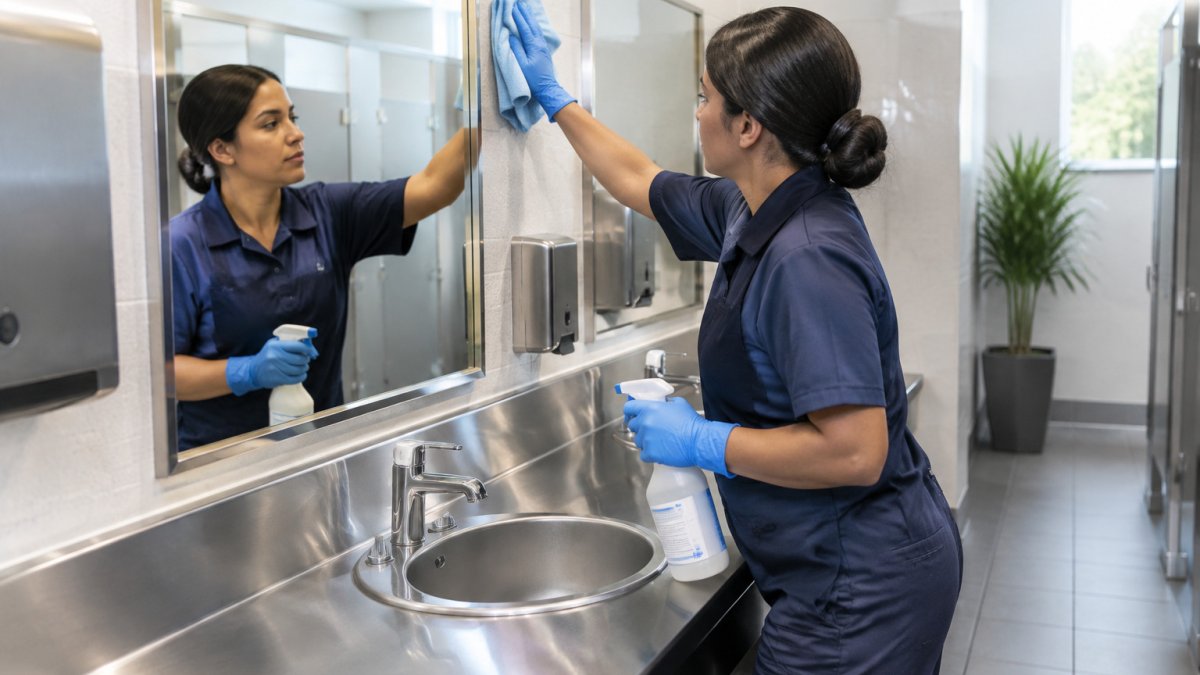
- Empty trash and sanitary bins, then replace liners
- Refill toilet paper, soap, paper towels, and sanitizer
- Clean and disinfect the toilet seat, bowl, and flush handle
- Clean urinals and their surrounds
- Scrub and disinfect sinks, faucets, and the countertop
- Wipe mirrors and stainless steel fixtures until streak-free
- Mop floors with a disinfectant suited to the surface
- Check for leaks, clogs, or damaged fixtures and report them
Keep a log of completed tasks. A signed sheet or simple digital check-off shows building managers that the work happened and makes gaps easy to spot.
Disinfection Mechanics That Make the Checklist Work
The checklist only works if the products and tools behind it are used correctly. A few mechanics separate a real disinfection pass from a wipe-down:
- Use a disinfectant registered with the EPA (the EPA). Look for an EPA registration number on the label, and check that the product carries a disinfectant claim rather than being only a cleaner.
- Respect the label contact time. Every registered disinfectant lists a dwell time, often one to ten minutes depending on the product and the organism. A surface wiped and dried in seconds may not stay wet long enough to be effective, so read the label and let the product sit.
- Color-code your cloths. A common pattern is red for toilets and urinals, yellow for sinks and counters, and blue for mirrors and glass. Separate cloths for toilets and everything else prevent cross-contamination between fixtures and hand-contact surfaces.
- Change mop water and solution on a schedule. Dirty solution redeposits soil, so change it between restrooms or when it turns visibly cloudy.
High-Touch Surfaces and Disinfection
Some surfaces are touched far more than others and need extra attention. Door handles, push plates, flush levers, faucet handles, soap dispenser nozzles, and light switches carry most of the germs in a restroom.
Work from the dry, clean surfaces toward the wet, dirty ones, and use separate cloths for toilets and for everything else. Check the disinfectant label for contact time, because a surface wiped and dried too quickly may not stay disinfected long enough to be effective.
Touchless Fixtures as a Preventative Measure
The most effective sanitation step happens before anyone cleans: reduce the number of surfaces hands touch. Touchless faucets, soap dispensers, paper-towel dispensers, and flush valves remove the handles and levers that the daily checklist otherwise has to disinfect.
Watch out: touchless fixtures still need the same daily wipe-down on the surrounding counter and wall, and a dead battery or a misaimed sensor can leave a sink unusable, so add a sensor and battery check to the weekly detail list. For more detail on sanitizing shared high-touch areas, see how to sanitize high-touch surfaces in shared spaces.
Deep Cleaning Versus Daily Maintenance
Daily maintenance keeps a restroom presentable. Deep cleaning restores it. Because deep cleaning needs to fit around daily upkeep and restroom use, scheduling office cleaning as a coordinated routine helps keep both levels of maintenance consistent.
Keep the two separate on your schedule. Trying to do deep work during a daily shift usually means the daily tasks get skipped. A common mistake is letting grout and drain buildup go for months, then paying for an emergency job.
The daily checklist works best when the disinfectant and cloth handling behind each task are right, as summarised below.
| Practice | Why it matters | Detail |
|---|---|---|
| EPA-registered disinfectant | Confirms a real disinfectant claim | Look for an EPA registration number on the label |
| Respect contact time | Surface must stay wet long enough | Read the label; let the product sit |
| Color-coded cloths | Prevents cross-contamination | Red for toilets, yellow for sinks, blue for mirrors |
| Change mop solution | Dirty water redeposits soil | Change between restrooms or when cloudy |
| High-touch surfaces | Carry most germs in a restroom | Wipe handles, levers and switches each shift in busy periods |
Stocking Commercial Restroom Cleaning Supplies
Running out of supplies is the most visible failure in any office restroom. Stock the basics in quantities matched to headcount and usage, and set reorder points so you never hit zero. You can browse a curated list of office cleaning supplies that make a healthier workspace.
- Commercial-grade toilet paper and paper towels in high-capacity dispensers
- Liquid hand soap in dispensers that are easy to refill
- An EPA-registered disinfectant for surfaces and fixtures
- Neutral or mild cleaner for daily wiping and mirrors
- Descaler or acid-free fixture cleaner for mineral buildup
- Microfiber cloths and mop heads, color-coded by area
- Gloves, a squeegee, and a sealed container for waste
Look at product labels for disinfectant claims, surface compatibility, and dilution rates. Using a disinfectant at the wrong strength wastes money and can leave residue. Many Metro Atlanta offices find that a bulk dispensing system reduces both cost and waste compared with buying single bottles.
Ventilation, Hand Hygiene and Managing Restroom Traffic
Clean restrooms still feel unpleasant if the air is stale. Make sure exhaust fans run during business hours and that filters are cleaned on schedule. For practical steps, see how to improve office indoor air quality. For guidance on indoor air, the EPA indoor air quality guidance offers practical steps for building managers.
Hand hygiene is the other half of the picture. Post clear handwashing reminders, keep soap and towels within easy reach, and make sure sinks drain quickly. Restroom traffic also matters.
Eco-Friendly Sanitation and Restroom Design Choices
Sanitation and sustainability can work together. Guso Janitorial Services uses clean and green products. Look for cleaners with third-party environmental certifications, use concentrated products diluted on site to cut packaging waste, and choose microfiber cloths that can be laundered and reused instead of disposable wipes.
Restroom design also affects how easy a space is to clean. Choose wall-mounted fixtures so floors can be cleaned underneath, pick non-porous, easy-wipe surfaces, and avoid tight corners that trap grime. Automatic faucets and dispensers can reduce touch points and water waste.
Booking a Restroom Sanitation Review for Your Kennesaw Office
If your restrooms are not holding up to the schedule above, a professional review can help. Guso Janitorial Services provides janitorial service for offices across Metro Atlanta, including Kennesaw, with tailored cleaning programs and clean and green products. To discuss your facility’s needs, visit book a restroom sanitation review on our website or call today for a quote.
Frequently Asked Questions
What are the OSHA requirements for restrooms in the workplace?
OSHA’s sanitation standard (29 CFR 1910.141) requires employers to provide toilet facilities in adequate number, kept clean and in sanitary condition, with hot and cold or warm running water, soap and hand-drying supplies or dryers. Facilities must be accessible, lit and ventilated. The standard sets minimum fixture counts based on the number of employees, so check the ratios for your headcount and keep records of your cleaning schedule. Consult OSHA directly or a qualified safety professional for your specific workplace.
How often should an office restroom be cleaned?
Most busy office restrooms need a full cleaning at least once per workday, with high-touch surfaces such as faucets, flush handles, door handles and dispensers wiped down several times during the day. Restrooms in high-traffic buildings may need a midday check. Deep cleaning of floors, grout, partitions and drains is usually scheduled weekly or monthly depending on use. Adjust frequency based on how many people use the restroom and how quickly it soils.
What supplies should be stocked in a workplace restroom?
Stock a reliable supply of soap, paper towels or hand dryers, and toilet paper, plus a waste receptacle for paper towels and sanitary products. Keep disinfectant wipes or spray, microfiber cloths, gloves and a disinfectant cleaner rated for the surfaces in your facility. Dispensers that hold enough product for a full day reduce the risk of empty supplies during peak use. Review inventory weekly so restocking never falls behind.
How can employers keep high-traffic office restrooms hygienic?
Schedule a midday restock and spot-clean, and post a simple checklist so staff know who is responsible for each task. Encourage hand hygiene with well-stocked soap and hand-drying options, and place signage that reminds users to wash their hands. Track problems reported by employees and adjust the cleaning schedule when a restroom consistently needs more attention. A janitorial provider such as Guso Janitorial Services can tailor a schedule to your traffic; contact us through our website for a quote.

Leave a Reply