
Last Updated: November 3, 2026
Quick Summary
Slip and fall prevention for cleaning crews means controlling the four hazards on every route: water, cords, clutter, and the surface itself. Run every wet task through the same six steps, from arrival and route walk to isolate, clean, dry, check traction, and reopen only after the floor passes a dry-to-the-touch test.
- Set wet-floor signs at every approach before the hazard exists, not after.
- Pull signs only when the floor passes a touch test, not when the client arrives.
- Run cords along walls, tape them at doorways, and coil hoses off walking paths.
- Choose rubber outsoles with deep tread, closed toes, and water-resistant uppers.
- Report every incident and near miss the same day and fix the cause, not just the spot.
Table of Contents
- Why Cleaning Crews Face the Highest Slip and Fall Risk
- Wet Floor Safety Procedures That Hold Up on a Busy Site
- Cleaning Equipment Cord Safety: Power Cords, Hoses, and Obstructions
- Slip-Resistant Shoes for Cleaning Staff: What to Look For
- A Janitorial Safety Checklist for Every Shift
- Chemical Dilution, Residue, and Floor Compatibility
- Incident Reporting and Near-Miss Follow-Up
- Building a Slip and Fall Prevention Program with Guso Janitorial Services in Kennesaw
- Frequently Asked Questions
Why Cleaning Crews Face the Highest Slip and Fall Risk
Slip and fall prevention for cleaning crews starts with one hard truth: the people who make floors safe are also the people most likely to go down on them.
At Guso Janitorial Services, we build our shifts around that reality. The hazards repeat from site to site.
Slip and fall prevention is the practice of removing or controlling the conditions that cause a person to lose footing or balance on a walking surface.
The four hazard zones on every route
Most falls happen in the same handful of spots. Walk your building and you will find them:
- Entrances and lobbies. Rain and foot traffic bring water in. Hard tile turns slick fast.
- Break rooms and restrooms. Spills, dropped food, and standing water near sinks.
- Stairways and handrail landings. Uneven steps, worn nosings, and poor lighting.
- Service corridors and storage areas. Mop buckets, hoses, and boxes left in the path.
Watch out: the highest-risk zone is the one your crew just cleaned. Freshly mopped tile near a main entrance can catch people who walk in without looking down.
Wet Floor Safety Procedures That Hold Up on a Busy Site
A wet-floor sign only works when it is placed before the hazard exists, not after. The best procedure is simple: set the sign, clean the area, then pull the sign only after the floor is dry to the touch.
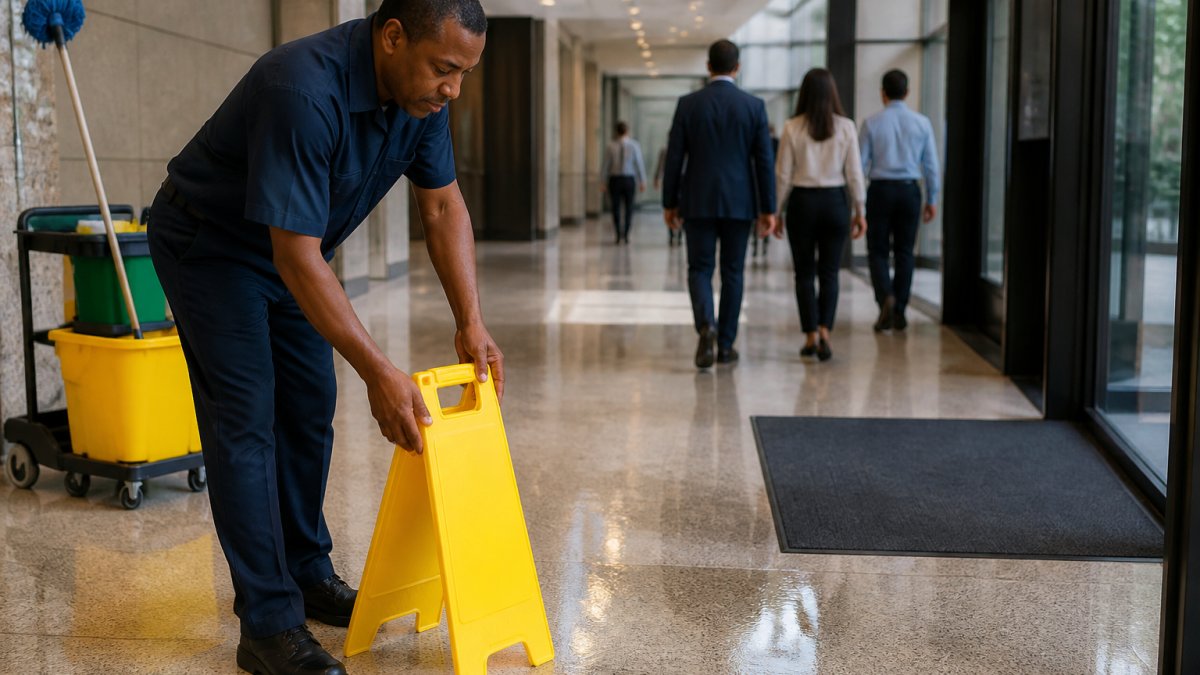
A clearly placed sign helps protect the freshly mopped lobby, while securing office paths also means keeping walkways clear and dry as cleaning moves through the building.
Where signs go and how many you need
One sign per approach is the working rule. A sign at the far end of a corridor does not warn someone walking in from the lobby, and a sign flat against a wall gets ignored.
On a busy site, the bigger question is routing. Before you wet a floor, identify the alternate path people will use and confirm it is clear, lit, and free of cords, carts, and buckets. If the only alternate route runs through a stairwell or a narrow service corridor, walk it first.
When a floor is actually dry
“Dry to the touch” is the removal standard, not “looks dry.” A damp floor can look dry and still slip, especially on sealed concrete, vinyl composition tile, and polished stone.
Drying time depends on the method and the building.
Watch out: pulling signs early to “look tidy” for a client walk-through is one of the most common causes of a crew-caused fall. The sign comes down when the floor passes the touch test, not when the client arrives.
Signage that people actually obey
Standard yellow A-frame signs are the baseline, but they fail in two predictable ways: they get knocked over, and regular building occupants learn to ignore them. Keep signs clean and upright, replace cracked or faded ones, and use cones or barrier tape in addition to signs where a route must be fully closed rather than merely cautioned. For more on what goes wrong when crews skip these steps, see what happens if janitorial staff ignore safety protocols.
Cleaning Equipment Cord Safety: Power Cords, Hoses, and Obstructions
Power cords and hoses cause more falls than most crews realize. A cord stretched across a walkway is a trip hazard, and a mop hose left coiled on tile is a slip hazard.
Run cords along walls, never across open floor. Tape them down at doorways. Coil hoses immediately after use and store them off the walking path.
Cord safety also means checking the equipment itself. When you are choosing machines, look for models with cord management built in.
Slip-Resistant Shoes for Cleaning Staff: What to Look For
The right shoe is the cheapest safety upgrade a cleaning operation can make. A good slip-resistant shoe grips wet tile, sheds water, and stays comfortable for a full shift.
Look for these features:
- Rubber or soft-rubber outsoles. They grip wet surfaces better than hard plastic.
- A defined tread pattern. Deep grooves channel water away from the sole.
- Closed toes and a secure fit. No clogs, no loose slip-ons.
- Water-resistant uppers. Wet socks lead to cold feet and rushed work.
Check the tread on a regular schedule. Worn soles lose grip long before they look worn out.
A Janitorial Safety Checklist for Every Shift
A janitorial safety checklist is a short, repeatable list a crew runs through at the start, middle, and end of every shift. The checklist is what turns good intentions into a habit, but a checklist alone does not prevent falls. What prevents falls is a workflow that runs from arrival through reopening, plus a way to measure whether the workflow is holding.
The arrival-to-reopening workflow
Run every wet task through the same six steps. The sequence matters more than the individual items.
- Arrival and route walk. Before any water hits the floor, walk the route and note wet spots, spills, clutter, burned-out lights, and damaged flooring. Mark anything you cannot fix immediately.
- Isolate the area. Set signs at every approach, confirm the alternate route is clear and lit, and close the area to foot traffic before you start.
- Clean. Match the product to the floor, mix to the label ratio, and keep mop water clean enough that it is not spreading residue.
- Dry. Use air movers, microfiber, or increased airflow to bring the surface to dry-to-the-touch, not just visually dry.
- Check traction. Test the surface before reopening. If it feels slick or the towel picks up moisture, keep the area closed and keep drying.
- Reopen and reset. Pull signs only after the traction check passes, store equipment off the walking path, and log anything that needs follow-up.
The shift checklist
Use this one alongside the workflow:
- Walk the route and note wet spots, spills, and clutter
- Confirm wet-floor signs are stocked and within reach
- Check cords and hoses for damage before use
- Clear walkways, stairways, and exits of carts and buckets
- Verify lighting works in stairwells and service corridors
- Report uneven surfaces, loose tiles, and worn handrails
- Pull all signs and store equipment at shift end
Keep the checklist short enough that crews actually fill it out. A long form gets skipped.
Measuring whether prevention is working
A checklist nobody reviews is paperwork. Track a handful of practical indicators so you can see whether the workflow is holding: inspection completion rate, time from hazard report to hazard response, training completion, and the count of slip-related incidents and near misses by zone and shift.
Watch out: if inspection completion is high but near-miss reports are zero, the likely problem is that crews are not reporting, not that the building is safe.
Every wet task runs through the same six-step sequence, from arrival to reopening.
| Step | What to do |
|---|---|
| Arrival and route walk | Note wet spots, spills, clutter, bad lights, damaged flooring |
| Isolate the area | Set signs at every approach and confirm alternate route |
| Clean | Match product to floor and mix to label ratio |
| Dry | Use air movers or microfiber to reach dry-to-the-touch |
| Check traction | Test surface; keep area closed if slick or damp |
| Reopen and reset | Pull signs after traction check, store equipment off path |
Chemical Dilution, Residue, and Floor Compatibility
Too much cleaner leaves a film, and a film is slick. Over-diluted chemicals are one of the most common causes of a floor that looks clean but feels greasy underfoot.
Mix chemicals to the label ratio, every time. Rinse mop water when it turns cloudy. For practical guidance on cleaning commercial vinyl without leaving residue, read how to remove scuff marks from commercial vinyl flooring.
Watch out: mixing two cleaners to “boost” results can create a slippery residue or a dangerous reaction. Use one product at a time.
Incident Reporting and Near-Miss Follow-Up
Every near miss is a free lesson. A crew member who almost slips on a wet patch has just told you where your next fall will happen.
Report every incident and near miss the same day. Note the location, the surface, the cause, and the time. Then fix the cause, not just the spot. If three near misses happen at the same entrance, the problem is the entrance, not the crew.
Review reports weekly. Look for patterns by zone and by shift. Prevention works when the fix reaches the source.
Building a Slip and Fall Prevention Program with Guso Janitorial Services in Kennesaw
A real program ties every piece together: hazard identification, signage, equipment checks, training, and follow-up. That is the difference between a crew that reacts to spills and one that prevents falls.
Guso Janitorial Services builds tailored cleaning programs for offices, industrial facilities, retail spaces, and post-construction sites across Metro Atlanta.
If you are formalizing a program, it helps to align with recognized green cleaning standards. And when you are ready to hire, our guide to what to look for in janitorial contracts shows how to lock safety requirements into the agreement.
Looking for a reliable crew near you? We are available 24 hours a day, 7 days a week, with programs built around your building’s specific needs. Call Today!
Frequently Asked Questions
What safety procedures should cleaning crews follow to prevent falls?
Start with a written procedure for every task that wets a floor. Place wet-floor signage before the mop touches the ground, not after. Keep cords and hoses coiled along walls instead of across walkways. Inspect stairways and entrances at the start of each shift for debris and uneven surfaces. Require slip-resistant shoes for cleaning staff and train new hires on the same steps. A short janitorial safety checklist completed every shift catches most hazards before they cause an injury.
How should cleaning crews manage wet floors in occupied buildings?
Work in sections and finish one area before starting the next so occupants always have a dry path. Place warning signs at both ends of the wet zone and remove them only after the floor is visibly dry, which can take longer than the mop pass. Schedule floor cleaning during low-traffic hours where possible. For buildings with steady foot traffic, use a wet-floor procedure that pairs signage with physical barriers at entrances and stairways.
What footwear helps reduce slip risks for janitorial workers?
Look for shoes with a rubber or nitrile outsole rated for wet and oily surfaces, a low heel, and deep tread that sheds water. Slip-resistant shoes for cleaning staff should fit snugly and stay tied, since loose laces catch on equipment. Replace them when the tread smooths out, which happens faster on crews working wet floors daily. Avoid soft-soled sneakers and any shoe with a smooth leather sole.
How should a cleaning crew respond to a slip-and-fall incident?
Stop work, check the person for injury, and call for medical help if needed. Do not move someone who reports back or head pain. Cordon the area so no one else falls, then document what happened: the surface condition, the time, the signage in place, and any witnesses. Report it to the facility manager the same day. Review near misses too, since a near miss on a wet entrance usually predicts a real fall within weeks.
Falls are the most preventable injury in a commercial building, and the fix starts with the crew on the floor. Guso Janitorial Services brings trained staff, clear procedures, and 24/7 availability to every account. Get started with Guso Janitorial Services and give your facility a cleaning program that keeps people on their feet. Call today.

Leave a Reply