

Quick Summary
A manufacturing floor safety checklist is a written inspection tool that covers spills, clear aisles, drainage, ladders and guarding on a fixed schedule. It turns everyday floor hazards into routine checks, so crews know what to look for and when. Most incidents trace back to liquid on the floor, material in walkways, and damaged flooring.
- Most floor incidents trace back to liquid on the surface, material in walkways, and damaged flooring.
- OSHA’s walking-working surfaces standard, 29 CFR 1910.22, requires floors kept clean, orderly and free of hazards.
- Set cleaning frequency by area, with high-soil zones like degreasing areas needing daily attention.
- Tie each inspection frequency to the hazard and give every failed item a named owner and due date.
- Verify every corrective action with a second person before closing the item.
Table of Contents
- Why a Manufacturing Floor Safety Checklist Matters
- OSHA 1910.22 Walking-Working Surfaces Requirements
- Industrial Facility Housekeeping Best Practices
- Hazard Communication, PPE, and Machine Guarding Checks
- Building an OSHA Manufacturing Self-Inspection Template
- Georgia Context and Documentation for Kennesaw Facilities
- Turning Audit Findings Into a Remediation Plan
- Frequently Asked Questions
Why a Manufacturing Floor Safety Checklist Matters
Last Updated: November 4, 2026
Floors are where manufacturing injuries start. A spill that sits for ten minutes, a cord across an aisle, or a worn tread on a platform can cause a serious fall long before any machine is involved. A written OSHA compliance checklist for manufacturing floor safety turns those everyday hazards into a routine inspection instead of a memory test. For the broader rules that apply to your facility, see industrial cleaning safety standards. The sites with the fewest slip incidents are almost always the ones that inspect and document their floors on a fixed schedule.
Most facilities already know the rules exist. The gap is usually execution: who checks what, how often, and what gets written down when a problem turns up. A checklist closes that gap. It gives the maintenance lead, the safety coordinator and the janitorial crew the same list of conditions to look for.
OSHA 1910.22 Walking-Working Surfaces Requirements
OSHA’s general walking-working surfaces standard, 29 CFR 1910.22, requires that floors be kept clean, orderly and in sanitary condition, and that surfaces be maintained so they are free of hazards such as sharp edges, loose boards or unstable materials. It also requires that spills be cleaned up promptly where they could cause a slip. Your checklist should translate those duties into specific items: floor condition, drainage, spill response and clear aisles.
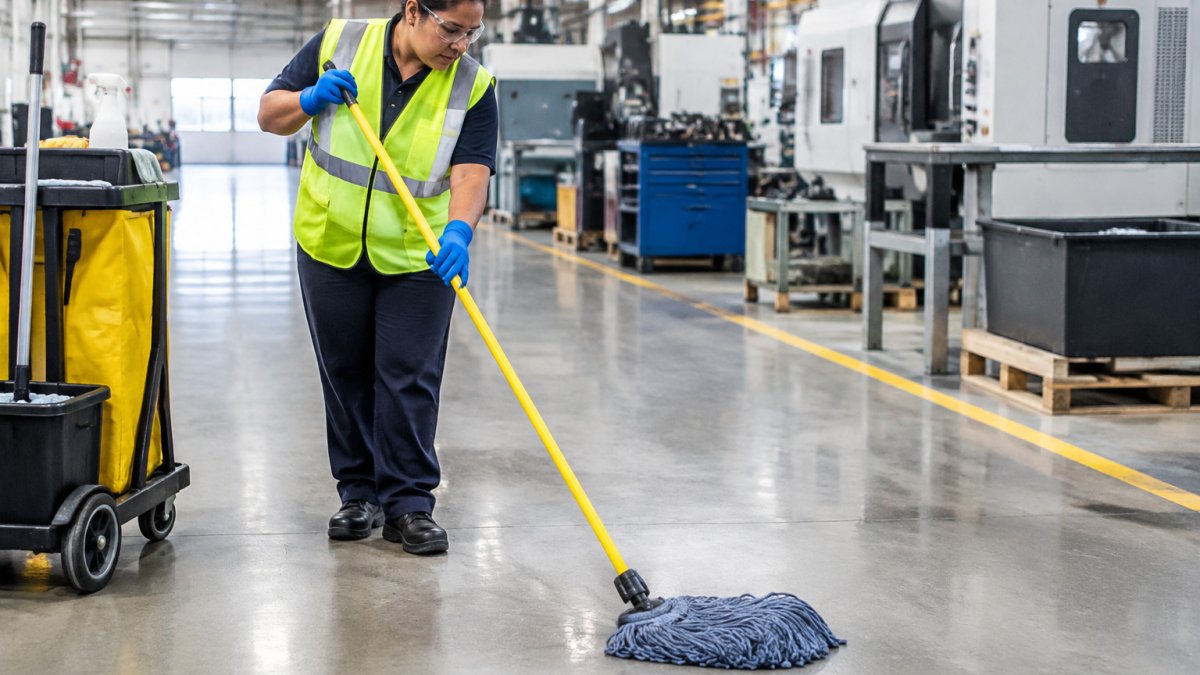
Slip, Trip, and Fall Prevention on the Floor
Most floor incidents trace back to three conditions: liquid on the surface, material in the walkway and uneven or damaged flooring. For practical guidance on slip and fall prevention for cleaning crews, see the safety guide. Build your inspection around them. Check that wet-process areas have adequate drainage and that spill kits are stocked and within reach. Confirm that aisles stay clear of pallets, hoses and cords. Walk the floor for cracks, raised seams and worn coatings, and log anything that needs repair.
A common mistake is treating slip hazards as a janitorial-only problem. When the crew is not told about a leak or an oil drip the moment it happens, the hazard can stay on the floor for hours. Make reporting part of the checklist, not an afterthought.
Fixed Ladders and Elevated Work Areas
Fixed ladders, mezzanines and catwalks fall under related requirements in 29 CFR 1910, and they belong on the same checklist. Verify that ladder rungs and side rails are intact, that cages or fall-protection systems are in place where required, and that guardrails and toeboards on elevated platforms are secure. Record the inspection date and the inspector’s initials for each item so the log can be produced if an OSHA inspector asks for it.
Industrial Facility Housekeeping Best Practices
Housekeeping is the cheapest safety control a manufacturing floor has. Good housekeeping means that tools return to their storage points, scrap is removed at the end of each shift, and floors are cleaned on a schedule matched to the process. Degreasing is a common example: oil and grease build up quickly around presses, conveyors and machining centers, and a neglected degreasing schedule is one of the most frequent causes of slips on these floors.
Set the cleaning frequency by area, not by the calendar. For a step-by-step process, see floor maintenance and degreasing. High-soil zones may need daily degreasing, while offices and storage areas can run on a weekly cycle. Keep a written record of what was cleaned, when, and by whom. For a how-to guide built for manufacturing sites, see commercial cleaning for manufacturing. That record doubles as evidence during an audit and as a way to spot recurring problem areas.
Hazard Communication, PPE, and Machine Guarding Checks
Your checklist should cover three areas beyond the walking surface. Under the Hazard Communication Standard, confirm that every hazardous chemical in the building has a current Safety Data Sheet that workers can access, and that containers are labeled correctly. For personal protective equipment, check that the required PPE is available at each task, in the right size, and in serviceable condition. For machine guarding, verify that guards are in place, interlocks function and lockout/tagout procedures are posted at each machine.
Cleaning crews are often among the first people to notice a missing guard or a damaged cord, so including them in these checks can help.
Building an OSHA Manufacturing Self-Inspection Template
A useful self-inspection template is simple enough to finish in under an hour per area, but specific enough that two different supervisors would flag the same conditions. Organize it by zone (receiving, machining, assembly, warehouse aisles, wet-process areas, mezzanines), and for each zone list the conditions to check, the pass/fail result, the inspector’s name, the date, and a corrective-action field. Keep it to one page per area so supervisors actually complete it instead of skimming it.
A practical template includes these columns:
| Check item | Frequency | Pass/Fail | Corrective action | Owner | Date closed |
|---|---|---|---|---|---|
| Floor dry, no active spills | Each shift | ||||
| Drainage clear in wet areas | Weekly | ||||
| Aisles free of obstructions | Each shift | ||||
| Ladders and platforms intact | Monthly | ||||
| Guards and interlocks functional | Weekly | ||||
| SDS available for chemicals in area | Monthly | ||||
| Eyewash station flushed and tagged | Weekly | ||||
| Exit signs and egress paths lit and clear | Monthly | ||||
| Extension cords not daisy-chained or damaged | Weekly | ||||
| Spill kit stocked and within reach | Monthly |
Two design choices separate a template that survives an inspection from one that gets abandoned by week three. First, tie each frequency to the hazard, not to convenience: shift-level checks belong on high-traffic aisles and wet-process zones, while monthly checks fit mezzanines and storage. Second, add a scoring rule so a single fail does not get buried. A common pattern is to mark any item that creates an immediate fall or electrical hazard as a stop-and-fix, require the supervisor to initial it before the shift ends, and route everything else to the corrective-action log with an owner and due date.
Moving the Checklist Off Paper
Most guides stop at the printable PDF. The higher-value move is to run the same checklist through a mobile or cloud-based safety management system so the data is timestamped, searchable, and tied to the corrective action. A practical setup uses a tablet or rugged phone at each zone, a short form with photo capture for failed items, and an automatic notification to the maintenance lead when a stop-and-fix item is logged. That turns a clipboard into an audit trail an inspector can review by date and area. Standardizing these digital workflows across the entire facility provides the foundational structure necessary to maintain a comprehensive OSHA site compliance guide.
Watch out: a digital checklist that mirrors a bad paper form just digitizes the gaps. Before rolling out an app, confirm the form maps to the actual 29 CFR 1910.22 conditions in each zone and that failed items trigger a named owner, not a generic inbox.
Review the completed forms at a regular safety meeting, and retain them so you can show a pattern of inspections over time. Under OSHA recordkeeping expectations, a consistent inspection cadence with dated entries is far more persuasive than a single thorough audit performed the week before a visit.
Georgia Context and Documentation for Kennesaw Facilities
Federal OSHA standards apply to private manufacturing facilities in Kennesaw, GA. Georgia’s state workplace safety program is administered by the Georgia Department of Labor, and it covers certain public-sector employers. Your checklist should reference the federal standards as the baseline and note any state-specific requirements your safety consultant identifies for your operation. Confirm current rules directly with OSHA at osha.gov and with the Georgia Department of Labor before relying on any single interpretation.
For facilities in Kennesaw and the surrounding Cobb County area, documentation matters as much as the physical conditions. Keep inspection logs, training records and corrective-action records together and easy to retrieve. When an inspector or insurer asks for proof of your program, a clear paper trail is what separates a routine visit from a costly citation.
Turning Audit Findings Into a Remediation Plan
An inspection is only useful if the findings lead to action, and the part most guides skip is the documentation that proves the action happened. Sort each finding into one of three categories: immediate hazard (stop work and fix now), repair needed (schedule within a defined window), or process change (update procedures or training). Assign an owner and a due date to every item, and track them until they are closed. If the backlog grows beyond your crew’s capacity, you can hire an industrial cleaning service.
A remediation workflow that holds up to an inspector’s review has four concrete steps:
- Log the finding the same shift. Record the zone, the check item, the date, the inspector, and a photo where the condition is visual. A finding that lives only in a supervisor’s memory is not a corrective action.
- Assign a named owner and a due date. “Maintenance” is not an owner; a specific lead with a specific date is. For immediate hazards, the due date is the same shift and the item stays open until a second person verifies the fix.
- Record the corrective action taken. Note what was actually done (guard reattached, aisle re-marked, drain cleared, procedure revised) and the date it was completed. This is the entry an inspector or insurer will ask to see.
- Verify closure. A second person initials the closed item after confirming the condition is corrected. Self-closure without verification is the most common weak point in a paper program.
Review open items at each safety meeting until they are resolved, and keep a running count of items past due. Facilities that close findings within a set timeframe tend to see fewer repeat issues on the next inspection, and the closure log becomes the evidence that the program is working rather than just documented.
Watch out: remediation lists that grow faster than crews can close them are a signal, not a paperwork problem. If housekeeping and degreasing backlogs are driving repeat slip findings, adding scheduled industrial cleaning capacity may be worth evaluating.
Frequently Asked Questions
What are the top OSHA violations in manufacturing?
Walking-working surfaces, hazard communication, machine guarding, electrical hazards, and respiratory protection appear among the most frequently cited OSHA standards in manufacturing. Slip and trip hazards from wet floors, oil, debris, and poor drainage are a common source of citations and injuries. Reviewing your facility against these categories before an inspection helps you target the areas most likely to be cited. Pair this review with documented housekeeping schedules so you can show routine correction, not just one-time cleanup.
How often should a manufacturing facility conduct an OSHA self-inspection?
OSHA does not set a single fixed frequency for self-inspections, but most safety programs schedule them at least monthly for production floors, with more frequent walkthroughs after process changes or incidents. Use a written checklist, record each finding, and track corrective actions to completion. Consistent, documented inspections demonstrate an active safety program and make it easier to identify recurring hazards such as wet floors or blocked egress.
What documentation is required for OSHA manufacturing compliance?
Key records typically include your hazard communication program and safety data sheets, injury and illness logs (OSHA Forms 300, 300A, and 301) where applicable, training records, inspection reports, and evidence of corrective actions. Keep safety data sheets accessible to employees on every shift. Retain logs according to OSHA recordkeeping rules, and confirm current requirements with OSHA directly, since specific obligations depend on your establishment size and industry.
How does industrial cleanliness impact OSHA compliance?
Housekeeping directly affects several OSHA requirements, including walking-working surfaces, fire prevention, and exit route access. Oil, grease, loose debris, and water on floors create slip and trip hazards, while stacked material can block aisles and emergency egress. A scheduled cleaning program with clear responsibilities, combined with regular inspections, helps keep surfaces safe and documented. Contact Guso Janitorial Services directly for a quote, since pricing depends on facility size, frequency, and scope.

Leave a Reply