
Last Updated: October 26, 2026
Quick Summary
Train staff sanitation protocols through structured onboarding, hands-on demonstration, documented standard operating procedures, and ongoing refresher training that teaches both what to do and why it matters. Effective training combines initial competency checks with weekly micro-topics, monthly skill drills, and quarterly comprehensive reviews to prevent drift and build a strong sanitation culture.
- Document standard operating procedures specific to your facility’s contamination risks, including cleaning frequency, agents, dilution ratios, and visual cues for each area.
- Conduct hands-on practice sessions where staff demonstrate tasks under supervision and sign off on each practiced procedure for accountability and audit evidence.
- Implement a spaced refresher calendar with weekly five-to-ten minute micro-topics, monthly skill drills, quarterly reviews, and annual recertification rather than one annual training session.
- Measure training success at four levels: reaction and relevance per session, learning via competency checks, behavior through supervisor observation, and results via audit and ATP pass rates.
- Address compliance barriers by communicating why sanitation matters, adjusting procedures that take too long, and recognizing staff who follow protocols correctly.
Table of Contents
- Why Industrial Sanitation Training Matters for Your Facility
- Building Your Sanitation Standard Operating Procedures
- Creating Your Sanitation Training Checklist
- Implementing Your Industrial Cleaning Checklist
- Establishing Sanitation Refresher Training
- Measuring Training Success and Compliance
- Overcoming Compliance Barriers and Building Safety Culture
- Getting Your Team Started with Professional Training Support
- Frequently Asked Questions
Why Industrial Sanitation Training Matters for Your Facility
Sanitation protocols in industrial facilities protect your workforce, ensure regulatory compliance, and prevent costly shutdowns.
The difference between strong sanitation cultures and weak ones is structured, ongoing training that teaches staff WHY protocols matter, not just WHAT to do.
Inadequate training creates real risks: improper chemical dilution damages equipment, poor hand hygiene spreads cross-contamination, and hazardous materials errors create liability.
Training isn’t a one-time event.
Building Your Sanitation Standard Operating Procedures
Your sanitation standard operating procedures (SSOP) are the foundation of all staff training. Learn how to develop comprehensive cleaning procedures specific to manufacturing environments.
Map your facility’s specific contamination risks, a production floor differs from a packaging area. Document what needs cleaning, how often, and why. Include:
- Surfaces and equipment that require cleaning
- Cleaning frequency for each area
- Specific cleaning agents and dilution ratios
- Drying and storage requirements
Your SSOP should cover the full cleaning cycle: pre-cleaning, wet sanitation, rinsing, drying, and inspection.
Make procedures visual and simple with photos, diagrams, and checklists. Complex written descriptions get ignored or misinterpreted.
Keep procedures in a centralized, accessible location and update them when processes change so new staff can reference the exact procedure for their role.
OSHA’s guidelines on workplace safety training emphasize that documented procedures reduce injuries and compliance violations.
Creating Your Sanitation Training Checklist
A structured checklist ensures every new hire and refresher helps you train staff sanitation protocols consistently across critical topics.
Essential Topics to Cover
Your training program must address these core areas:
Contamination Risk and Pathogen Control, Explain how pathogens spread, how contamination occurs, and what happens when sanitation fails, creating motivation beyond “follow the rules.”
Personal Protective Equipment (PPE) Protocols, Show which PPE each task requires and demonstrate donning and doffing.
Cleaning vs. Sanitizing, Cleaning removes visible soil; sanitizing reduces pathogens to safe levels.
Hazardous Materials Handling, Cover chemical safety, dilution, storage, and disposal.
Hand Hygiene Compliance, Cross-contamination starts here.
Visual Cues and Floor Markings, Explain what each color-coded zone, tape marking, or sign means and why it matters.
Hands-On Demonstration and Practice
Reading procedures and watching demonstrations aren’t enough, staff must practice tasks under supervision.
Schedule small-group hands-on sessions, starting simple and building to complex.
Correct mistakes immediately, show the right dilution before the error repeats, and have staff redo missed spots.
Make mistakes learning opportunities; staff who fear correction hide errors instead of asking for help.
Have staff sign off on each practiced task, this creates accountability and audit evidence.
Implementing Your Industrial Cleaning Checklist
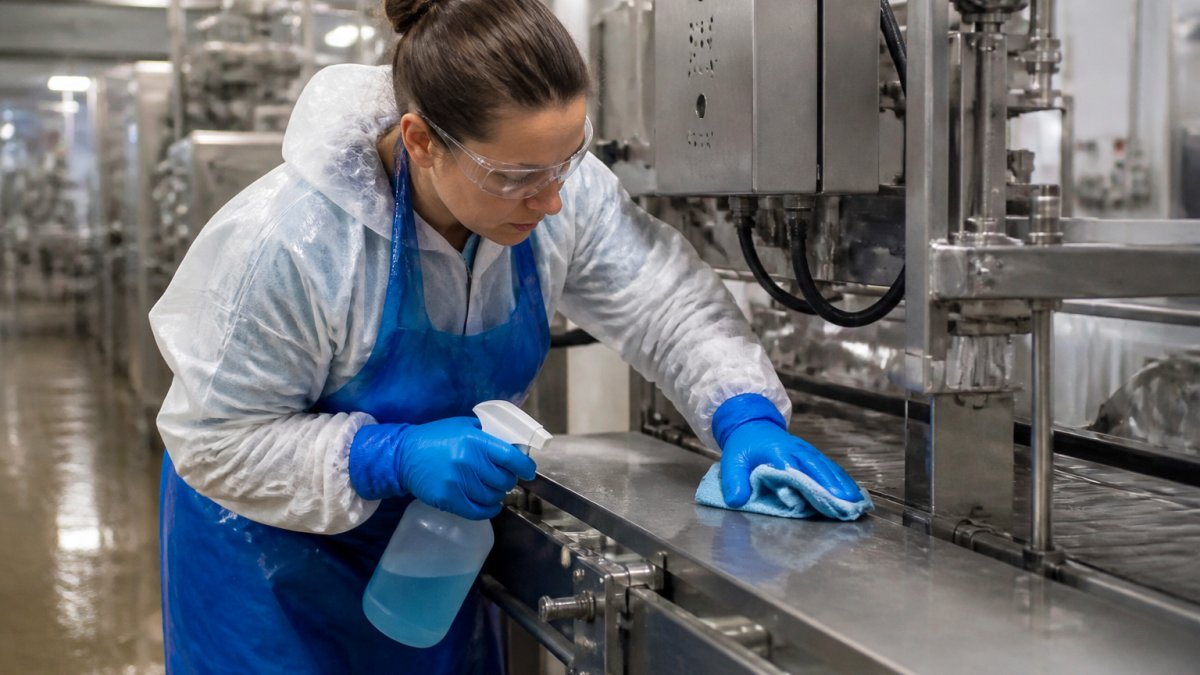
Make your checklist specific to your facility layout and equipment. Include:
- Specific surfaces and equipment requiring cleaning
- Cleaning frequency (daily, weekly, monthly)
- Required cleaning agents and dilution ratios
- Time required for each task
Use checkboxes, not narrative descriptions, so staff can work through it quickly.
Post checklists where staff can access them during shifts, digital or paper, whichever fits your operation.
Review completed checklists for patterns; areas consistently missed signal a training gap to address immediately.
Connect your checklist to workplace safety standards, which require documented cleaning procedures.
Establishing Sanitation Refresher Training
Initial training is the start, not the finish. Sanitation refresher training keeps protocols fresh and counters drift. Too often refreshers become a quarterly box-check, same slide deck, signed attendance sheet, no change on the floor. Treat refreshers as a maintenance schedule for skills, not a compliance ritual.
Build a Spaced Refresher Calendar
Break content into short, recurring touchpoints instead of one long annual session:
- Weekly micro-topic (5-10 minutes): one narrow behavior per week, delivered at shift huddle. Example: “This week we’re checking hand-wash timing before entering the production floor.”
- Monthly skill drill (20-30 minutes): hands-on practice of one procedure, such as chemical dilution or PPE doffing, with a supervisor observing and correcting.
- Quarterly comprehensive review (45-60 minutes): reconnect individual tasks to the full SSOP and to audit findings from the prior quarter.
- Annual recertification: formal sign-off on every core competency, tied to your training records.
Rotate topics so every checklist item gets at least one drill and one review yearly, weighted toward what audits and ATP results show is slipping.
Use the Tools That Fit Your Workforce
Match refresher format to the shift and task:
- Shift-huddle microlearning: five-minute supervisor-led talks covering one behavior and one “why”, lowest-cost, highest-frequency, works on any shift.
- QR-code procedure access: post QR codes at cleaning stations linking to short videos or one-page procedures for that area.
- Mobile microlearning modules: under-five-minute LMS or messaging-app modules with a two-question check; completion data flows into training records.
- Gamified scoreboards: post team audit or ATP pass rates and recognize the most-improved team, not just the highest scorer.
- Peer-led demonstrations: a strong operator, not a manager, demonstrates, peer credibility drives adoption better than authority.
Keep every refresher under 30 minutes and focused on one behavior. A 10-minute drill that staff actually practice beats a 90-minute session they sit through.
Make Refreshers Problem-Driven
Use refresher time on real observed problems: hand hygiene lapses from last month’s audit, or rising ATP readings on a line. Pull topics from your own data, not a generic curriculum.
Make sessions interactive: have staff explain procedures back, quiz dilution ratios, and demonstrate rather than describe. Active recall sticks better and surfaces misunderstandings before they become incidents.
Document and Close the Loop
Track attendance, content, date, and observed outcome, recording each participant’s drill result (pass, needs coaching, retrain). This protects you in audits and shows who needs individual follow-up versus a program-level fix.
Include new hires in refreshers from week one to reinforce that sanitation is ongoing, not a one-time event.
A structured refresher calendar breaks training into manageable touchpoints throughout the year.
| Refresher Type | Frequency | Duration | Focus |
|---|---|---|---|
| Weekly micro-topic | Weekly | 5-10 minutes | One narrow behavior at shift huddle |
| Monthly skill drill | Monthly | 20-30 minutes | Hands-on practice of one procedure |
| Quarterly comprehensive review | Quarterly | 45-60 minutes | Full SSOP and audit findings |
| Annual recertification | Annually | Varies | Formal sign-off on all competencies |
Measuring Training Success and Compliance
“Everyone attended” is not a measurement. Build a small scorecard tying training inputs to sanitation outcomes and review it on a fixed cadence, this is how you prove return on your training investment.
Build a Four-Layer Scorecard
Measure at four levels:
- Reaction and relevance (per session): a two-question pulse, “Was this clear?” and “Can you do this on your shift?” Low scores flag a delivery problem, not a staff problem.
- Learning (per competency): a short knowledge or demonstration check per core task, dilution ratios, PPE doffing, hand-wash timing, validation steps, recorded pass/fail in the training file.
- Behavior (per shift or week): supervisor observation scoring whether the procedure was followed, not whether the surface looked clean, where drift shows up first.
- Results (per month or quarter): internal audit pass rate, ATP pass rate on high-risk surfaces, contamination or rework incidents, and equipment failures linked to improper cleaning.
Set a Baseline, Then a Target
Record four to eight weeks of baseline data per results metric, then set a realistic target and review date, for example, a two-quarter improvement goal on audit pass rate, tracked monthly, plus the same for ATP pass rates and contamination incidents.
A training program is only as good as the behavior it changes. Track behavior (observation scores) and results (audit and ATP pass rates) side by side; if learning scores rise but behavior does not, the gap is in supervision and reinforcement, not in the classroom.
Calculate a Simple Training ROI
A straightforward comparison makes the case:
- Cost side: staff training hours (attendees × hours × loaded rate), supervisor time, LMS or content costs, and validation supplies like ATP swabs.
- Benefit side: avoided incidents and rework, fewer failed audits and re-clean labor, reduced equipment repair, and lower overtime.
Even a rough estimate beats none. If one contamination event or failed audit costs more than a year of refreshers, the program pays for itself, and you have numbers for leadership.
Watch for Patterns, Not Just Averages
Disaggregate data: one staff member missing steps needs coaching; multiple staff missing the same step signals a training or procedure gap; one shift underperforming points to supervision, staffing, or supply access before attitude.
Gather staff feedback alongside metrics, are procedures achievable in the time allowed, are supplies and PPE within reach? If staff say a procedure is impossible as written, fix the procedure, don’t discipline.
Keep Audit-Ready Records
Document who was trained, when, on what, the assessment result, and the observed outcome. Keep training records, observation checklists, audit scores, and ATP logs in one place for a complete training-to-outcome trail during inspections, and as evidence for your next budget conversation.
Overcoming Compliance Barriers and Building Safety Culture
Training fails when staff don’t believe in it. Safety culture requires more than procedures and checklists.
A common mistake is treating sanitation as a compliance checkbox rather than a core operational value.
Communicate why sanitation matters with real examples.
Recognize and reward compliance, acknowledge correct procedure-following and celebrate high audit scores.
OSHA’s workplace safety culture resources show that facilities with strong safety cultures have fewer incidents and better compliance.
Compliance barriers are often psychological, not procedural: staff who don’t see a protocol’s purpose find reasons to skip it, while those who understand why it matters make it happen. Understand the consequences of inadequate training to reinforce the importance of compliance.
Getting Your Team Started with Professional Training Support
Building a training program takes time and expertise; many facilities benefit from professional support. Explore customized training plans tailored to your facility’s specific needs.
Frequently Asked Questions
What should a sanitation standard operating procedure include?
A complete SSOP covers cleaning vs. sanitizing definitions, specific steps for each area, chemical dilution ratios, contact times for disinfectants, PPE requirements, hazard communication for chemicals, frequency of cleaning tasks, visual inspection criteria, and documentation methods. Include step-by-step instructions for both routine and deep cleaning, assign responsibility by role, and specify equipment needed for each task. The procedure should also address cross-contamination prevention and what to do if contamination is discovered.
How often should sanitation staff receive refresher training?
Most facilities conduct sanitation refresher training at least annually, with additional sessions when procedures change, after safety incidents, or when new equipment is introduced. Many high-risk environments like food processing or healthcare conduct refresher training every 6 months. New staff should complete initial training before starting work, then refresher training at 30, 90, and 180 days. Track attendance and assessment results to identify staff needing additional support.
How can supervisors verify that employees follow sanitation protocols?
Use a combination of methods: daily visual inspections against your industrial cleaning checklist, spot audits of specific areas, observation of staff performing tasks, and documentation review. Implement digital audit tools or paper checklists signed by staff completing tasks. Conduct monthly or quarterly compliance audits with photos. Hold brief toolbox talks to reinforce key protocols. Track non-compliance patterns to identify whether issues stem from knowledge gaps, resource shortages, or deliberate shortcuts.
What are the main barriers to staff compliance with sanitation protocols?
Common barriers include unclear or overly complex procedures, insufficient time allocated for cleaning tasks, lack of proper tools or chemicals, inadequate PPE availability, poor understanding of why protocols matter, and fatigue from repetitive work. Staff may also cut corners if they perceive no consequences or if competing priorities seem more urgent. Building a strong safety culture through recognition, clear communication about contamination risks, and leadership modeling helps overcome these barriers. Regularly gather staff feedback to identify and address obstacles.
Building a trained, compliant sanitation team takes commitment, but the payoff is substantial. Fewer incidents, better regulatory standing, and a facility that runs smoothly. Start with clear procedures, deliver structured training, measure results, and refine continuously. Your facility’s safety and reputation depend on it.

Leave a Reply